
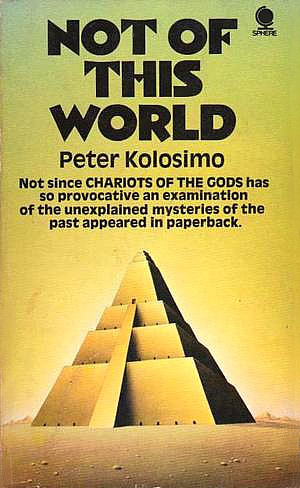
 As I think I mentioned in the past, I was (and still am) a fan of Peter Kolosimo, the Italian answer to Von Daniken of Chariots of the Gods? fame. Kolosimo’s books, like Timeless Earth, were a gateway to wonders and mysteries for a generation of kids in the 70s.
I particularly love his Cittadini delle Tenebre (Citizens of Darkness, but alas never translated in English), a survey of the paranormal and the ghostly published in 1971, and that I read somewhere in 1976 or ‘77.
Apart for the nostalgia factor, Kolosimo’s books are a great resource for writing weird fantasy and adventure stories: ancient astronauts, archaeological mysteries, stone age flying saucers, you name it.
For the same reason I have in the past read far and wide on a number of subjects, always feeling wonder at the concepts, always making notes about what I could recycle in my writing, always remembering that it is a game. Continue reading
Category Archives: Books
Nitpicking in Samarcand
 A fan (yes, I have fans!) very kindly sent me a copy of the reprint edition of Oriental Stories, the Summer 1932 issue. I am putting together a collection of these nice reprints from Wildside Press, and the gift was highly appreciated.
The magazine includes, among others, an Otis Adelbert Kline story in his Dragoman series, a weird mystery set in Shanghai, an August Derleth story set in Manchuria, and a “complete novel” called “Pirate Whelp”. It is quite promising.
Now, whenever I get one of these magazines, the first thing I do is go through the whole issue, checking out the illustrations, marveling at the period advertisement…
Geez, really I could get me 12 mystery novels featuring Experience Smith, master detective1, by simply subscribing to Weird Tales for four months? Sounds like a great deal!
… and then I check out the readers mail page – called The Souk.
I sometimes wonder if readers at the time did the same.
And there, in the Summer 32 issue of Oriental Stories, in the Souk page, there is a reply to a mister Francis X. Bell, that wrote to point out that Robert E. Howard blundered badly, in his Lord of Samarcand (published in a previous issue), when he described Timur celebrating his victory with a drink of wine, Timur being a Muslim and the Koran banning the faithful from drinking alcohol.
Which of course is a silly thing and it gets properly dismantled in a very detailed response (by Farnsworth Wright himself?), which is quite a nice read, really.
Of course I thought about recycling this for my worldbuilding course, about how sometimes our deep historical background checks are completely lost to (some of) our readers – and it is at the same time sad and sort-of-reassuring to see that nitpicking readers playing a game of one-upmanship with the author are not something that started with the internet.
Anyway, in case you are interested, you can check out the Howard story, Lord of Samarcand, for free, on the pages of the Gutenberg Project of Australia.
And have a drink of wine with Timur.
- I wonder if the character is in the Public Domain, because one feels the need to write a story or five about Experience Smith, master detective… ↩
Somewhere, beneath the sea…
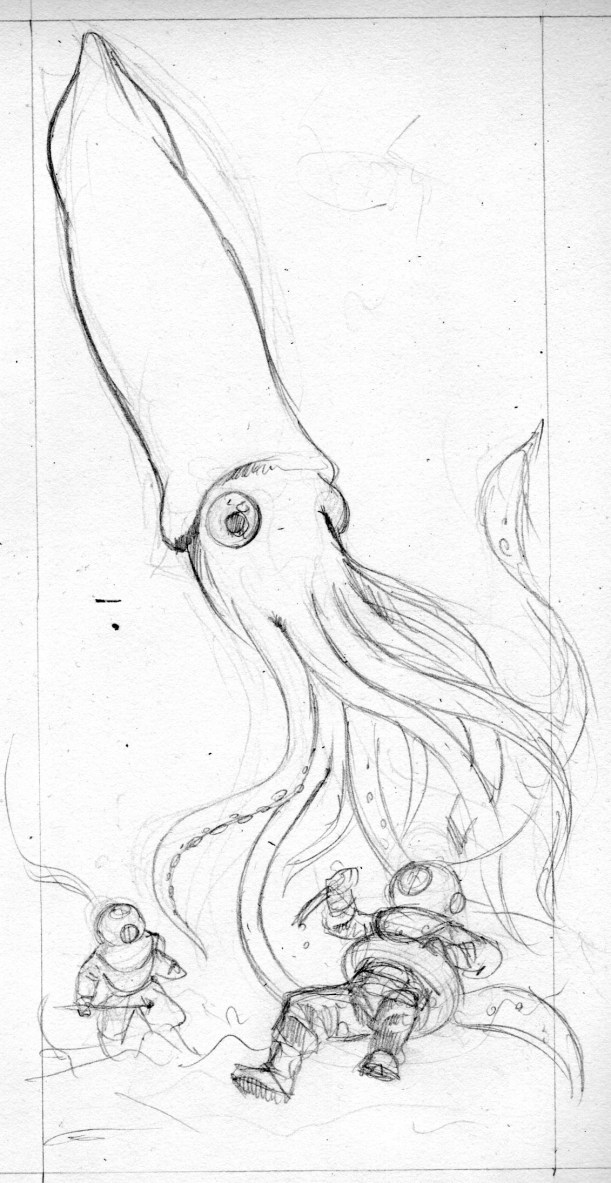
New Hope & Glory illustration in the works, by Alberto Bontempi
22 Books, and then a few other
I just went through a nice piece on the Conde Nast Traveler website, called 22 Ambassadors Recommend the One Book to Read Before Visiting Their Country.
It’s the sort of article that’s been designed specifically to make me weep – foreign countries and excellent literature, and 22 books to read!
 And indeed, thankfully there’s a few titles I know, but still there’s a number of books in there that I have instantly put on my list.
Kurban Said’s Ali and Nino, for instance, a 1937 novel about a cross-cultural love story set in Baku, Azerbaijan, as suggested by Azerbaijani ambassador.
Or Treasures of the Thunder Dragon, a portrait of Buthan written by the queen of that Himalayan country.
And what about the Estonian alternate history of The Man Who Spoke Snakish? Continue reading
Why?
This week I made the students of my worldbuilding course happy because I announced one extra lesson, free.
The need to add a lesson became apparent to me when I realized there is one essential worldbuilding question we had not asked ourselves, and we had not explored – that question being WHY.
Which is of course very philosophical and all that, but more simply, it is
Why do we decide to set our story in a specific world?
Why that world and not another, that time and not another, that city and not another?
And no, “Because” is not a good answer. Continue reading
Cheer Like an Egyptian
This post was shared with my Patrons, but it’s too good a story to keep for a chosen few. Also, this is the genre of anachronism thing that my friend Claire loves to hate, and I hope she passes hereabouts and enjoys the disaster.
Fact is, a friend forwarded me, three days ago, the preview of a book – I will not mention the author nor the title. The reason the pages were forwarded is simple, and three-fold:
. It’s a story set in Egypt, and therefore intersects my interests
. It’s a good example of bad worldbuilding (and I am currently teaching a course on the subject, so I need show-and-tell material)
. “See, you fool? You spend too much time doing research…”
Well, I do not.
I love doing research, and if it does not make my writing better, at least it helps with my Impostor’s Syndrome.
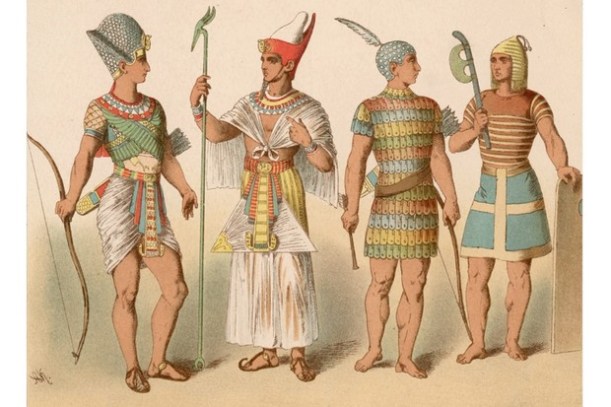
Anyway, the extract is rather amusing, sort of like putting a rabid cat in a box and then sitting over it, and it will certainly make for a great handout for my course.
The names are at best wrong, at worst ridiculous, the action is wooden and stilted, and then the Egyptians shout
Hooray!
Really? Continue reading
Mister and Miss Belzoni
I was absolutely sure I had done a post about The Great Belzoni, but I was unable to find it.
It’s becoming unnerving, this thing that I get an idea for a post, plan it and write it in my mind, and then forget about actually writing it. I am damn scared of Alzheiner, you know…
 Anyway, here’s the guy, portrayed in all his barbaric style and Oriental mystery.
Giovanni Battista Belzoni was born in Padua in 1778, but his family was from Rome, and in Rome he studied hydraulics. He flirted with the idea of joining a monastery, fled when Napoleon conquered the city and ended up as a barber in the Netherlands.
From there he moved to London, met and married a woman named Sarah Bane, and they both joined a circus – Belzoni was 6 foot 7 inches, and got a gig as a strongman, but he later got into phantasmagorias and light shows.
During a tour of southern Europe in the early 1810s, Belzoni became acquainted with Muhammad Ali, and went to Egypt to demonstrate a hydraulic machine of his own devising, that would be used to pump water from the Nile.
The machine worked but he was not hired, and therefore he found himself in Egypt, and without a job.
Someone suggested he should look into the local antiques. Continue reading

