Karavansara

East of Constantinople, West of Shanghai


1 Comment

Characters at Large into the Media Landscape

452719337_640I’m taking part in a strange experiment.
As part of my online course on The Future of Storytelling, the 50.000-odd students were asked last week to create a character, give him/her/it a web presence, and let them interact with each other.

So, during this week, some 50.000 imaginary web citizens entered or will enter the net – as Facebook profiles, as blogs, as G+ identities, as tumblrs, as e-mail addresses, as podcasts.
They are out there, or will be soon, interacting with each other, and with… you.
With us.

There will be stories born.
There will be stories, I think, developed across the media landscape – a weird, heady mix of storytelling, multimedia and roleplaying game.

Now, admittedly – setting up a character with a virtual life is no laughing matter.
It takes time, imagination, effort.
Outlining the character was simple and fun – I picked an old character from some stories I wrote 30 years ago.
But then translating it to the web in a believable way… ouch!
It’s a chore – I got bogged down in passwords, nicknames, whistles and bells.
But the results… ah, the results will be fun.
Of that I’m almost certain.


Leave a comment

Three for the Dragon Tong

I first discovered F. Paul Wilson by way of a novel called The Keep.
Nazis, supernatural evil, some nice references to assorted Yog-Sothotheries.
My kind of thing*.

Ever since The Keep, while I’m not an assiduous reader, I’m quite happy to pick one of F. Paul Wilson stories once in a while.
He’s good at what he does, he writes good solid horror, and we are clearly members of the same tribe.

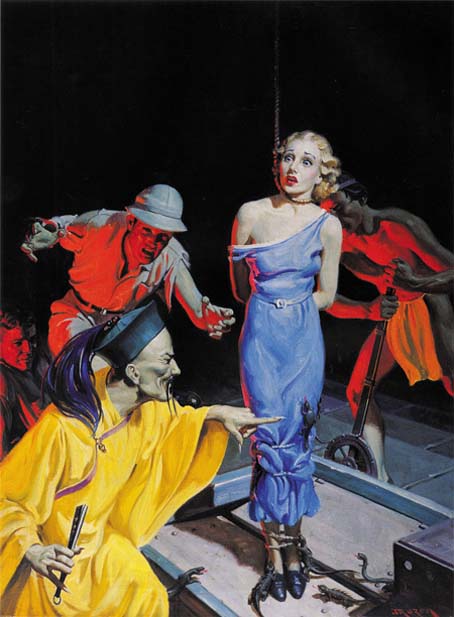
sex-slavesThis is particularly evident in the elegantly-titled Sex Slaves of the Dragon Tong, a small collection packing three novelettes under a suitably lurid cover.

These are three Fu Manchu apocrypha – but the Lord of Strange Deaths is never mentioned by name, which is a fine touch.
Three stories, involving three characters facing the Yellow Peril, and chock full of references and inside jokes, referencing, tongue firmly in cheek, just everything from The Shadow to Hammett’s Continental Op .
There’s enough stuff in these three shorts to fill a much longer work – but here, brevity is one of the winning traits of the collection.

Wilson plays with the old style of the classic pulps – which means we get a brief but fun introduction, to warn off oversensitive fools and people missing historical perspective.
Yes, this is a slightly politically incorrect book.
But that’s another one of its charms.

A good addition to my pulp library.

——————————-
* Yes, I know there was a movie made from the novel, but it was badly mangled by the production.


Leave a comment

Roy Chapman Andrews and the Dinosaurs of Mongolia

It’s Sunday, let’s go back in time.
Here’s some footage from the Roy Chapman Andrews expeditions in Mongolia and the Taklamakan/Gobi desert in 1913.
Enjoy!


2 Comments

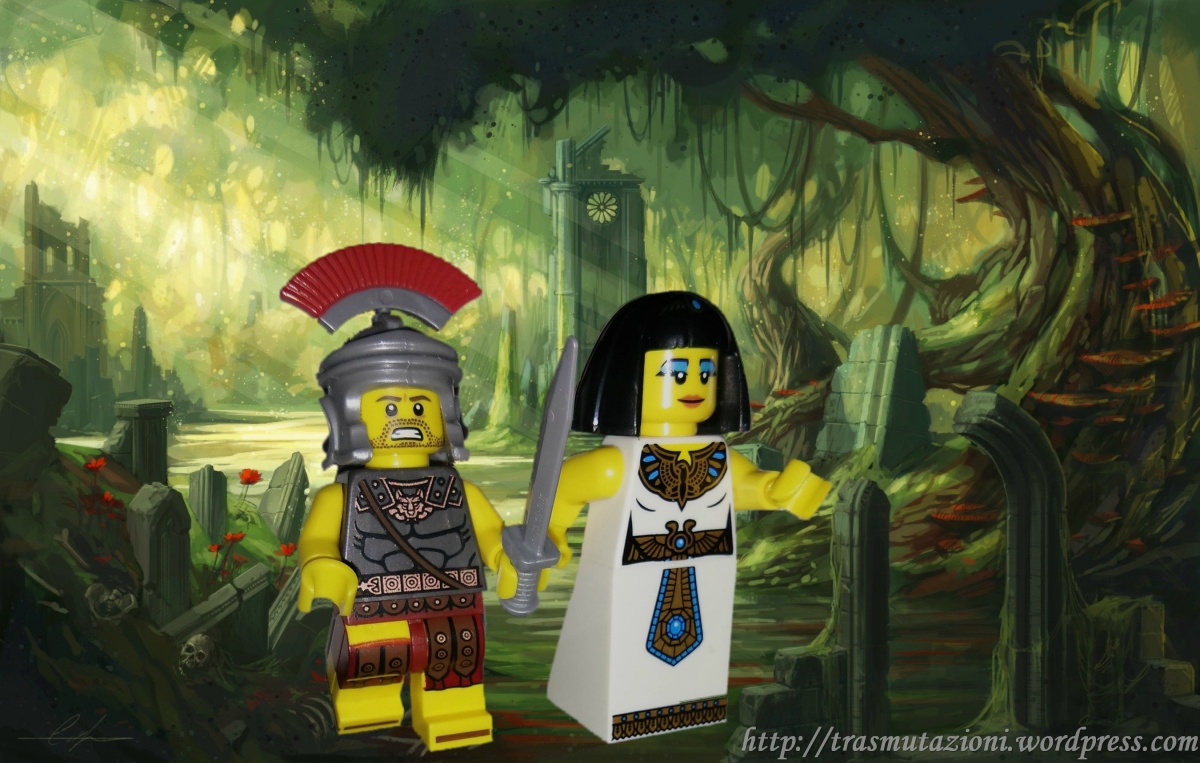
Bride of the LEGO God

Giacomo Dacarro, the webmaster of the blog Trasmutazioni and my long-suffering cover artist Giordano Efrodini had a go at a LEGO version of Bride of the Swamp God.
It’s great, and I think the world needs to see it.
My series work has just begun, and already I have fan-art and action figures!

aculeo-e-amunetLEGO


2 Comments

Waiting for the Tartars

9781841959283I’m stealing an idea from my friend Claire’s blog, Scribblings, and her creative task for the Future of Storytelling course.

She tells about the effect that reading Dino Buzzati‘s The Tartar Steppe had on her as a reader and a writer.

The Steppe shattered the prettiness, showed me new depths, and answered some unvoiced, shapeless questions of mine…

I find her observations quite fitting, and I find Buzzati’s novel a worthy subject for my blog.
First, because of its ipothetical Central Asian setting, but secondly and most importantly because I always perceived The Tartar Steppe as a curious take on the adventure novel.

The set up is classical: a fortress in the middle of nowhere, a young officer eager to prove his worth, the hanging menace of fierce barbarians that might be just beyond the horizon.

English: Cover of the pulp magazine Oriental S...

Oriental Stories (October-November 1931, vol. 1, no. 1) featuring Singapore Nights by Frank Owen. (Photo credit: Wikipedia)

This could be the premise of a Central Asian take on Beau Geste, maybe a story out of Oriental Stories, this could be Harold Lamb ready to unleash a storm of action and adventure.
Instead, Buzzati uses the classic adventure setting to write about the end of adventure.
Total absence of change.
The Tartars are not coming.
The hero is bogged down in the petty feuds of his colleagues, he’s smothered by ennui, he wastes his life away.

Buzzati is one of those “serious writers” your literature teacher will not like you to call “writer of the weird” – and yet he is a strong voice in the weird genre, and a darling of my brothers in Lovecraft.
The Tartar Steppe deals with the loss a generation felt about the promise of adventure – and was written in 1940, as my country stood on the brink of a new “adventure” which would turn out to be devastating and traumatic.

I was deeply struck by Claire’s observation…

And as I read, I realised that this was what I wanted to write: not fairy tales, not pretty, sunlit stories, but of this peculiar kind of loss that is no loss of anything tangible, of forever yearning for things that can’t be had, of prices to pay, of the wait itself…

I too felt that darkness, reading the same book.
And if you are a fan of adventure stories, of fantasy, the darkness underlying Buzzati’s work can hit you hard.
So much so that I was probably influenced by it -but not along the same lines as Claire.
To me, the total nothing hanging over the denizens of the fort in The Tartar Steppe is not my theme, but my antagonist – an almost lovecraftian menace my characters implicitly fight, or strive to keep at bay.
I guess that’s why Claire’s a serious writer and an appreciated playwright, and I’m a second row pulp hack writing stories with tentacles on their cover.

But, really, get yourself a copy of Dino Buzzati’s story – it will be a great read.