

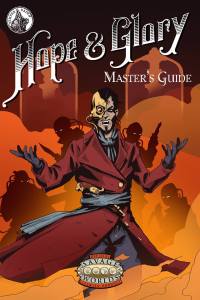
 One of the things I wanted in Hope & Glory was to offer my players a science fiction game. Much as I loved Castle Falkenstein, I did not want to insert fantasy races and magic in my setting.
Hope & Glory was designed to be a hard science fiction setting, but with a twist: this being a Victorian-ish setting, it would stick to 19th century science.
If it was considered science in the 19th century, we would treat it like real science, and go with it.
So yes, basically I cheated. Continue reading
Category Archives: Karavansara Free Library
Change the world with music
No, this is not a post about some 1970s disco extravaganza.
 In a post about the late Robert F. Young a few days back I mentioned his influence on a Japanese anime called RahXephon.
I was first interested in the thing when it was described to me as Evangelion’s smarter brother.
Confessions of an Anime viewer: I was never able to get Neon Genesis Evangelion. I know it was a huge success and a smash hit and all that, but I tried it and I did not like it.
The fact that there were at the time self-styled otakus shouting ceaselessly about how the series was better than anything that had gone before and anything that would come afterwards sort of cooled my already not-very-hot enthusiasm.
But RahXephon came with that comment, the reference to Robert F. Young’s masterful short story The Dandelion Girl and the discovery that it was somehow related to Churchward’s work about the lost continent of Mu.
So I gave it a try, and while I still have some misgivings, I’ll admit I was positively impressed. I do not normally cover anime on this blog, but once in a while, during the Silly Season… why not? Continue reading
The Blazing World
A weird one today for the Karavansara Free Library.
I found out about Margaret Cavendish, Duchess of Newcastle-upon-Tyne in a piece on the BBC website – trust the beeb to expand our horizons.

Margaret Cavendish was born in 1623, and is listed in Wikipedia as
aristocrat, philosopher, poet, scientist, fiction-writer, and playwright
Not bad, uh? Continue reading
The Magic Island (1929)
You realize that you are on to something when the book you need to check out for your next non-fiction article was written by a cannibal that tried to kill Hitler with a voodoo ritual.
William Buehler Seabrook was a writer and reporter, an explorer, an occultist, occasionally a cannibal. He served in the Great War and was gassed in action.
While visiting Africa he developed an interest in cannibalism, that led him to acquire a number of medical samples and cook them to try and see what they tasted like. This was in the ’20s.
Then, in ’29, he visited Haiti – that at the time was being controlled by the US, that had invaded it in 1914 – and “discovered” voodoo. Continue reading
Night of the Demon (1957)
It has been written since the beginning of time, even unto these ancient stones, that evil supernatural creatures exist in a world of darkness. And it is also said man using the magic power of the ancient runic symbols can call forth these powers of darkness, the demons of Hell.
The real problem with Night of the Demon (aka Curse of the Demon, originally supposed to be called The Haunted) is, of course, the demon. Director Jacques Tourneur of Cat People fame was all against it, but the producer apparently ignored the director’s choice, and had the scenes with the demon that bookend the movie shot by a second unit.
The demon looks cheap and fake and borders on laugh-out-loud ridiculous, and it’s a pity, because without it Night of the Demon would be an otherwise impeccable horror movie.
As things stand, it’s still one of the best horror thrillers ever produced.
Continue reading
Insomnia – Five Books
If you can’t beat them, join them.
Isn’t that what they say?
My insomnia rages on. I sleep (badly) by day and I am wide awake through the night.
I work, I write, I watch old movies, I read books, and wonder what will become of me. Who knows, maybe that last bit is the reason why I am suffering from insomnia, who knows.
But anyway, I thought about doing something about it, and I decided to write about it. Big surprise, uh?
I’ll start with blog posts, and then see where that takes me. I could setup a minimalist blog on some ultralight platform. Or do a podcast. A small, minimalist podcast.
I’d call it Melatonin On the Rocks.
A podcast that goes on air only when I can’t sleep.
Or I could set-up a live hangout every time I can’t sleep.
Or something.
This post is sort of a prototype.
A test run. Continue reading
The man who invented the periscope
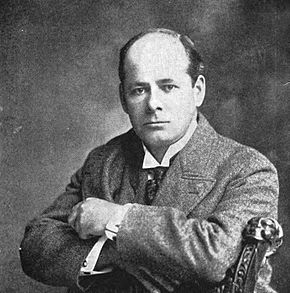 Morgan Andrew Robertson said he had invented the periscope. He had written a story, called The Submarine Destroyer, in 1905, which featured a submarine provided with a telescoping periscope, and called it a periscope, so he claimed he had invented the thing.
A former jeweler that had to find another job due to a loss of eyesight, Robertson mostly wrote sea stories, being the son of a Great Lakes captain and having spent ten years in the Merchant Marines (he had ran away from home at the age of 16, in 1877).
He mostly wrote short stories and novellas, that he sold to the story magazines that came before the pulps. He started writing, apparently, after reading some rather bad sea stories and going “What the heck! I can do better than that!”
He never made much money with his writing, but he sort of did better than that. Continue reading
 Karavansara