Karavansara

East of Constantinople, West of Shanghai


Leave a comment

Ghost Ships

61PY+t3T-+L._BO2,204,203,200_PIsitb-sticker-arrow-click,TopRight,35,-76_AA278_PIkin4,BottomRight,-57,22_AA300_SH20_OU01_A quick post that will have a limited interest for my English-speaking readers, but which is very close to my heart.
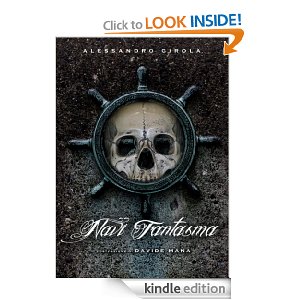
My good friend Alessandro Girola has made available through the Amazon Kindle store his volume Navi Fantasma (Ghosts Ships) – a collection of short essays on some of the most interesting mysteries of the sea.
Cursed vessels, haunted ships, mysterious disappearances…
Alex was so kind, he asked me to provide an extra essay as an afterword.
It was fun.

I repeat, the ebook is in Italian, and is a fast, interesting read.

Navi Fantasma in Kindle marks the next step in the development of a small little project we set up long ago as a lark.

More mystery/pulp/adventure related essays will be published.
Hopefully in English, too.


Leave a comment

Achmed Abdullah

PHOTOSPIN TRAVEL OBJECT AND BACKGROUNDS © 1997 PHOTOSPIN www.photospin.comFemale fans of Tom Jones used to throw their hotel room keys (and sometimes their bras) at him, during concerts.

My fans sometimes throw books at me – and thank goodness for ebooks, because some of the things they throw at me – often selected from my Amazon wish list – would be hefty, and potentially dangerous, paper volumes.

The Achmed Abdullah Megapack, for instance, which landed on my Kindle last night, courtesy of a kind reader of mine (thanks!!), is a 20-stories collection of vintage pulp goodness that would run to 420 pages in the material world.
Enough to knock me senseless.

23863284217880916Achmed Abdullah was not his real name – his name was Alexander Nicholayevitch Romanoff, and was connected bybirth with the Czar of Russia.
After his mother – an Afghan princess – tried to poison his father – a Russian, cousin to the Czar, and with a penchant for adultery – the resulting divorce caused Alex to move to England.

He studied in Eton and Oxford, joined the army and served for seventeen years in Asia and Africa.
Captured and interned as spy by the Germans during the Great War, he then moved to the US of A, where he started a carreer as a pulp writer and movie scriptwriter.
{9056AABD-BE75-4C50-B352-3F45B20465FB}Img400He wrote the script for Douglas Fairbanks Jr‘s 1924 The Thief of Baghdad.
And he wrote a lot for the pulps – fantasy, horror, adventure, mysteries – mostly with Oriental or African settings.
He wrote for Adventure, for Oriental Stories, for Weird Tales.

The megapack is – like most Wildside Press Megapacks – nothing fancy: just a lot of great fiction, with a good introduction by Darrell Schweitzer.
This is the “I want as much good fiction as possible with me with the least fuss” approach, and I like it.
The stories listed cover the whole spectrum of genres and subgenres Achmed Abdullah wrote, and promise long hours of delight.

It’s not the key to some lady’s hotel room, but it’s great!
Thanks again!


4 Comments

I remember Zanthodon

“…there are still lost lands in the remote corners of the earth where fantastic monsters roam, where chaste and beautiful women remain to be rescued from sneering villains, and where adventure and peril and heroism thrive amid exotic and bizarre scenery.”

journey

I was just sweet sixteen…
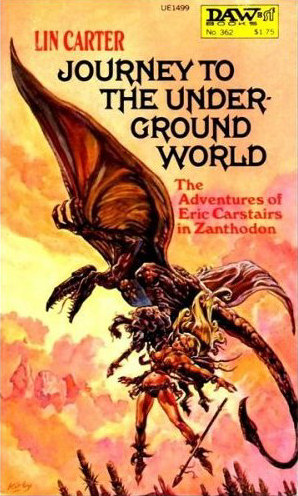
Well, no, I was a tad younger, actually, when I found, on a shelf of my favourite bookstore, an old copy of Lin Carter’s Journey to the Underground World, published by DAW book.
A very small pocket-sized paperback, the pages crispy with age, and a cover with… well, with a pterodactyl carrying away a busty blonde.

Now, I do not know if it’s still like this out there, or if it was ever like this anywhere else back then, but when I was a kid of ten or thereabouts, the general practice was, they handed you a thick Jules Verne book, maybe for Christmas, or for your birthday – because you were a kid, and kids “just love” adventure stories.

OK, so let me tell you – there’s nothing worse, when you are a kid of ten/twelve in the seventies, to be handed a 1950s translation of Journey to the Center of the Earth.
It’s boring.

So I went through Verne’s Center of the Earth as a kid, being bored silly, when I found out there were actual real books with Tarzan in them.
Tarzan, the guy from the movies.
Only, I found out, much better than in the movies.

Having read a few Tarzans, I started looking for something I really thought should be a smash – At the Earth’s Core, from the same guy that did Tarzan, but… wow, with dinosaurs! And adventure! And babes!

But the novel was not translated in Italian, so I put it on my list for my project of starting and reading in English.

And then, I found Zanthodon.
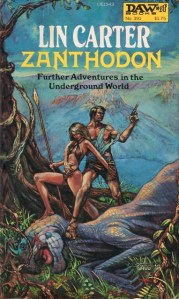
ZNTHDNVVJN1980Lin Carter’s Zanthodon books – the first in the series being the afore mentioned pterodactyl-with-blonde book – are a pastiche of Burrough’s Pellucidar series.
And they are fun.
They are, probably, the best stuff Carter wrote – I love the John Dark novels, I enjoyed his Lemurian tales, but Zanthodon is more tongue-in-cheek, more happy-go-lucky in its approach to the exotic adventure, more modern, and fun.
In an classic Burroughsian twist, Eric Carstairs journeys by drilling-mole to a huge cave beneath the Sahara, where the classic cast of babes and dinos awaits.
His sidekick is eccentric Professor Percival Penthesileia Potter.
You can guess the rest.
Carter follows the Burroughs standard plot closely – but provides us with a highly psaeudo-scientific rationale for the existance of his subterranean worls, which is actually slightly more plausible than the classic Hollow earth scenario.

Blimey, it was fun!

A few months later, I left Zanthodon for Pellucidar, having found a copy of teh Signet edition of the first book.
But Carter’s slightly parodic and yet not-ridiculous-at-all approach to his stories and characters remained with me a long time.

Right now, I’m going through my Pellucidar and Caprona books, and I’ll probably post some ideas here.
But before I start, I wanted to pay homage to Lin carter’s Underground World.
It was great fun.


3 Comments

Journeys on the Silk Road

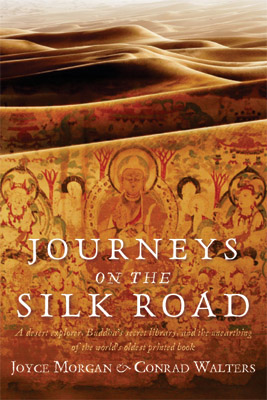
coverThe latest addition to my ever-growing library of books about the Silk Road is Journeys on the Silk Road *, by Joyce Morgan and Conrad Walters.
The book was published in 2012 and was a gift from my brother.

The book focuses on Aurel Stein‘s second Silk Road expedition, between 1906 and 1908.
Following his passion for the history of Central Asia and a series of often unlikely leads, Stein reached the Mogao Caves – also known as the Caves of Thousand Buddhas – in the Taklamakan region, and there he started playing a bargaining game with the local monk, the Daoist Wang.
At the end of a long battle of wits, the monk agreed to part with a few thousand ancient texts, which had been waiting in a cave for eight centuries.
The collection – which Stein acquired somewhat wholesale for 130 sterling pounds – included texts in a number of languages, and on a variety of subjects, from sacred texts to personal letters.
A veritable cross-cut of a multicultural community whose existence had never been suspected by western scholars.
The bundle included the oldest printed book known – a woodblock print copy of the Diamond Sutra, one of the central texts in the Buddhist canon.
Morgan & Walter’s text does therefore shift its attention from the old explorer to the text, outlining its importance for the development of Buddhist culture in Asia, but also its impact on Western culture.

All in all, a book that touches on so many interests of mine, it was impossible for me not to like it a lot – I started and finished it in one day, also thanks a very long train journey.

The volume is highly enjoyable and gives a sympathetic, humane portrait of Stein, a giant of archaeology who’s been somewhat forgotten by the public, and whose activities in Cantral Asia are often portrayed as piracy and plunder, not excavation and research.
The book keeps a balanced view of Stein’s work, while presenting the reader with a character that is, as they say, larger than life.

Filled with anecdotes, quotes from Stein’s diaries, books and letters and a good number of funny bits.
Stein’s companions on the road and his competitors in the race for the Mogao Caves are a gallery of unique characters.

Great reading.
And the book is also supported by a nice and informative website.

————————————————–

* The title “Journeys on the Silk Road”, and variations thereof, must be the most widely used when Central Asian travel and Silk Road exploration are concerned.
Which is not bad – dial it in the Amazon search window, and you’ll find a treasure trove of great reads, and excellent music.


1 Comment

Hail to the Queen

4902075237.02.LZZZZZZZA quick one, to raise three cheers to the novel Queen of K’n-Yan, by Japan’s foremost supernatural horror author and H.P. Lovecraft scholar, Ken Asamatsu.
The novel – published in the Kathleen Taji English translation by the fine guys at Kurodahan Press –  is finally available in ebook format, and it is highly recommended – a heady mix of science fiction, ancient mysteries and Lovecraftian Mythos, set in a finely detailed Japanese setting.
One of the best Lovecraftian horrors out there, subtly disquieting and deeply suggestive.
An ancient mummy, biogenetic experimentation, old military experiments, horror, madness and a dark shadow extending over humanity’s future.
Fast, furious, and scary in a very unusual way.
Great introduction by Darrell Schweitzer.
Stunning cover.
Highly recommended indeed.


5 Comments

Stories from the deep future

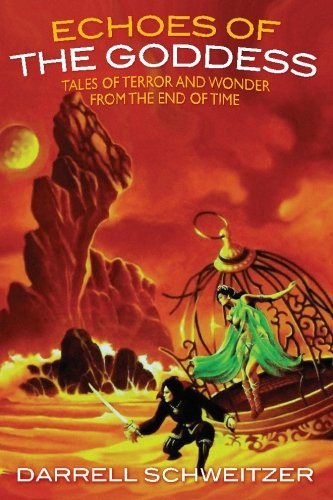
echoesI’m having lots of fun reading Echoes of the Goddess, Tales of Terror and Wonder from the End of Time, a great collection of stories by Darrell Schweitzer, set in the same universe of the author’s popular and highly respected 1982 novel, The Shattered Goddess.

The eleven stories in the volume – which is available as an inexpensive ebook through Amazon – are set in a distant, decadent future, after a catastrophe of theological proportions (narrated in the novel mentioned above).
The setting and the mood recall Clark Ashton Smith’s Zothique and Jack Vance’s Dying Earth – the so called dying earth/end of times subgenre.

Now I am particularly interested in this subgenre, and I’m highly impressed by Schweitzer’s prose – the quality of the storytelling is such, that even a deceivingly light plot becomes multi-layered and highly satisfactory.
There is style and substance.
This is fantasy fiction, but a style of fantasy fiction and swords & sorcery that goes back to the roots of the genre, back to the pages of Weird Tales.
And yet, it is not just a nostalgia trip or a form of narrative archaeology.

The book was released by Wildside Press in february 2013, and is highly recommended.


1 Comment

Shark Attack

Steven Spielberg’s 1975 movie Jaws was one of the movies that changed the game, and the highest grossing movie of its time.
I was too young to go and see it in a cinema – although some of my pals did sneak in and emerge later from the darkness of the movie hall with tales of horror and wonder.
Today, I like to watch Jaws every time a TV channel runs it again.

And yet, if as a movie-goer and a fan of action thrillers I love Jaws, as a scientist I always felt the shark facts in the film leave more than something to be desired.

Ellis_SharkAttack-lowresShark Attack, a quick-read, fact-filled pamphlet by noted biologist Richard Ellis, published by Open Road Media, aims at setting the record straight, providing an ample overview of actual shark attacks – including those that inspired the original novel from which the Spielberg movie was made – and a passionate discussion of what sharks are really like, and what a shark attack is in reality.

But the booklet is not only a debunking of the 1975 movie.
This is a condensed introduction to the life and biology of the shark, its interaction with marine ecosystems and with humans.

It’s clear, concise, fun, filled with great images.
It does not detract from the enjoyment of the movie – and provides a further layer to the viewing.