Karavansara

East of Constantinople, West of Shanghai


Leave a comment

Nazis & Dinosaurs – Half Past Danger

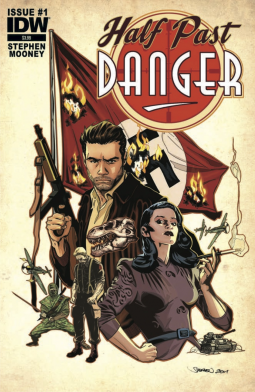
cover39842-mediumHalf Past Danger is a comic series by Stephen Mooney, released by IDW Publishing.

In 1943, sergeant “Irish” Flynn is on a recon mission on a Pacific Island, when his squad hits on something big.
Nazis.
And dinosaurs.
The sole survivor of a confrontation with rampaging T rexes, Sargent Flynn comes back with a wild story and a few grainy photographs.
Nobody seems to believe him, until a special expedition on the mysterious island is put together.
Together with a supercilious British spy, a larger than life USMC captain and a Japanese martial artist, embittered Flynn will have to face his nightmares again.
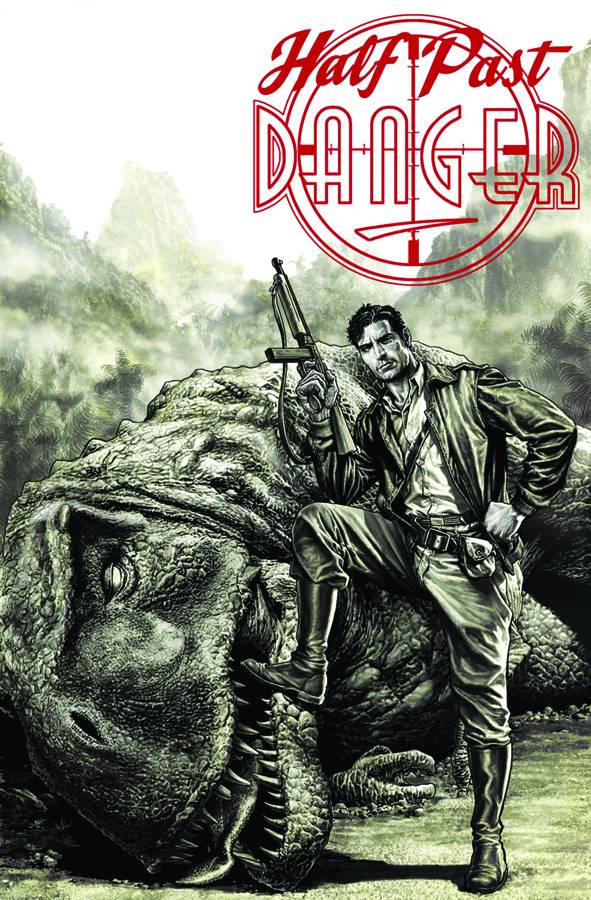
STK612602Half Past Danger is a concentrated extract of pulp adventure – it has got everything, and then some.
There’s the war, the Nazis trying to develop a superweapon (but not what you think), yankee supersoldiers, ninjas, beautiful women, and dinosaurs.
In its approach to its subject matter, Half Past Danger fits perfectly the style of New Pulp – old fashioned themes with a modern sensibility.

It’s fast, fun without being comedic, it’s gritty and nostalgic, with lots of meat and excellent art.
The first series of six issues will be collected in a massive hardcover that will hit the shelves in February 2014.
In case you missed the single issues, it’s well worth looking out for.

And let’s hope there’s more coming.


Leave a comment

Traveling without money

cover38852-mediumA mixed post today – both book review and media-rich.
Now, How to Travel the World for Free has nothing to do with the Silk Road or with pulp fiction, or fantasy – but it has a lot to do with travel.
That, and it being a good, fun read, are enough for me to point it out.

In a nutshell: German journalist Michael Wigge wanted to visit Antarctica, but did not feel like spending 15.000 dollars in tickets.
So he planned for one full year a long trip – through Europe, North and South America.
A trip he would make without money.

The book details his adventures on the road, and despite the title this is not a how-to book.
It does provide a lot of information, but it is still a travelogue at heart.
It’s a fast read, and highly entertaining.

For more details, let’s hear from the author himself (don’t be distracted by gorgeous Katy Perry)


Leave a comment

On the border – Liz Williams’ Snake Agent

Singapore is a city franchise.
Nanotechnology is replacing some areas of standard technology (there is a fantastic liquid personal computer).
There is an Afterlife, which conforms to the standards of Chinese tradition – a feudal paradise , a highly bureaucratized hell.
Gods and demons interact directly with humanity.
Detective Inspector Chen of Singapore Three police department deals with crimes on the border between the two worlds.
Now, someone is killing teenagers, kidnapping their virtuous souls to initiate them into prostitution in the alleyways of Hell.
And it may just be the tip of a very dangerous iceberg, in a plot full of political collusion and interdimensional speculations.

cover35998-mediumSnake Agent is the first novel in the series featuring Inspector Chen by British award-winning author Liz Williams.
The story is an unusual, heady mix of science fiction, urban fantasy, horror and thriller, reprising the classic “buddy movie” motif, when Chen joins his infernal counterpart , the Seneschal Zhu Irzh, a humanoid enough demon (whith something of the mantis) who is also on the trail of criminals.
Mystical combats, exorcisms, investigations – there’s it all, and then more.

The first Detective Chen novel is very well written, original, funny, with characters that are multi-faceted enough to transcend the obvious limitations imposed by the adoption of certain clichés.
Highly recommended.


Leave a comment

Black Pulp

Black-PulpI’m currently reading Black Pulp, and a fine collection it is.
I like the idea, I like the execution.

Walter Mosley‘s introduction is a great love letter to the pulps of old – which is fitting for an anthology of stories that manage to update the old without throwing out what good was there in ancient (well, ok…) times.
The list of authors reads like a selection of the best writers in the field – Walter Mosley and Joe R. Lansdale, Gary Phillips, Charles R. Saunders, Derrick Ferguson, D. Alan Lewis, Christopher Chambers, Mel Odom, Kimberly Richardson, Ron Fortier, Michael A. Gonzales, Gar Anthony Haywood, Tommy Hancock…
All genres get covered, a gallery of great characters is deployed in the service of adventure.
Excellent.

It’s hard to single out one title in this selection of gems.
I’d be tempted to get my fanboy hat on and exclaim “there’s a new Dillon story in here!” – but it would be unfair to all the other fine stories between the covers of this great book.

And talking about the cover – the book is wonderfully designed, and it’s a pleasure to read.
Great work from the guys at Pro Se Press.
We want more.


Leave a comment

Three for the Dragon Tong

I first discovered F. Paul Wilson by way of a novel called The Keep.
Nazis, supernatural evil, some nice references to assorted Yog-Sothotheries.
My kind of thing*.

Ever since The Keep, while I’m not an assiduous reader, I’m quite happy to pick one of F. Paul Wilson stories once in a while.
He’s good at what he does, he writes good solid horror, and we are clearly members of the same tribe.

sex-slavesThis is particularly evident in the elegantly-titled Sex Slaves of the Dragon Tong, a small collection packing three novelettes under a suitably lurid cover.

These are three Fu Manchu apocrypha – but the Lord of Strange Deaths is never mentioned by name, which is a fine touch.
Three stories, involving three characters facing the Yellow Peril, and chock full of references and inside jokes, referencing, tongue firmly in cheek, just everything from The Shadow to Hammett’s Continental Op .
There’s enough stuff in these three shorts to fill a much longer work – but here, brevity is one of the winning traits of the collection.

Wilson plays with the old style of the classic pulps – which means we get a brief but fun introduction, to warn off oversensitive fools and people missing historical perspective.
Yes, this is a slightly politically incorrect book.
But that’s another one of its charms.

A good addition to my pulp library.

——————————-
* Yes, I know there was a movie made from the novel, but it was badly mangled by the production.


2 Comments

Waiting for the Tartars

9781841959283I’m stealing an idea from my friend Claire’s blog, Scribblings, and her creative task for the Future of Storytelling course.

She tells about the effect that reading Dino Buzzati‘s The Tartar Steppe had on her as a reader and a writer.

The Steppe shattered the prettiness, showed me new depths, and answered some unvoiced, shapeless questions of mine…

I find her observations quite fitting, and I find Buzzati’s novel a worthy subject for my blog.
First, because of its ipothetical Central Asian setting, but secondly and most importantly because I always perceived The Tartar Steppe as a curious take on the adventure novel.

The set up is classical: a fortress in the middle of nowhere, a young officer eager to prove his worth, the hanging menace of fierce barbarians that might be just beyond the horizon.

English: Cover of the pulp magazine Oriental S...

Oriental Stories (October-November 1931, vol. 1, no. 1) featuring Singapore Nights by Frank Owen. (Photo credit: Wikipedia)

This could be the premise of a Central Asian take on Beau Geste, maybe a story out of Oriental Stories, this could be Harold Lamb ready to unleash a storm of action and adventure.
Instead, Buzzati uses the classic adventure setting to write about the end of adventure.
Total absence of change.
The Tartars are not coming.
The hero is bogged down in the petty feuds of his colleagues, he’s smothered by ennui, he wastes his life away.

Buzzati is one of those “serious writers” your literature teacher will not like you to call “writer of the weird” – and yet he is a strong voice in the weird genre, and a darling of my brothers in Lovecraft.
The Tartar Steppe deals with the loss a generation felt about the promise of adventure – and was written in 1940, as my country stood on the brink of a new “adventure” which would turn out to be devastating and traumatic.

I was deeply struck by Claire’s observation…

And as I read, I realised that this was what I wanted to write: not fairy tales, not pretty, sunlit stories, but of this peculiar kind of loss that is no loss of anything tangible, of forever yearning for things that can’t be had, of prices to pay, of the wait itself…

I too felt that darkness, reading the same book.
And if you are a fan of adventure stories, of fantasy, the darkness underlying Buzzati’s work can hit you hard.
So much so that I was probably influenced by it -but not along the same lines as Claire.
To me, the total nothing hanging over the denizens of the fort in The Tartar Steppe is not my theme, but my antagonist – an almost lovecraftian menace my characters implicitly fight, or strive to keep at bay.
I guess that’s why Claire’s a serious writer and an appreciated playwright, and I’m a second row pulp hack writing stories with tentacles on their cover.

But, really, get yourself a copy of Dino Buzzati’s story – it will be a great read.


1 Comment

Stunt Double Blues – The Queen of Escapes

air-72They say you can’t judge a book by its cover, but I confess it was the cover of Curtis Fernlund’s The Queen of Escapes that sold me the book.
One hour after seeing the cover for the first time (on Barry Reese’s blog), the ebook was on my Kindle (I’d have made it sooner, but my web connection was too shaky).
That same night, I happily sacrificed a few hours of sleep to read the first two chapters of the novel.
By that time, I was hooked.
Now, I need more.

Set in 1935, The Queen of Escapes drops us smack in the middle of a movie set, somewhere in the Amazon Jungle.
Action serial star Gloria Swann is not aging gracefully, and her long suffering stunt double, Angela Morgan, is first in line when it comes to taking the brunt of her tempers – and she has to risk her neck, too, in complicated action shots.
But there’s something moving in the jungle, something that seems set on getting Gloria… and once again Angela is first in line when trouble comes.

The book is a fun, well-written adventure yarn – Fernlund handles both action and dialogue with verve, and the cast of characters is intriguing and well-drawn. The novel is fast but nothing seems rushed – it’s paced marvelously, and it’s very very good, old-style adventure fiction.

And talking about well-drawn characters – the cover by Andy Fish is gorgeous, and the black & white interior illustrations by James Lyle are equally excellent.

All in all a great book – great story, characters, artwork.
Airship 27 delivers the goods (again), and I can’t recommend this fine book strongly enough.
Get it – it will be fun.