Karavansara

East of Constantinople, West of Shanghai


Leave a comment

Cimmerian September #5 – The Slithering Shadow

This is where I come in.
The comic book adaptation of The Slithering Shadow marks the first time I became aware of Conan.
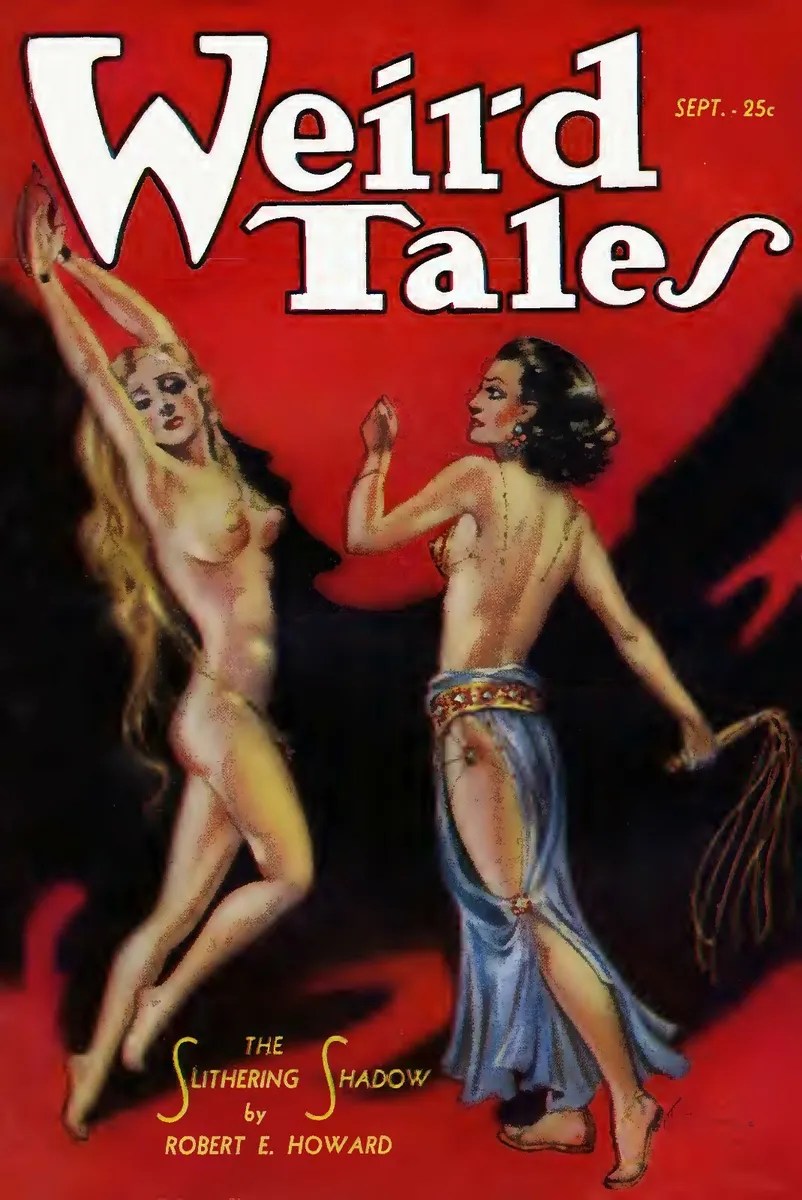
The story was originally published in September 1933 issue of Weird Tales – and again made the cover. The Howard piece was the opener of an issue jam-packed with great stories: Edmond Hamilton and Seabury Quinn, Hugh B. Cave, Jack Williamson and Frank Bellknap Long.


The story opens with Conan in his mercenary days, last survivor – together with a blond slave-girl, Natala – of an army that was destroyed in battle by the Stygians. Lost in the desert, they find refuge in a strange citadel, where the few inhabitants spend their time in drug-fueled dreams, and serve as snacks for Thog, a Shoggoth-like creature.
The situation is further complicated by Thalis, a evil woman that develops an interest for Conan (or maybe for Natala – it’s complicated).

I found the comic-book adaptation of this story, by Roy Thomas, John Buscema and Alfredo Alcala sometimes in the early 80s. Subsequently, I decided to check out the stories by Howard, and here we are.

The Slithering Shadow (sometimes known as Xuthal of the Dusk) has all the elements that to me, today, mark the perfect sword & sorcery story: a mysterious place, a lost civilization, clear, small scale stakes, a sexy evil woman, a creative monster. Howard provides also a lengthy flagellation scene – that apparently Margaret Brundage found inspiring.
This is not Howard’s best story, but it’s pretty solid, it is compact and economical, with great action scenes and a creeping sense of menace.
Maybe Natala is somewhat insipid as a character, but Thalis more than compensates what the blonde is lacking. And the setting reprises the sense of wonder and the deep past on the previous Tower of the Elephant. To me this is way better that the usual “undead sorcerer, conspirators and battlefield” formula that Howard has been milking so far,,
True, Fritz Leiber called it childish – but it’s never too late for having a happy childhood.


Leave a comment

Cimmerian September #4 – Black Colossus

And finally, in June 1933, Robert E. Howard and Conan finally make the cover of Weird Tales.
The story is Black Colossus, and after the cosmic wonders of Tower of the Elephant, Conan is back to his initial formula. A kingdom in peril, an evil wizard, and a mighty battle.


Awakened after 3000 years of undeath by a thief, the evil wizard Thugra Khotan, under the alias of “Nathok”, builds an army and start spreading north from the borders of Stygia. The kingdom of Khoraja is next in line, and in the absence of its young king, the rule of the land falls of young princess Yasmela, who is in the wizards sights as a potential consort. The girl consults the priests of Mithra and is told to entrust her future to the first man she’ll meet on the road. The man happens to be a Cimmerian mercenary, Conan.


All the standard elements of a Conan story are featured in Black Colossus – the evil undead wizard, the young princess that falls for Conan, a giant snake, a huge battle. Even the contempt for the aristocracy is there, and probably an in-joke about Prohibition.
Howard manages to make movement of troops and strategy as entertaining as ever, and we have the finale with the wizard killed by a sword used as a throwing weapon.
The end result is fun, and shows once again Howard’s skill in building his geography on the run.
Yasmela is a little lacking in personality, and does not shine as other female companions of the Cimmerian would.
But the story id more that OK.

Silly personal detail: the (beautiful) Margaret Brundage cover was the image we initially selected for the launch of our fantasy movie podcast, “Chiodi Rossi”; we changed it when we received some complaints by some acquaintances that were afraid Facebook would have penalized them should they share our “pornographic imagery” on the social network.


Silly, of course – but having the first episode of our podcast self-censored by nervous friends would have been a very bad start. We selected another image.
Poor Brundage – 90 years on, they still can’t tell her art from smut.


2 Comments

Cimmerian September #2 – The Scarlet Citadel

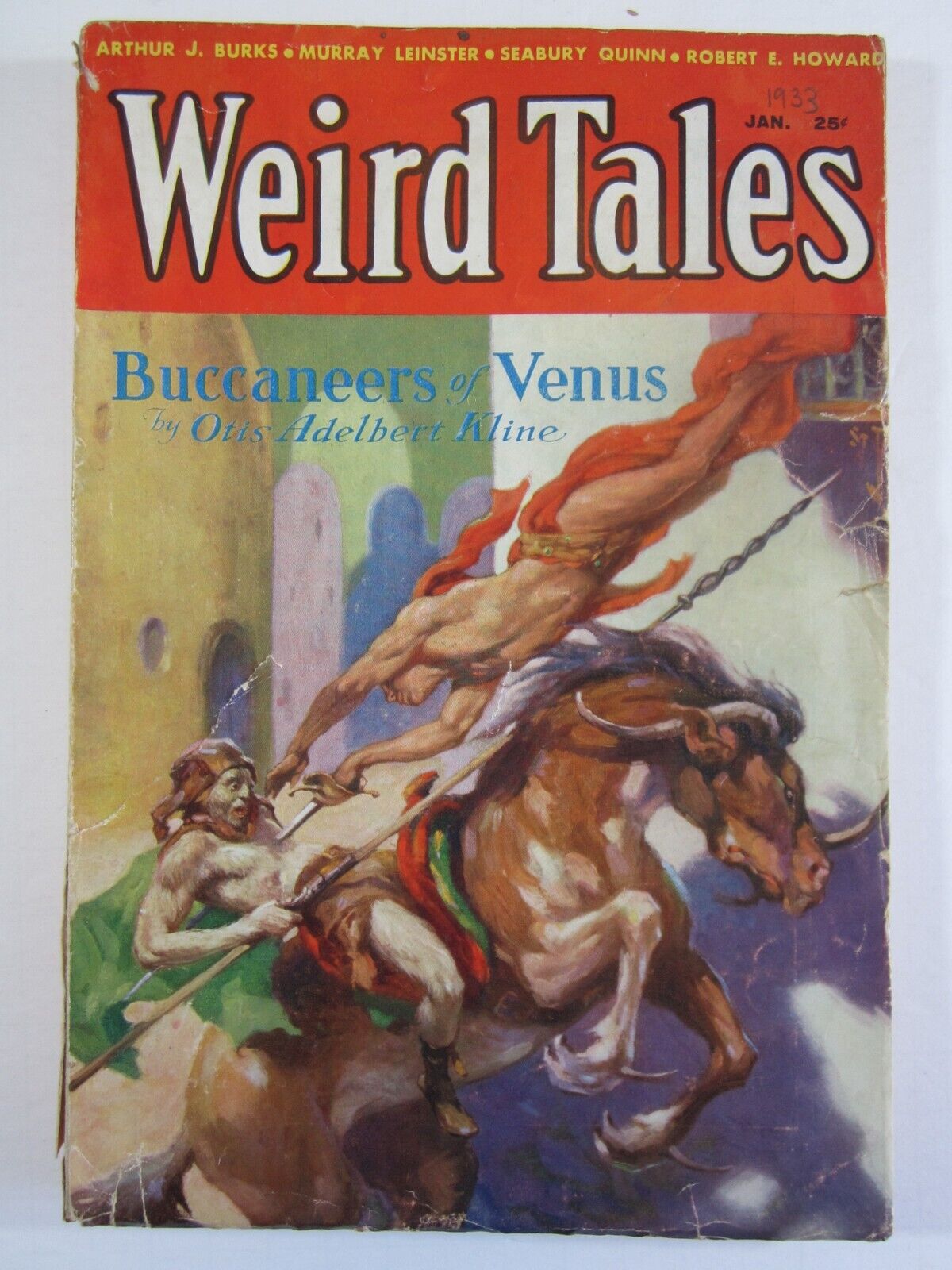
January 1933 brings a new issue of Weird Tales, featuring the works of Murray Leinster, Edmond Hamilton, Seabury Quinn and a new installment of Otis Adelbert Kline’s Buccaneers of Venus (that again gets the cover). The letters section includes one from Jack Williamson.
And halfway through the issue we find a new Robert E. Howard story featuring Conan the Cimmerian, the novelette The Scarlet Citadel.

The story is an almost direct follow-up of the one in the previous issue. King Conan of Aquilonia again has to defend his throne, this time by two treacherous nearby kings, the rulers of Ophir and Koth, aided by the sinister Tsotha-lanti, a sorcerer born (or so they say) of a Zamoran dancing girl and a black demon.

And here we get what is for me the most interesting element of this story: while in Phoenix on the Sword Howard dropped a lot of names of conspirators and aristocrats, here the naming game has a clear worldbuilding purpose. Cited en-passant for color, we get nation and cities of the Hyborian world, and we get passing references at Conan’s career. The upstart mercenary of the first story now reveals a past as a pirate and an adventurer all over the map. That a map has not yet been drawn for the readers is incidental – Howard has clearly the whole of Hyboria sketched in his mind.

Meanwhile, Conan is trapped in a dark dungeon, meets a number of weird horrors, fights the first of many giant snakes, and frees Pelias, a suavely dangerous sorcerer that helps him get his revenge (and provides transportation in the shape of a giant bat-thing).

We get a massive, epic battle and we catch a glimpse of the politics Conan/Howard, that is clearly critical of monarchy. Conan is a king that actually cares for the well-being of his subjects – a fact that leaves himself surprised.

Random note: king Conan has a harem. Ah, the barbaric life!

The story is solid, while not being one of my favorites.
Much probably depends by the order in which I originally read the Conan series – I always found the tales of the older Conan, dealing with politics and court conspiracies rather boring when compared to the more swashbuckling adventures of his youth.

But that’s just me.
In his second outing, Conan is finding his legs, and the Hyborian world is taking shape around him.


Leave a comment

Gearing up for Cimmerian September

The Cimmerian September starts tomorrow – a month in which a number of Youtubers will read all the original Conan stories written by Robert E, Howard, and post videos about it.
And I thought, why not do something similar here on Karavansara?

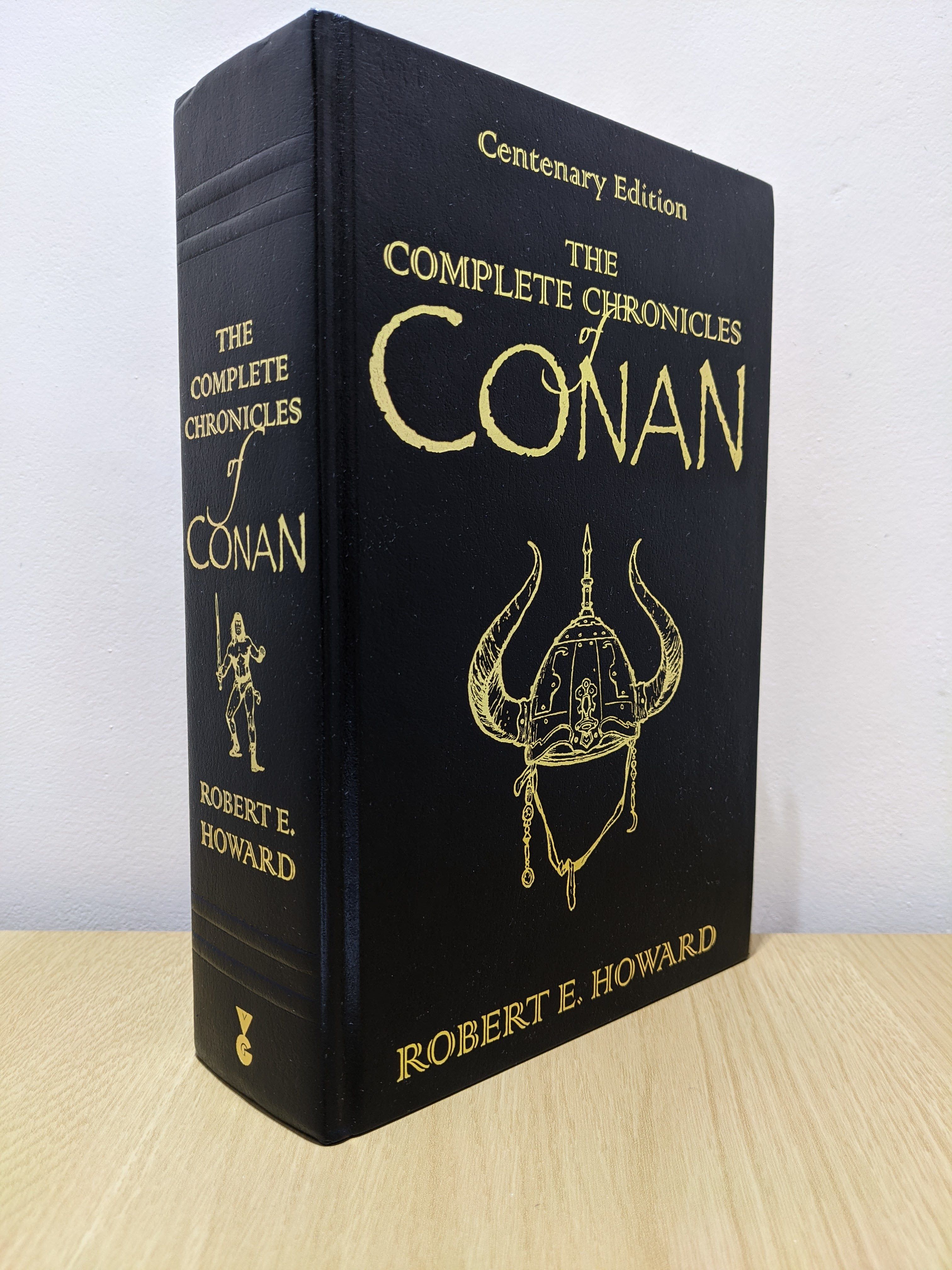
Robert E. Howard wrote only 21 stories about Conan during his life, and those are the ones I’m going to read.The reference edition I’ll be using is the Gollancz The Complete Chronicles of Conan, Centenary Edition edited by Stephen Jones.


For reason of portability I might also check The Coming of Conan the Cimmerian, published by DelRey, that collects the earliest stories of Conan, masterfully illustrated by Mark Schultz.
I’ll add a simple copybook to jot down notes while reading in bed or out in the garden, and I’ll get me lots of hot tea and treats, because, why not?

The idea is to go through the series from cover to cover, and then write a post about them – possibly collecting two or three stories in one post for practical purposes.

While there are stories that I re-read regularly, most of the series belongs to a dim and distant past, and it will be fun to revisit the Hyborian Age after all this time.
I will also try and squeeze in some extras, and do some extended cut for my Patrons.
But anyway, tomorrow we start.
Watch this space.
It’s going to be fun.


3 Comments

Damask without Damascus: Duncan, Howard, Eddison and another style of world building

Last post of the year, and somewhat unexpected – I am suffering from a bout of insomnia, and about one hour ago, while exchanging new years greetings, I suggested to my friend Marina Dave Duncan’s novels in the A Man of His Word series.
This led to a quick search online – are they still available (they are!), are they affordable (more or less, yes), have they a good rating…?

And this leads me to a review of Magic Casement, the first book in the series – and the reviewer writing…

personal and place names, as well as cultural items such as furniture, fabric, dance types are a mishmash, a veneer that cannot make sense naturally in this world…how is there damask without a Damascus? How are there minuettes and ballet without French?

The reviewer notes that Duncan’s secondary word is filled with names pulled straight out of ours, and that puts a strain on their suspension of disbelief.
Fair enough.
It works fine for me, and actually I like it, but to each their own.

I remember Samuel Delany mentioning how Robert E. Howard’s penchant for dodgy names in the Hyborian world as a cause for a similar breach of suspension of disbelief – the obvious references to historical geography (Vendya instead of India, the Kozaki or the lands of Shem and Stygia) bugged young Delany, dragging him back in our own world instead of helping him settle in the Hyborian landscape.

And really, I get it.
I mentioned a few days back how characters using “OK!” while living in a psaeudo-medieval secondary world bugged me.
It’s OK.
Each one of us has a different degree of tolerance for this straining of the worldbuilding, these fractures in the coherence of the creation. What is OK for me may be unacceptable for someone else, causing the world not just to creak and shudder in a pleasantly reassuring way, but to crumble and collapse in dust and ruin.

In all honesty, Dave Duncan’s heterodox approach to his worldbuilding never caused me any stress – sure, it’s weird that he says “faun” and then describes an individual of apparent Celtic ethnicity instead of a guy with goat feet, but it’s OK. Similarly, Imps look Mediterranean and Djinns look Middle-Eastern. It’s strange, for the first five pages. But it’s also fun, actually.
To me, at least.

And I am also reminded of that old E.R. Eddison passage in Mistress of Mistresses, that I often use when discussing worldbuilding…

At least, I am fortunate. For there is peace in these Arctic July nights, where the long sunset scarcely stoops beneath the horizon to kiss awake the long dawn. And on me, sitting in the deep embrasure upon your cushions of cloth of gold and your rugs of Samarkand that break the chill of the granite, something sheds peace, as those great sulphur-coloured lilies in your Ming vase shed their scent on the air. Peace; and power; indoors and out: the peace of the glassy surface of the sound with its strange midnight glory as of pale molten latoun or orichalc; and the peace of the waning moon unnaturally risen, large and pink-coloured, in the midst of the confused region betwixt sunset and sunrise, above the low slate-hued cloud-bank that fills the narrows far up the sound a little east of north, where the Trangstrómmen runs deep and still between mountain and shadowing mountain. That for power: and the Troldtinder, rearing their bare cliffs sheer from the further brink; and, away to the left of them, like pictures I have seen of your Ushba in the Caucasus, the tremendous two-eared Rulten, lifted up against the afterglow above a score of lesser spires and bastions: Rulten, that kept you and me hard at work for nineteen hours, climbing his paltry three thousand feet. Lord! and that was twenty-five years ago, when you were about the age I am to-day, an old man, by common reckoning; yet it taxed not me only in my prime but your own Swiss guides, to keep pace with you.

Mistress of Mistresses takes place, of course, in fabled Zimiamvia, but here we are, with rugs from Samarkand and Ming vases…

For me, it works.
Soon we will leave the mundane behind and travel to the Mezentian Gates, but for the time being this mishmash of references builds anticipation, and wonder.
That’s what I am here for.
More, it is a form of fantasy creation that fascinates me, and that I’d love sometimes to imitate.
It gives me this impression of the secondary world as a sort of strange, dusty attic, in which bits and pieces from different times and places somehow came together, to form something that is new, and different, and still has ties, but weird and unlikely, with the Known World.
This form of continuity is more explicit and straightforward in Howard – his ancient lands and peoples are somewhere in the past of our own past.
In the case of Duncan and Eddison – but also of Lord Dunsany, I dare say – the echoes and the flotsam of our own world and history are less immediate, and come through the veil of fantasy – in the sense of fabulation and faery tale, or fairy story.
Just like in Peter Pan we have pirates and crocodiles and in Alice in Wonderland we have Victorian hatters (but mad) and hookah-smoking caterpillars, so in Duncan’s books Imps are basically your ancient Romans, and in Eddison you can have collections of Earth exotica and Zimiavian magic.
We do not question the provenance of the items contained in Red Riding Hood’s basket.

Pulling such a trick – building a secondary world with explicit bits and pieces of our own, in open disregard for what goes under good and proper practices of worldbuilding as exposed in no end of manuals – is no little feat.
And we are indeed talking great authors, with an immense zest and passion for their creation, a conviction that (usually) manages to grab the average reader, and drag them along in an adventure, but also, I believe, rests at least in part on the will on the part of the reader to go along for the ride without questioning page after page, paragraph after paragraph, the skill or the good faith or the intent of the writer.

And yes, of course there are some kind of stories in which such mishmash, to quote the critic, can grate and feel out of place.
But there are some stories in which it works just fine – if we let it work.

Back in the days of Eddison – but also much more recently, when Dave Duncan set out to write Magic Casement – readers were maybe less interested in the authors’ magic system rules, in the coherent syntax and grammar of their made-up languages, and in the fauxtentication of their worlds through accurate mapping and worldbuilding. They wanted fantastic imagery and high adventure, and as long as those were there on the page, it was fine.
Maybe modern readers are more sophisticated – or they just know more about the theory of the writing practice, and look at the way the pudding was cooked instead of just appreciating the flavor.
Or maybe I am just old, and I am shaking my fist at those pesky kids and their newfangled ways.

I really believe, anyway, that getting distracted by what I perceive as technicalities can often distract us from appreciating what is, basically, a damn good story.

I still believe fantasy has enough freedom to bend the rules – any rule – and as long as the writer gets away with it, be as anarchic and jazz-like in the building of the worlds, the characters and the stories.

2 Comments

The Conan Re-Read 4: Red Nails

It felt right to end our overview of Robert E. Howard’s Conan with the final Conan story, and the one that gave our podcast its name: Red Nails, published between July and October 1936 in Weird Tales. This was my friend Germano’s second choice, and is one of his favorite Conan yarns – while I have always been somewhat cold towards this story in particular.

I first read this story in English, in the paperback of the same title, edited by Karl Edward Wagner, and I agree with Wagner when he says that our knowledge that this is the last Conan story often colors our reading experience, the shadow of Howard’s death weighing heavy on the text, somehow causing us to dislike the story.

Art by Ken Kelly

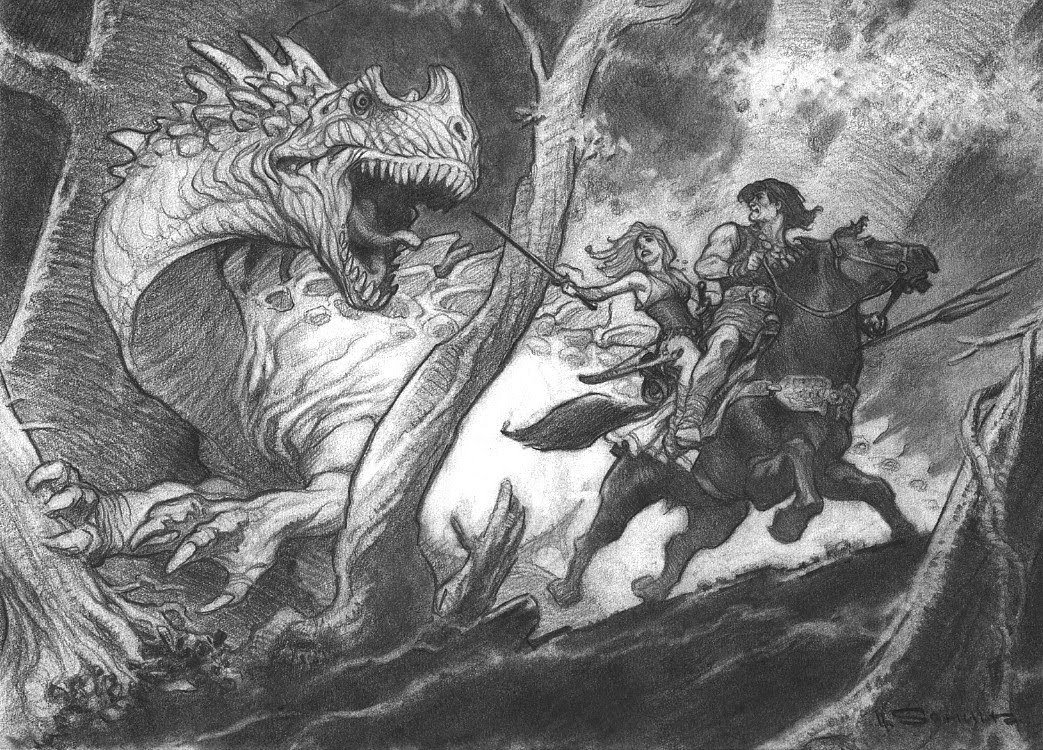
The story is set in the jungles at the far south of the Hyborian continent, where Conan follows piratess Valeria, herself on the run after killing a man who tried to rape her. After an encounter with a “dragon” (actually a dinosaur of some sort), the two adventurers reach a strange city; here they get entangled in the feud between two factions that in the last fifty years have been killing each other for control over the city. The arrival of the two foreigners – and their involvement in the feud – is the unforeseen event that causes the situation to precipitate, in a series of betrayals and murder attempts that leave Conan and Valeria as the two sole survivors.

Art by Oliver Cuthberson

Red Nails was to be the last Conan story, and the last fantasy from Howard – in 1936, Weird Tales was owing the author 1350 dollars (over 27.000 dollars in today money), and Howard had decided to leave the field, and move on to writing westerns – a genre in which he was enjoying a great success and regular payments.
Maybe the decision to leave Weird Tales and fantasy behind explains some of the characteristics of Red Nails – a story Howard himself described as his raciest and darkest.

Art by Mark Schultz

The people of the lost city of Xuchotl are engaged in a turf war that has been dragging on for five decades, and is fueled by the twisted culture of the citizens – that in various scenes describe in almost obscene fashion the pleasure they got from torturing their enemies.

“Tolkemec warred on both clans. He was a fiend in the form of a human, worse than Xotalanc. He knew many secrets of the city he never told the others. From the crypts of the catacombs he plundered the dead of their grisly secrets—secrets of ancient kings and wizards, long forgotten by the degenerate Xuchotlans our ancestors slew. But all his magic did not aid him the night we of Tecuhltli stormed his castle and butchered all his people. Tolkemec we tortured for many days.”
His voice sank to a caressing slur, and a far-away look grew in his eyes, as if he looked back over the years to a scene which caused him intense pleasure.
“Aye, we kept the life in him until he screamed for death as for a bride. At last we took him living from the torture chamber and cast him into a dungeon for the rats to gnaw as he died. From that dungeon, somehow, he managed to escape, and dragged himself into the catacombs. There without doubt he died, for the only way out of the catacombs beneath Tecuhltli is through Tecuhltli, and he never emerged by that way. His bones were never found, and the superstitious among our people swear that his ghost haunts the crypts to this day, wailing among the bones of the dead. Twelve years ago we butchered the people of Tolkemec, but the feud raged on between Tecuhltli and Xotalanc, as it will rage until the last man, the last woman is dead.”

Red Nails, chapter 3

To complicate matters, the obviously evil Tascela, a sort of vampire femme fatale who rules over a portion of the city, has singled out Valeria as her next victim, with the purpose of drinking her life essence and preserving her own youth. Tascela’s attitude towards Valeria is patently homosexual in nature – another example of the “extreme” themes Howard is dropping in his story.

She came down from her dais, playing with a thin gold-hilted dagger. Her eyes burned like nothing on the hither side of hell. She paused beside the altar and spoke in the tense stillness.
“Your life shall make me young, white woman!” she said. “I shall lean upon your bosom and place my lips over yours, and slowly—ah, slowly!—sink this blade through your heart, so that your life, fleeing your stiffening body, shall enter mine, making me bloom again with youth and with life everlasting!”
Slowly, like a serpent arching toward its victim, she bent down through the writhing smoke, closer and closer over the now motionless woman who stared up into her glowing dark eyes—eyes that grew larger and deeper, blazing like black moons in the swirling smoke.

Red Nails, chapter 7
Art by Mark Schultz

The presence of an immortal evil woman as an antagonist in Red Nails signals the story’s debt towards the works of H. Rider Haggard and Edgar Rice Burroughs – here mixed with the classic “standard Conan plot” featuring a lot city,a woman in peril, a strange monster and some human adversaries.
But this take on the story is much more nihilistic and dark than the usual commercial Conan story, and the sense of decay and despair is impossible to ignore.

Once again Howard provides us with a strong female character, seriously undermining some critics’ claim of generalized misogyny or sexism in Howard’s writing. When he wanted, Howard was more than capable to put on the page fully-developed female characters that were not just ornaments or “men with boobs”.

For sure, in his last outing, Conan goes out with a bang, and Red Nails is enjoyable and masterfully written . despite a few choices that almost seem to be tongue-in-cheek send-offs of the fantasy genre.

“There’s more than one way of skinning a panther.”

Red Nails, chapter 1

As usual, I have provided the link to the online text of the story, above, and here are the links at the three issues of Weird Tales in which it was serialized.

https://archive.org/details/WeirdTalesV28N01193607

https://archive.org/details/Weird_Tales_v28n02_1936-08-09/mode/2up

https://archive.org/details/WeirdTalesVolume28Number03/mode/2up

And here is an audiobook version is that’s your preferred mode of access.


5 Comments

The Conan Re-read 3: The People of the Black Circle

My second story choice was a no-brainer from the beginning: The People of the Black Circle, from September-October 1934 Weird Tales, is the first Robert E. Howard story I ever read, forty years ago, when I first bought a copy of the Italian translation of Conan the Adventurer.
So, my first meeting with Conan, and the story that sold me on the character, the world, and the author.

Art by Karel Thole

This novella-length story is probably Howard’s most accomplished in terms of pure plotting and writing. It features a wide cast, a large number of moving pieces, and the plot has been compared to an Elizabethan drama by none else than Fritz Leiber (a writer that knew something about Elizabethan dramas).

Inspired by the adventure/intrigue stories of Talbot Mundy, The People of the Black Circle is set on the mountain-rimmed border of Vendya – the Hyborian equivalent of Mughal India, and it opens with an impressive set piece about the agony of emperor Bunda Chand, whose soul is being tormented by an evil sorcerer. The sorcerer Khemsa, a servant of the Black Seers, worked his dark arts on Bunda Chand on orders from Kerim Shah, a Turanian spy. Such is the torment the emperor is suffering, that he asks his sister Yasmina to release him by killing him.

The king of Vendhya was dying. Through the hot, stifling night the temple gongs boomed and the conchs roared. Their clamor was a faint echo in the gold-domed chamber where Bunda Chand struggled on the velvet-cushioned dais. Beads of sweat glistened on his dark skin; his fingers twisted the gold-worked fabric beneath him. He was young; no spear had touched him, no poison lurked in his wine. But his veins stood out like blue cords on his temples, and his eyes dilated with the nearness of death. Trembling slave-girls knelt at the foot of the dais, and leaning down to him, watching him with passionate intensity, was his sister, the Devi Yasmina. With her was the wazam, a noble grown old in the royal court.

The People of the Black Circle, chapter 1

This theme of death as a release we already found in The Tower of the Elephant, and acquires a darker meaning if we consider that, at this point, the author’s self-inflicted death is about two years away.

Art by Gary Gianni

Yasmina now wants to find those that caused her brother’s death, and travels to the border to seek the collaboration of a bandit king who’s said to be quite effective in achieving results: Conan the Cimmerian. The local governor has seven of Conan’s men in prison, and hopes to reach some sort of agreement with the barbarian. But when things precipitate, Conan makes a grab for Yasmina, and with the girl on his shoulder, makes for the hills.

Here things get complicated – Conan is simply trying to get back to his men, but is attacked and captured by a not-necesarily-friendly tribe, that refrain from killing him simply because in the past he saved the life of their chieftain. On the Cimmerian’s tracks are the Turanian spy – that wants to get a hold on Yasmina; the Vendyan army – that want to recover their princess; and Khemsa and his lover, who have decided to ditch the Black Seers and go solo, using captive Yasmina as a pawn in their bid for power and riches.

Art by Gary Gianni

Nothing goes according to plan: Khemsa kills Conan’s friend, and incites the tribesmen to kill the Cimmerian; Conan and Yasmina escape, Yimsha hot on their heels, but are intercepted by the Black Seers, that kill Khemsa’s girfriend, cast the sorcerer in a ravine, and steal Yasmina. With his dying breath, Khemsa provides Conan with the information and equipment he needs to get into the citadel of the Seers, and Conan goes on, with the Turanian spy Kerim Shah in tow, because after all the enemy of my enemy is my friend.

Conan faces the Seers and makes short thrift of them – and of Kerim Shah, two-faced backstabber that he is.
All’s well?
Not exactly – because now Yasmina’s troops from Vendia find themselves faced with the Turanian cavalry, and the battle is decided when Conan’s raiders join the fight on Yasmina’s side.

Art by Ken Kelly

Whew, that was complicated!

But you never feel lost or confused, reading this story – the prose is crisp, the descriptions are impressive and just right, and the characters are absolutely perfect. Yasmina is not just another pretty face, and Khemsa is probably the best bad guy in the whole series.

A sorcerer in the service of more powerful sorcerers, Khemsa is motivated by very mundane needs, exemplified by his lover, who is as greedy, amoral and ruthless as he is. Khemsa does not dream of world domination, but just of acquiring enough wealth and power to enjoy the good life with his girlfriend.
Yet, he is the sort of guy that can dismissively order an hypnotized man to kill himself, and that at death’s door manages to turn Conan into the weapon of his revenge.
That’s some first-class evil, but elegant.

“I have no more use for you. Kill yourself!”

The People of the Black Circle, chapter 3

The story is very tight, with no filler, and yet there is so much going on that it turns out to be one of the longest in Conan’s canon – and one of the best sales in Howard’s career, getting him 250$ (that would be over 2000$ in today money).
It features an interesting mix of action, intrigue, gruesome sorcery and exoticism, and would make for a great movie – but of course we’ll never get one.

Art by Margaret Brundage (who else?)

The link at the top of this post leads to the Wiki Commons text of Howard’s novella. For those interested, online scans of the three issues of Weird Tales that featured The People of the Black Circle are found in the Internet Archive

https://archive.org/details/weirdtalesv24n03193409

https://archive.org/details/WeirdTalesV24N04193410saspages4856Damaged

https://archive.org/details/WeirdTalesV24n05193411ATLPM

And here is an audiobook version for those of you that would rather listen than read this excellent story.