Karavansara

East of Constantinople, West of Shanghai


3 Comments

Journeys on the Silk Road

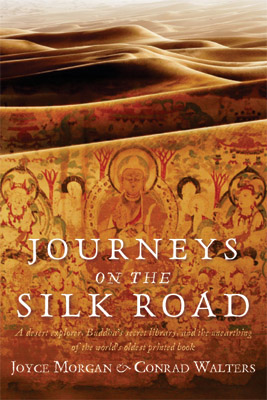
coverThe latest addition to my ever-growing library of books about the Silk Road is Journeys on the Silk Road *, by Joyce Morgan and Conrad Walters.
The book was published in 2012 and was a gift from my brother.

The book focuses on Aurel Stein‘s second Silk Road expedition, between 1906 and 1908.
Following his passion for the history of Central Asia and a series of often unlikely leads, Stein reached the Mogao Caves – also known as the Caves of Thousand Buddhas – in the Taklamakan region, and there he started playing a bargaining game with the local monk, the Daoist Wang.
At the end of a long battle of wits, the monk agreed to part with a few thousand ancient texts, which had been waiting in a cave for eight centuries.
The collection – which Stein acquired somewhat wholesale for 130 sterling pounds – included texts in a number of languages, and on a variety of subjects, from sacred texts to personal letters.
A veritable cross-cut of a multicultural community whose existence had never been suspected by western scholars.
The bundle included the oldest printed book known – a woodblock print copy of the Diamond Sutra, one of the central texts in the Buddhist canon.
Morgan & Walter’s text does therefore shift its attention from the old explorer to the text, outlining its importance for the development of Buddhist culture in Asia, but also its impact on Western culture.

All in all, a book that touches on so many interests of mine, it was impossible for me not to like it a lot – I started and finished it in one day, also thanks a very long train journey.

The volume is highly enjoyable and gives a sympathetic, humane portrait of Stein, a giant of archaeology who’s been somewhat forgotten by the public, and whose activities in Cantral Asia are often portrayed as piracy and plunder, not excavation and research.
The book keeps a balanced view of Stein’s work, while presenting the reader with a character that is, as they say, larger than life.

Filled with anecdotes, quotes from Stein’s diaries, books and letters and a good number of funny bits.
Stein’s companions on the road and his competitors in the race for the Mogao Caves are a gallery of unique characters.

Great reading.
And the book is also supported by a nice and informative website.

————————————————–

* The title “Journeys on the Silk Road”, and variations thereof, must be the most widely used when Central Asian travel and Silk Road exploration are concerned.
Which is not bad – dial it in the Amazon search window, and you’ll find a treasure trove of great reads, and excellent music.

Images from China

Leave a comment

I’m doing some light revision work on an interesting text about China in the days of old.
As a side effect, the author gave me some images for my blog.
These pictures were taken by her grand-granfather, in China, between 1900 and 1905.
There’s six of them and they are captioned (in Italian).

Enjoy!

This slideshow requires JavaScript.

This gallery contains 6 photos


3 Comments

Phishers of Men

phishing_hThis morning I got a message from a pretty generic “services firm” handling the security for my email provider.
Due to some unspecified troubles, I was asked to send them my account details.
All of my account details.
Including my date and place of birth.
Including my password and the answer to my secret recovery question.

Only, they called it my “secernere” question.
“Secernere”, in italian, means “to secrete” – like in glands and stuff like that.
It was the most glaring in a variety of spelling and gramar errors.

Now, some phishers are so naive they ar almost cute.
But these guys were quite professional – had it not been for the bad Italian, I might have thought about… phoning the customer service of my email provider.

So I thought, why not?
And I replied to that mail. Like this

“Gentlemen,
your phishing attempt was one of the best I’ve seen so far, but your decision to use GoogleTranslate sank any hope you had of getting my personal data. The language is sluggish and wooden, and translating ‘secret’ with ‘secernere’ makes me wonder if your primary language is not, after all, French.
Just in case, should you need a professional translation, drop me a line – I’m sure we’ll be able to arrange some way for you to pay me.
Cheers!”

Who knows, maybe I’ll get me a job as a freelance translator for the mob.


1 Comment

Keeping busy

It’s a busy season.
My research work is picking up speed again – while my University engagements force me to 36-hours/1000+ Kms trips week in, week out.
I’m learning to work on trains, which is something I was never good at before.

In the meantime, in the extracurricular department, I’m pleased to say I’m working on a scenario for a roleplaying game -something I hope I’ll see published late this year. My brother is also involved in a the project with a work of his own, on which I’ll act as revisor/editor.
The Mana Brothers ride again.

I’m also working on an instant book of sorts – a short’n’sweet non-fiction ebook that could be the first in a series should sales impress the publisher enough.
Let’s call it an experiment.

AND I’m working on two translations – one of which is due for tomorrow morning!

And finally, I shood rebooth my online course in Taoist Culture, which should have restarted last month, but I was forced to put on the afterburner due to bad health and other problems.

overworked-1The mystery remains – how comes I do so much work and still I struggle to make ends meet?
Which boils down to the basic problem with Italy where creative work is concerned – creative work is not considered “serious” work.
It is underpaid, or – if they can get away with it – it’s not paid at all.
I’ll have to make a post on this subject.

In top of all this, I keep reading books and writing stories.

Which explains, I guess, why the updates of Karavansara are so erratic of late.

But I’ll pick up speed again.


1 Comment

Hail to the Queen

4902075237.02.LZZZZZZZA quick one, to raise three cheers to the novel Queen of K’n-Yan, by Japan’s foremost supernatural horror author and H.P. Lovecraft scholar, Ken Asamatsu.
The novel – published in the Kathleen Taji English translation by the fine guys at Kurodahan Press –  is finally available in ebook format, and it is highly recommended – a heady mix of science fiction, ancient mysteries and Lovecraftian Mythos, set in a finely detailed Japanese setting.
One of the best Lovecraftian horrors out there, subtly disquieting and deeply suggestive.
An ancient mummy, biogenetic experimentation, old military experiments, horror, madness and a dark shadow extending over humanity’s future.
Fast, furious, and scary in a very unusual way.
Great introduction by Darrell Schweitzer.
Stunning cover.
Highly recommended indeed.


5 Comments

Stories from the deep future

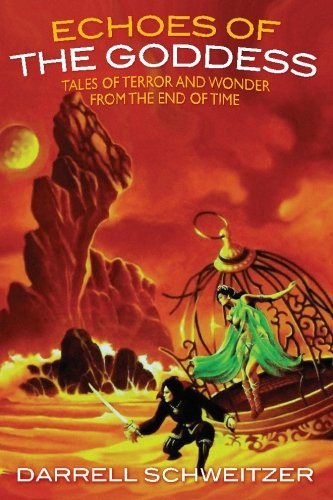
echoesI’m having lots of fun reading Echoes of the Goddess, Tales of Terror and Wonder from the End of Time, a great collection of stories by Darrell Schweitzer, set in the same universe of the author’s popular and highly respected 1982 novel, The Shattered Goddess.

The eleven stories in the volume – which is available as an inexpensive ebook through Amazon – are set in a distant, decadent future, after a catastrophe of theological proportions (narrated in the novel mentioned above).
The setting and the mood recall Clark Ashton Smith’s Zothique and Jack Vance’s Dying Earth – the so called dying earth/end of times subgenre.

Now I am particularly interested in this subgenre, and I’m highly impressed by Schweitzer’s prose – the quality of the storytelling is such, that even a deceivingly light plot becomes multi-layered and highly satisfactory.
There is style and substance.
This is fantasy fiction, but a style of fantasy fiction and swords & sorcery that goes back to the roots of the genre, back to the pages of Weird Tales.
And yet, it is not just a nostalgia trip or a form of narrative archaeology.

The book was released by Wildside Press in february 2013, and is highly recommended.