As I think I mentioned – or I should have mentioned – I’ll devote this autumn to the development and growth of my Patreon. I want more patrons, and I want happier patrons. So I am announcing a number of new perks for those brave souls that decide to gamble a few bucks on me and my writing, and show small glimpses of things to come. The World of Tomorrow, if you will…
First day with the new Operating System, and while I am well pleased with Linux Mint, I am still unable to run Scrivener, and this means 90% of my work-in-progress is out of reach. All the files are safe and nicely backed up, but I can’t read them, and I can’t work on them.
But this provides me with an opportunity – there’s two stories I have in Word format, one I was editing and the other I was translating and re-writing. These are the only ones I can work on at the moment, so I’ll stop procrastinating and I’ll finish the work straight away. Because working on multiple projects at the same time provides us with a fantastic opportunity for procrastination – I’ll work one hour on this one, then OK, maybe I’ll move to something else. Then wait, this idea would work great with that story… let me take a break while I think about it. It can be a huge waste of time, and we need to exercise a terrible discipline, or we’ll get lost in too many projects, too many ideas, to many wastes of time. Discipline. Or a software mishap that leaves you with very limited options.
So today I’ll nail closed the revision of The Queen of Spades, a tarot-based story for a forthcoming Italian anthology. I think I’m going to add a 250/500-words, high action scene. Boy, will the editor be pleased with this surprise!
Yesterday it was Friday the 13th and there was a full moon, so I met a friend who’s a fine horror writer and we went for a bite and a long night talking. Of course we would have done it even had it been Monday the 19th and a quarter moon, but the whole day/moon thing was a nice touch. We were assigned table 13 in the diner where we stopped, and that did not escape our notice.
As it usually happens in these situations, we ended up talking shop, and the discussion turned to our professional designation. Writer, that is.
About twenty years ago (my goodness, is it really been this long?) while my mother was resting after a major surgery event, she used to spend her afternoons watching German-produced TV movies based on the novels by Rosamunde Pilcher. She said she found the locations beautiful, and the stories were engaging, “even if in the end they are all the same story.”
I sat with her on a few of these afternoons, and at a certain point, I picked up a notebook and started sketching a diagram – I had seen three movies, and they all shared the same structure, that I could sketch quite easily. I made a point of catching a few others and yes, there was a formula, not only in the sequence of events, but in the characters and their relations. Just as in the Commedia dell’Arte or in any good pantomime, the cast was the same, the roles were the same, the interactions were the same.
Yesterday I posted an article for my Patrons, in which I tangentially compared this writing business to being an adventurer. And I know, it’s a romantic notion, it’s me telling stories about myself to paint a veneer of glamour over the tight budget and the overdue bills, but that’s my story and I’m sticking to it: writing for a living is like setting off on a long journey to find the ancient ruins of the Lost City, or crossing an ocean on a sailing ship.
Having recently discovered the works of Alastair Humphreys, I’ve been reading Ten Lessons from the Road, a motivational handbook based on Humphreys experiences during his four years travelling around the world on a bicycle.
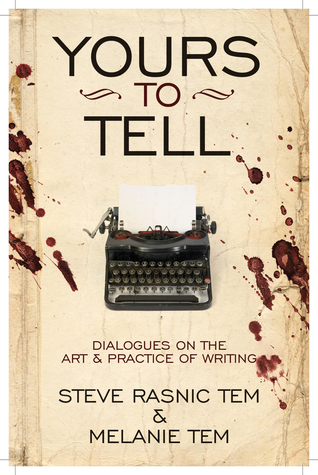
I have finally finished reading Yours to Tell, Dialogues on the Art & Practice of Writing, by Steven Rasnic Tem and Melanie Tem, that I had started back at the end of may, and then had somehow slid down the reading pile, for a number of reasons. I collect writing handbooks, and this one came back to me at the right time to offer some diversion and a different and fresh outlook on what I do. Because sometimes while we can’t write (for whatever reason), we still can read about writing
As the title says, the book is built in the form of a dialogue between the two authors, and it has a very relaxed, informal tone. It is probably not the best choice as a first handbook for the totally uninitiated, but if you’ve tried your hand at writing, you’ll find a lot of interesting insights in this one. While all the classic topics one finds in various writing primers are here, the approach is much more personal, and the book feels like you’re sitting somewhere, having a drink with your writer friends, and they start talking shop – as writers will often do.
The wide range of topics is handled with class and the authors manage to have a very sophisticated approach while keeping the text fresh, accessible and fun.
I started dictating my stories to Google Docs. The basic idea: we talk a lot faster than we type, so we can essentially dictate a rough first draft a lot faster than we can type it. This is one of the nifty ideas in Chris Fox’s excellent little handbook, 5000 Words per Hour, but it’s not something he invented: many authors of the past dictated their work, including Erle Stanley Gardner and, as it was pointed out to me a few days back, Edgar Wallace.
What you need: a Google account and a smartphone or, if you are the sort that prefers to work with a microphone and a PC, you need to make sure your PC is 64 bit. Mine is not, so I use the smartphone. If you use an Android phone, it comes with the full suite of Google services, including Drive (where your text will be saved) and Docs (that will do the heavy lifting, recording your text). Depending on your setup, you might need to load a Google Talk thing. Or maybe not.





 Karavansara