OK, guys, we need to move fast: the Kickstarter for The Last Incantation, an indie fantasy movie based on a short story by Clark Ashton Smith will last only 9 more days and the crew needs still about 500 dollars to hit the target and actually make the movie. You can see all of the details here. If you read this blog, I don’t need to tell you who Clark Ashton Smith was, what an indie fantasy movie is, and why these could be the best ten bucks you spend this year.
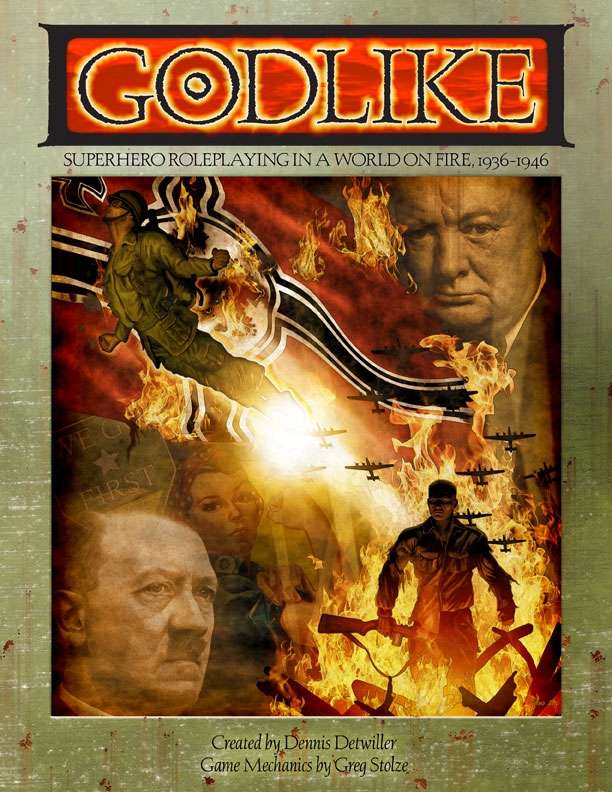
This is a sort of “request post” – I have been asked a short review of Godlike, the superhero game designed by Dennis Detwiller and Greg Stolze, currently published by Arc Dream Publishing. I like the game very much, and so it is no great sacrifice writing a review. I still own and play the first edition of the handbook – the second is gorgeous, but I only have the PDF, and I prefer to have a hardcopy book at my table.
So, it’s the 1930s, clouds of war are gathering on the horizon, and as a surprise move, the Nazi have developed a superman – a guy with a swastika on the chest, that actually flies. He opens Berlin’s Olimpics with a fly-by, and everything changes. Only it doesn’t.
I discovered Hawk & Fisher in the early ’90s, when I bought in bulk the six slim Headline paperbacks that make up the series. It was a very strange hybrid: sword & sorcery, detective story and humor. But I liked the general concept, the six paperbacks were cheap, and it was a fun way to spend a summer.
Hawk & Fisher is one of the first series developed by Simon R. Green, a British writer that has fully metabolized the pulp ethos of yore: he writes serial characters, usually in pretty classic genres (fantasy, horror, space opera), adding a twist that makes even the most trite concepts look fresher.
Yesterday I found out a friend of mine is a long time fan of Simon Templar, both in the Leslie Charteris novels and the Roger Moor TV series from the ’60s. Something I’d have never suspected, knowing her. This led to this and that and I found out the aborted pilot movie for the planned reboot of the series, that was announced in 2012, is now available on Youtube, for less than four bucks – the price of a big serving of ice cream.
So I served myself a big bowl of dark chocolate ice cream, and I sat down for 90 minutes to watch what might have been.
Captain Future was a pulp series of science fiction novels that started in 1940, mostly written by Edmond Hamilton. The stories, featuring Curtis Newton, aka Captain Future, aka The Wizard of Science were classic space opera with a pulp hero twist – Captain Future was sort of Doc Savage in space, complete with a team of quirky helpers and all that.
Now, for us here in Italy, and for my generation, Captain Future is a special thing, not much because of the novels – only a few were translated, and quickly disappeared – bu t because in the early ’80s the Toei Animation series was distributed in my country, a part of the “Japanese anime invasion”. To me it was a special treat, because I knew Hamilton, having read a few of his novels, and I had often heard mentioned the character but never been able to track down the books. Back then I was in my early teens and I loved Golden Age authors like Hamilton and Williamson, and so I really enjoyed the series (and to this day, I still like the jazz-based original soundtrack by Yuji Ohno, the same guy that did the Lupin III soundtrack).
It was therefore with a lot of expectations that I (finally) got myself a copy of Allen Steele’s 2017 novel Avengers of the Moon, that is presented as the first volume in an authorized reboot of the old Hamilton novels, written by noted hard SF author Allen Steele. Expectations, I had, and also a few doubts – why reboot the old stories?




 Karavansara