Karavansara

East of Constantinople, West of Shanghai


3 Comments

The Pulp Baker Street Detective

Sexton Blake

Sexton Blake (Photo credit: Wikipedia)

We talked about Biggles, last week, and the little spotlight the British pulp heroes are getting these days.
And yet, they were (and are) an interesting bunch.
The only one, apparently, that still gets around a lot is Sexton Blake.
Hard putting to sleep a character which appeared in over 4000 stories, penned by no less than 200 different authors.

And I’m particularly fond of Blake because he might well be the first true pulp hero I ever met.
It was in Baker Street, a long time ago…

Sexton Blake goes a long way back – he first appeared in the wonderfully titled Halfpenny Marvel, in December 1893.
One hundred and twenty years ago, actually.
And yes, the same year in which Conan Doyle decided to off his increasingly overwhelming character, the Baker Street Detective.

Part of a number of investigators which flooded the popular magazines with their adventures to fill the gap left by Holmes’ fall down Reichenbach Falls, Blake played the role of Holmes clone for about twenty years, being so cheeky he actually moved to Baker Street, and rented an apartment in front of the one occupied by his more famous counterpart.

blakeThen, in 1919, something changed, and Blake – while keeping his Holmes-like looks and manners – shifted to far more outrageous pulp territories.
Outrageous as in killer carnivore plants and zombie cannibal pigmies stalking the streets of London.
That sort of stuff.
Also, Blake showed a penchant for muscular action and a passion for innovation and technology that put him in the same league of, say, Doc Savage.
And did he travel!
There’s quite a bit of globetrotting in Blake’s stories.
And women – Blake had quite a number of ladies involved in his adventures.

And finally, the bad guys, first and foremost Zenith the Albino, but go on, check the excellent page Jess Nevins set up for Blake, and read the bad guys entries.

The character starred in stories, comics, movies, radio dramas and a TV series.

The Casebook of Sexton Blake

I chanced upon a Sexton Blake omnibus, called Sexton Blake Wins, in the late ’80s.
And I was blown away*.
Blake’s stories were hard to get by, but today something is moving.
There’s a few very good collections, available relatively on the cheap (the David Stuart Davies-edited selection published by Wordsworth goes for less than a fiver), and the character deserves a read, in my opinion.
He’s not the Poor Man’s Sherlock Holmes, as some say.
He’s a quite different sort of character – at least in his “golden age”, between the wars.
He’s a pulp hero**.

————————————————————-

* Being still a teenager I actually wrote a pastiche, in which Blake is hired by Count Dracula – who is stalked by a Dutch weirdo called Van Helsing who’s convinced the Rumanian nobleman is a vampire. Turns out Dracula was actually looking for Holmes, but he got the wrong address.

** And come to think about it, the quite fun movies starring Robert Downey Jr actually feel a lot like good old Sexton Blake fare.


2 Comments

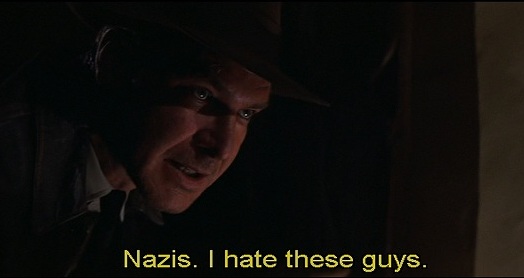
Nazis. I hate these guys

nazis-i-hate-these-guys1Today’s video comes complete with a rant.
A very short rant.

I hate those individuals that proudly proclaim their being “Grammar Nazis”.
First – and it’s a purely ideological thing – I find anything, but anything, coupled with “Nazi” and then displayed proudly to be highly offensive.
Secondly, I find these characters’ obsession with grammar, synthax and phrase morphology (whatever that is) a poor excuse for the fact that they are as creative as gnats, but more self-centerd.
And it’s interesting to discover (see link down below) that the term originally referred to those that make mistakes, not those that correct them!

But enough of this.
Here’s a very fun, and highly intelligent video, featuring Stephen Fry‘s voice and opinions (which I undersign fully).

Enjoy!


8 Comments

The Man That Would Be King, John Houston – 1946

GreatImaginaryFilm-Caine_zpsfdf9dfa1

Click on Caine as Bond to get the full list of the blogathon participants

Something different for today’s post – Karavansara is participating in The Great Imaginary Film Blogathon promoted by the fine ladies managing the Silver Scenes Blog.
The idea is simple – post an article about a movie that might have been.
Being Karavansara a blog about adventure, pulp and the Orient – we have obviously picked a nice pulpy adventure movie set in the higher reaches of the Himalayas, and based on a famous novella by Rudyard Kipling.
Being somewhat perverse, we also dropped a few dollops of uchronia in the mix, and hid a few bonuses in the following post.
And so, here goes our entry.

Enjoy!

Karavansara’s Imaginary Movie of the Week

ava_gardner_gallery_4a

Ava Gardner as Roxanne (photographer unknown)

. title: The Man That Would Be King
. year of production: 1946
. cast:

Clark Gable (Daniel Dravot)
Humphrey Bogart (Peachy Carnehan)
David Niven (Rudyard Kipling)
Ava Gardner (Roxanne)
Pedro Armendariz (Billy Fish)

. Directed by John Huston
. Screenplay John Huston, Leigh Brackett & Robert E. Howard, from the Rudyard Kipling  story of the same title
. Paramount
. Technicolor
. Plot in brief: former British Indian Army NCOs Dravot and Carnehan travel to a secluded Himalayan valley, planning to set themselves up as war lords. Through a series of weird coincidences, the two rogues rise to the status of gods, but in the end they lose everything. Only Peachy survives the ordeal, and comes back to relate the story of Dravot’s rise to power and fall from grace.

I will not bore you with how great this movie is.
I’ll leave it to others, better than me, to provide some further information. Continue reading


Leave a comment

Pulp History: nobody does it better

Me and my big mouth!
I promise a short post in a few hours.
Yes, you genius… about what?!

About the pulps, and adventure, and exotic locales, of course – because that’s what we deal in, here on Karavansara.

And when it comes to adventure, and the pulps, to me nothing beats reality.
It’s a tough statement from someone writing books with tentacles on the cover, but it’s one of my most rock-solid certainties: no matter how good is your pulp, the real world can trump that.
In fact, to be a good writer, you have to be as outrageous, unlikely, absurd and strange as only reality can be.
It takes practice.

running_the_show5One of the best places in which to practice is history – not so much the slam-bang, big numbers history of great men and nations, but the small-scale, local, oft-forgotten, “useless” sort of history.

Consider, if you will, a book like Running the Show, by Stephanie Williams, roughly 500 pages of paperback dealing with those faceless bureaucrats that managed the affairs of the British Empire.
Boring, right?
Not so.
In this globetrotting overview of the men (and women) that ran the Empire, we find no end of adventures, madness, tragic death, slapstick, espionage, two-fisted diplomacy and the natives are restless tonight.
Not faceless paper-pushers but often young men in search of their place in the world, the heroes (and villains) of this book are a good example of the way in which history can hit you with a curved ball when it comes to plausibility.

It’s good – and thanks goodness, there’s a lot of books dealing with this shadier, pulpier side of history.
I should know – I wrote one.