
“What I do is write stuff that I think is cool, which is what every good writer does. A hack will write what he thinks will sell. A good writer will write stuff that he thinks is cool, to the best of his ability. There are a lot of things I think are cool. And cloaks and swords — rapiers in particular — are definitely on the list. That doesn’t mean every book has them, but that’s what I gravitate toward.” [Steven Brust]
Category Archives: Writing

Writing Prompt – Paper Clipping
Look, mom! No hands!
 Good starting point for a noir, I’d say…
Writing Prompt – Science Fiction
Newcomers

Art by Virgil Finlay
I’m a pulp SF guy at heart…
This one might suggest a few developments – what’s the story?

Characters at Large into the Media Landscape
 I’m taking part in a strange experiment.
As part of my online course on The Future of Storytelling, the 50.000-odd students were asked last week to create a character, give him/her/it a web presence, and let them interact with each other.
So, during this week, some 50.000 imaginary web citizens entered or will enter the net – as Facebook profiles, as blogs, as G+ identities, as tumblrs, as e-mail addresses, as podcasts.
They are out there, or will be soon, interacting with each other, and with… you.
With us.
There will be stories born.
There will be stories, I think, developed across the media landscape – a weird, heady mix of storytelling, multimedia and roleplaying game.
Now, admittedly – setting up a character with a virtual life is no laughing matter.
It takes time, imagination, effort.
Outlining the character was simple and fun – I picked an old character from some stories I wrote 30 years ago.
But then translating it to the web in a believable way… ouch!
It’s a chore – I got bogged down in passwords, nicknames, whistles and bells.
But the results… ah, the results will be fun.
Of that I’m almost certain.
Related articles
- Keeping It in Character (koboldpress.com)
- Back to School (karavansara.wordpress.com)
- The Future of Storytelling: Chapter 1 Review (thedesignbender.wordpress.com)
- The Future Of Storytelling by Prof. Winfried Gerling, Prof. Constanze Langer, MA Christina Maria Schollerer, and Julian van Dieken (thedesignbender.wordpress.com)
- iversity.org’s The Future of Storytelling (mharobed.wordpress.com)
- Europe’s iversity Launches 1st MOOCs With 100k+ Students & Curriculum Of 24 Courses (techcrunch.com)
- QuickWire: European MOOC Provider’s First Courses Go Online (chronicle.com)
Writing Prompt – Overkill
Mad Mandarin
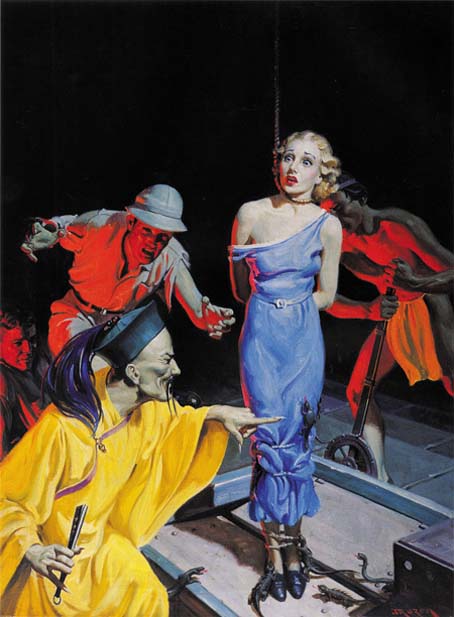
A classic illustration by Jerome Rozen, 1936.
This one should be easy…
Creative Task – Ulysses, The Odyssey and me

Homer was also called Melesigenes (son of Meles) by the name of the brook which flowed by Smyrna, and today, through İzmir. (Photo credit: Wikipedia)
The first story that really struck me was probably the Odyssey*.
Not in its original version: the Homer poem was adapted in a number of forms and media, and I guess I first found a simplified illustrated version among my uncle’s old books, in my grandmother’s attic.
A “boys library” book from the fifties of some sort.
I was six, and I was learning to read.
A TV adaptation was produced and broadcast in Italy in 1968, featuring some state-of-the-art SFX (for the time), and co-directed by Italian fantasy cinema giant, Mario Bava; I probably caught a rerun in ’73 or ’74, more or less while I was reading it in school – this time in a comic-book adaptation.
And later still I finally read some of the original, again as part of the History and Literature curriculum in school.
So, let’s say that between the ages of six and twelve, I was exposed to multiple re-tellings of the same story.
And the story is straightforward and well-known – a veteran of the War of Troy, Ulysses is on his way back home to Ithaca, together with his crew and companions. He faces a number of challenges, often being himself the instigator of the problems he is going to face. He meets mythical creatures and strange phenomena, he seduces and is seduced by dangerous women, he faces and defeats various enemies, he finally comes home to reclaim his own.

Ulysses at the court of Alcinous (Photo credit: Wikipedia)
The story is episodic, and part of it is narrated in the first person as a flashback by Ulysses himself.
The Odyssey is also used as a classic example of the so called Monomyth, or Arch-plot – not that I cared much as a kid.
What captured me as a kid and still stays with me today is the fact that Ulysses is an explorer – a man of intelligence and cunning, not just a muscular hero. His problems often arise from his cunning and his curiosity – a dumber hero would probably never get caught in some of the situations Homer describes.
Ulysses is not a martial hero, and while being an action character, he speaks for the intellectual thrills of adventure, for the fascination of the unknown, as much as he does for the more traditional challenges involving brawn and bravery.
To a rather solitary kid in a large industrial city, the adventures of Ulysses spoke loud and clear.
Then there is the world in which Ulysses moves – a world in which human intelligence is matched against supernatural occurrences, capricious gods, strange creatures.
It’s a fantasy world (or, at the time of Homer, a science fiction world), and yet it is superimposed on a real geography, a real history.
It’s a strange world, but one that to a kid – or an adult – is extraordinarily exciting.
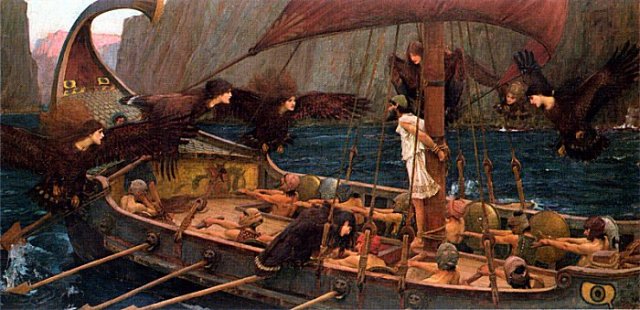
As a kid, being able to read about cyclops and sirens, about ghosts and gods, and yet find books with photographs of the treasures of Troy, maps of the Greek isles in which the places mentioned by Homer could be found, was an exploration in itself.
And I think in the end being exposed to such a massive dose of Odyssey in my early years led to a number of personal choices in matters as different as deciding my course of studies, setting my reading tastes, and finally influencing my writing.
———————————–
* It’s a close thing with the Arabian Nights, which was heavily featured in my childhood, in the form of bedtime stories, coloring books, and assorted media adaptations. But I guess the Odyssey came first and struck deeper.
Related articles
- Tales of Brave Ulysses, Cream by Thomas Sellers (freshfolk.wordpress.com)
- Ulysses and the Sirens (sreibstein91.wordpress.com)
Back to School
Despite my free time becoming more and more scarce as a lot of deadlines loom closer, I went and I enrolled myself in an online university course.
The course is interdisciplinary in nature, and is called The Future of Storytelling.
It was designed by the University of Applied Sciences of Potsdam, and is hosted on the Iversity platform.
This is a Massive Online Open Course (MOOC), and I am one of the 50.000 students worldwide taking part in the course.
The reasons why I am sacrificing my precious free time for this course are many, but basically I am intrigued by the idea of the Future of storytelling, by the interaction of stories and media, and also, with each passing day, I feel storytelling might after all be my future.
Also, the idea of taking part in an interdisciplinary course with a student population the size of a small town was quite exciting.
So, I went and signed up.
It will not be a painful sacrifice at all.
As part of the course, participants are given weekly creative tasks, to put the contents of each set of lecture into focus.
We are also invited to share these tasks with other students.
I’ll be posting my tasks here on Karavansara – both because it’s a valid option offered by the course designers, and because I believe in the value of growing up in public.
The first work I’ll be doing for the course, goes up tomorrow.
Just wanted to warn you guys out there.
Related articles
- The Future Of Storytelling: Enrolments Now Open (aerogrammestudio.com)
- Europe’s iversity Launches 1st MOOCs With 100k+ Students & Curriculum Of 24 Courses (downes.ca)
- Europe’s MOOC experiment accelerates in Berlin (venturevillage.eu)
- MOOCs will bring More Positivity & Minimal Risks in Education (freedomoflearning.wordpress.com)
- MOOCs not a threat to universities – Policy seminar (universityworldnews.com)
- The Future of Massive Open Online Courses (sbowie611.wordpress.com)
- European Universities Catch the Online Wave (educationnews.com)
 Karavansara