Karavansara

East of Constantinople, West of Shanghai


2 Comments

Waiting for the Tartars

9781841959283I’m stealing an idea from my friend Claire’s blog, Scribblings, and her creative task for the Future of Storytelling course.

She tells about the effect that reading Dino Buzzati‘s The Tartar Steppe had on her as a reader and a writer.

The Steppe shattered the prettiness, showed me new depths, and answered some unvoiced, shapeless questions of mine…

I find her observations quite fitting, and I find Buzzati’s novel a worthy subject for my blog.
First, because of its ipothetical Central Asian setting, but secondly and most importantly because I always perceived The Tartar Steppe as a curious take on the adventure novel.

The set up is classical: a fortress in the middle of nowhere, a young officer eager to prove his worth, the hanging menace of fierce barbarians that might be just beyond the horizon.

English: Cover of the pulp magazine Oriental S...

Oriental Stories (October-November 1931, vol. 1, no. 1) featuring Singapore Nights by Frank Owen. (Photo credit: Wikipedia)

This could be the premise of a Central Asian take on Beau Geste, maybe a story out of Oriental Stories, this could be Harold Lamb ready to unleash a storm of action and adventure.
Instead, Buzzati uses the classic adventure setting to write about the end of adventure.
Total absence of change.
The Tartars are not coming.
The hero is bogged down in the petty feuds of his colleagues, he’s smothered by ennui, he wastes his life away.

Buzzati is one of those “serious writers” your literature teacher will not like you to call “writer of the weird” – and yet he is a strong voice in the weird genre, and a darling of my brothers in Lovecraft.
The Tartar Steppe deals with the loss a generation felt about the promise of adventure – and was written in 1940, as my country stood on the brink of a new “adventure” which would turn out to be devastating and traumatic.

I was deeply struck by Claire’s observation…

And as I read, I realised that this was what I wanted to write: not fairy tales, not pretty, sunlit stories, but of this peculiar kind of loss that is no loss of anything tangible, of forever yearning for things that can’t be had, of prices to pay, of the wait itself…

I too felt that darkness, reading the same book.
And if you are a fan of adventure stories, of fantasy, the darkness underlying Buzzati’s work can hit you hard.
So much so that I was probably influenced by it -but not along the same lines as Claire.
To me, the total nothing hanging over the denizens of the fort in The Tartar Steppe is not my theme, but my antagonist – an almost lovecraftian menace my characters implicitly fight, or strive to keep at bay.
I guess that’s why Claire’s a serious writer and an appreciated playwright, and I’m a second row pulp hack writing stories with tentacles on their cover.

But, really, get yourself a copy of Dino Buzzati’s story – it will be a great read.


1 Comment

Where the hell was Biggles?

“So, where the hell was Biggles when you needed him last Saturday?”

Cover of "Biggles of 266"

Cover of “Biggles of 266” (Photo credit: Wikipedia)

Biggles was mentioned, last Saturday, on a discussion group devoted to pulp adventure, among other things.
While American classic pulp heroes are getting some attention right now, there’s this feeling their British counterparts are somewhat neglected.
Sure, there are fine reprints (and new stories) about Sexton Blake, but what of Biggles and Bulldog Drummond?

As luck would have it, I’ve a Biggles novel right here on my desk – a twenty-odd years old paperback edition of The Camels are Coming I bought second-hand for 1 eurocent.
So, why not write a small post about Biggles*?

Written by a veteran of the First World War, W.E. Johns, the Biggles novels follow the adventures of James “Biggles” Bigglesworth – an ace pilot that, starting as a fighter pilot in WWI, basically goes through most of the conflicts of the first half of the 20th century… flying most of the available planes in the catalog. Continue reading


2 Comments

The (pulp) Lost World

There’s precious little pulp on TV these days – and in the past it was not better.
But sometimes I get lucky.

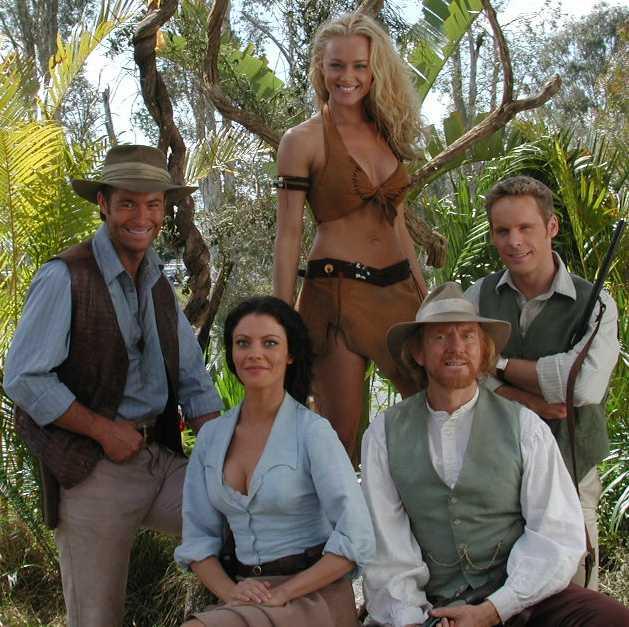
936full-the-lost-world-photoSummer has brought back to the Italian airwaves The Lost World, and I am a happy viewer again.

Now, I know many that do not like the series – not to the point of despising it, but let’s say it is not high in their appreciation where fantasy shows are concerned.
I’ll get to the main objection I registered later, because it is interesting.

Now, Sir Arthur Conan Doyle’s The Lost World (that’s the complete title) is an Australian/Canadian show which takes its lead from the classic novel, and soon ditches most of the Conan Doyle plot and develops as a dinosaur-infested, lost-civilizations-laced, weird-science-loaded feast of pulpy goodness.

The basic premise – a band of heroes gets trapped on a plateau in South America, a lost world filled with… yeah, dinosaurs, monsters, lost cities, mysterious strangers, weird civilizations, relics from other times, crashed aliens, magic…
There’s even an access to the Hollow Earth!

The writing is fairly good, the effects are cheap but fun, the cast is competent, and adequate to the over-the-top premises of many an episode.
The main characters are a fine sample of pulp clichés…

. omni-competent scientist
. fearless big game hunter
. two fisted journalist
. unreliable femme fatale*
. fierce jungle queen*

Earlier seasons feature a second scientist character (as per original novel), sparking scientific and philosophical debate, acting avuncular and more importantly allowing the screenwriters to split the team.

And I’d welcome such a team at my gaming table, as it is the kind of ensemble which just sparks off stories: such a bunch of individuals would turn a jaunt down at the supermarket for snacks into an adventure.

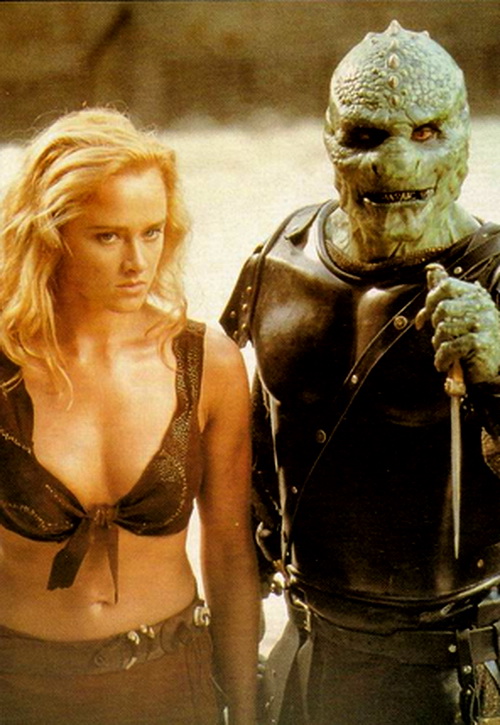
tumblr_menwbumk7U1qzr8nao1_500Some of the recurring elements in the series are also highly entertaining.
There’s a civilization of lizard-men mimicking the Roman Empire.
There’s the afore-mentioned access to the Hollow Earth.
There’s the growing idea (actually turned into a solid plot element in the later seasons of the series) that the lost world plateau is sort of a time-distortion crossroads.

And then there’s everything else – including the kitchen sink.
Which is where many friends of mine start groaning.
There’s too much stuff, they say.
C’mon – dinosaurs today, aliens last week, yet another lost civilization next week…
How comes the science guy is able to build almost any kind of gadget, and yet he can’t telegraph home for rescue?
How comes they never run out of ammo?
How comes the women are always gorgeous, the guys alway handsome and athletic?

And yet, that is exactly what I like – because it’s in line with the classics.
Well, my kind of classics, anyway.
If it was good enough for Tarzan, or Doc Savage, why shouldn’t it be fine for a team of adventurers trapped on a plateau in South America, surrounded by dinos and weirdness?
Are we really counting shots and dissecting dinosaurs for plausibility?

All in all, to me, The Lost World remains a competent, fun, lightweight fantasy show – with some hidden gems lost among the many episodes.
Maybe it’s a guilty pleasure – but it is a pleasure indeed.

NOTE
* Yes, I know there’s no femme fatales or jungle queens in Conan Doyle. There should be.

Related articles


5 Comments

Hunters of Legends

Roleplaying games are great for learning languages.
Without D&D, my brother would have never learned English, and I used the gorgeous French version of Call of Cthulhu, L’Appel de Cthulhu, by Sans Detour, to brush up my French, and give it a thorough workout.
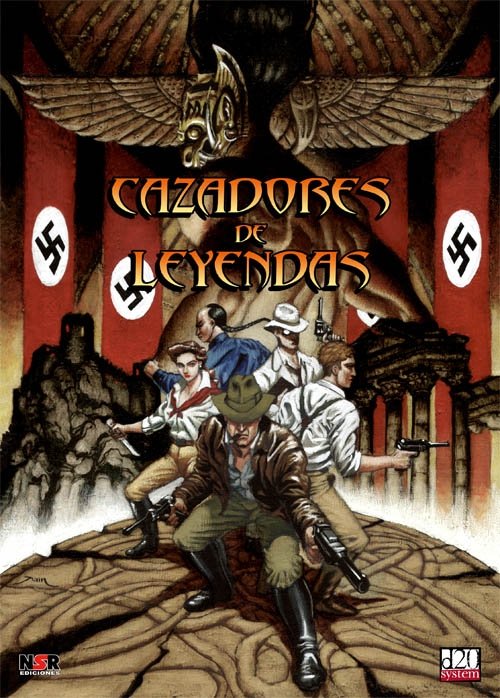
Now, it’s time for some Spanish – courtesy of NOSOLOROL Ediciones and their fine book, Cazadores de Leyendas.

cazadoresSo, ok – I’m a sucker for pulp games.
I saw the cover and I knew I had to take a look at this baby.
My birthday arrived, and my brother sort of had this vibe, and he knew somehow I was interested in it, and therefore he gave it to me as a gift.

Published in February 2013, Cazadores de Leyendas (Legend Hunters) is a 132 pages pulp adventure campaign, distributed as a PDf with color cover and black and white interior illustrations.
It was written by Ismael Diaz Sacaluga, and runs on the D20 system.

The set-up is classic – it’s the second half of the thirties, and the Nazis are looking for mystical artifacts to further their plans of world domination. The British intelligence sets up a team of adventurers to get at the artifacts before the Nazis. The players take the roles of members of this MI6 offshoot group.
Nice and smooth.

The Indiana Jones movies were clearly an inspiration – and basically, this campaign is probably the closest you can get to the Indiana Jones franchise without the Lucas & Spielberg lawyers coming after you with bullwhips and guns.
And it’s fine.

The book provides a general framework for the campaign, ample Keeper’s notes, five pre-generated, well detailed characters, and a campaign in ten episodes spanning the years 1936 and 1937:

  1. The Mask of Fu Kang
  2. The Mouth of Hell
  3. Zimmer’s Evil
  4. Venetian Masque
  5. The Devils Hunters
  6. The Last Will of Seneca
  7. The Return of Ravek
  8. The Ring of Odin
  9. The Heart of the Beast
  10. The Final Plague

Screenshot from 2013-05-29 05:07:12The book also includes a condensed, lightweight but fully functional version of the D20 system.

The campaign grants a fair amount of globe-trotting (Nepal, Egypt, Italy, England etc.) and pitches the heroes against the Thulegesellschaft.

The scenarios making up the campaign are fun, well-detailed and with some nice touches (like suggesting the music for each scene, from pulp adventure movie soundtracks). The cast of NPCs is large and varied. The artifacts are interesting, and the overall plot is well designed.
Some of the artwork is nothing to write home about, but most of it is still more than adequate, and a pair of pieces are very very good (such as the one here on the left).

I personally do not care for theD20 system, but converting this baby to a more suitable system (such as Savage Worlds, for instance) is not a big deal.
Some scenarios might require some tweaking – but the book leaves ample space for customization.

All in all, a fine addition to my collection of pulp-themed games.
And a good opportunity to improve my Spanish.