Karavansara

East of Constantinople, West of Shanghai


6 Comments

49 cents worth of Pulp

Last night I completed a long and heavy writing job (because sometimes insomnia is good for you), and to celebrate a job well done I invested 49 eurocents in a 1200 pages ebook.
Because I’m cheap.
But who said that expensive ebooks are better?

51TTaxtf7NL._SY346_The book I gave myself as a good job, old man! gift is called SCIENCE-FANTASY Ultimate Collection: Time Travel Adventures, Sword & Sorcery Tales, Space Fantasies and much more.
Which seems to be just the sort of stuff I like.
And sure is, because the guy that wrote all that stuff was Otis Adelbert Kline – pulp writer, amateur orientalist and frequent contributor to ArgosyWeird Tales (of which he was the editor for one issue) and Oriental Stories.
He was also Robert E. Howard’s literary agent.
Great catch! Continue reading

6 Comments

The wisdom of the hack

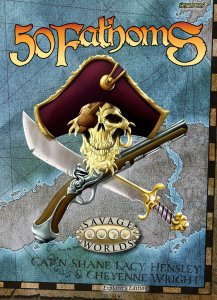
81sjDZU2pxLI’ve been asked by a friend a few suggestions about setting up a pulp-themed scenario for a roleplaying game.
And who am I to deny the masses my wisdom?
Especially when the masses acknowledge me as a pulp guru?
So here’s what I wrote him…

Writing pulp means pleasing your audience by giving them what they do not expect while promising them what they expect.
In roleplaying, your players are your audience, so the first thing is to know your players, their tastes and expectations. And then surprise them.
Easy, right?

The balance between familiarity and surprise is mainly achieved through the manipulation of clichés and tropes, with a few gimmicks to put the pressure on. Continue reading


2 Comments

Other people’s pulps: with Dray Prescot on Kregen

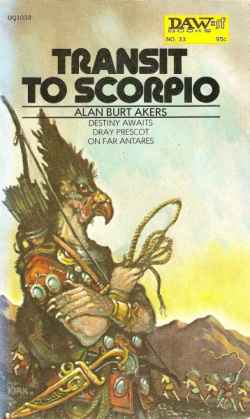
Transit_to_ScorpioI mentioned planetary romance, yesterday, and one thing led to another and I ended up browsing Amazon, using “planetary romance” as a search string.

And I chanced upon a fat list of Dray Prescott/Alan Burt Akers novels set on the planet Kregen, orbiting Antares, in the Scorpio constellation. The series was originally published by DAW between 1972 and 1988, and that’s how I remember it: thin books with yellow backs and garish covers.
The digital omnibuses are pretty expensive at 9 bucks per shot, but I was happy to see they are still available: when first published in Italy in the ’70s, the series stopped at volume 3 – that is exactly 49 volumes before the end of the series, or 2 books away from the closing of the first story arc. The readers were not amused, and the availability, forty years on, of the electronic texts had been saluted, by those that still remembered Dray Prescott’s exploits, as a welcome opportunity to learn how things ended… or how they went on, actually.
Continue reading


Leave a comment

Other people’s Pulp: Arsène Lupin (2004)

arsene_lupin_decrieresI mentioned in a post a while back how my tastes in literature and movies were influenced – among a myriad of other things – by the 1970s French/European series about the exploits of Arsène Lupin.
Maurice Leblanc wrote 17 novels, 39 shorter works and 5 comedies about Arsene Lupin, between 1907 and 1941 (and one was published posthumously), and he created for the French audience a character with the cultural impact and weight of a Sherlock Holmes or a Tarzan, with a touch of Gallic anarchy and darkness.
Like Raffles and more than Raffles, Lupin was the archetypical gentleman thief.
The character was brought to the screen a number of times, and as portrayed by the late, great Georges Descrieres in the old TV series was a perfect modern-day swashbuckler, winning through smarts and not just brown.

In the last week, my brother dug out our collection of DVDs of the series, and started watching them – turns out he never saw it before. I can hear him laugh from where I sit.

So, to relax last night I re-watched the 2004 movie version, and latest incarnation of the Maurice Leblanc’s character, Arsène Lupin, as directed by Jean-Paul Salomé.

Continue reading


27 Comments

The folk horror of Piedmontese Neogothic

Folk Horror.
Apparently the tag was coined by Mark Gatiss in 2010, and used to describe a certain genre of very British horror movies that focused on the countryside, its people and its folklore, its legends and superstitions.

sands1008The three movies that form the core of the genre are Michael Reeves’ historically accurate nightmare Witchfinder General (1968), Piers Haggard’s delicately-titled The Blood on Satan’s Claw (1971) and Robin Hardy’s classic The Wicker Man (1973). A lot of stuff follows, including some of the things that creeped me out the most when I was a kid, to wit Children of the Stones, a rather scary 1977 occult serial from ITV. It was supposed to be kid’s entertainment, but boy was it the stuff of nightmares.
But hey, even The Persuaders had a folk horror episode!

Now I am usually wary of labels when it comes to fiction – they make for good party games, but obsessing too much about such things often means forgetting about the story.
But there is a folk element in Arthur Machen, of course, and in M.R. James, and even in Lovecraft. The genre has a history, and deep roots, and more than a little pulp blood in its veins. Continue reading


23 Comments

A story for which the world is not yet prepared

Matilda Briggs was not the name of a young woman, Watson, … It was a ship which is associated with the giant rat of Sumatra, a story for which the world is not yet prepared.

holmes_wildcardThe reference to adventures that the good doctor never wrote down is one of the fun elements of the Sherlock Holmes canon.

As a Holmes reader I went through various phases – at first enthusiasm then irritation, and finally acceptance.
I will never be a Sherlockian1, meaning, I can’t quote you chapter and verse of Holmes adventures, but I like the Sherlock Holmes stories – and I saw the Basil Rathbone movies before I read the books, so there.
When it comes to the written word, I detest doctor Watson with a vengeance, but I’ve come to appreciate and respect Sherlock Holmes: anyone that can stand Watson as a housemate for any length of time is quite obviously a better man than I am.

And then there is the Gian Rat of Sumatra, which has that nice pulpy feel to it that it’s really a pity the facts concerning the Matilda Briggs were never published. It is obviously Holmes moonlighting in the territories in which his counterpart Sexton Blake was more at ease. Continue reading


Leave a comment

A second serving of Poirot: Evil under the Sun (1982)

It always goes like this: I re-watch Death on the Nile, and a week later I re-watch Evil Under the Sun. So why not write a post on the movie?

Four years after Death on the Nile, EMI made another Agatha Christie adaptation, choosing the 1941 novel “Evil Under the Sun”.
The ingredients were basically the same of the previous movie: a stellar cast (with Peter Ustinov, Jane Birkin and Maggie Smith returning, even if the ladies were cast in different roles), an exotic location (Mallorca, doubling for an unspecified Adriatic Island), the same screenwriter (Anthony Shaffer) and the same Oscar-winning costume designer. Even the poster concept was similar.

The result is on a par with the previous film: a good adaptation, with a cunning plot and an unexpected finale, with a beautiful look and a great selection of great actors. Continue reading