Karavansara

East of Constantinople, West of Shanghai


Leave a comment

A book for the rest of my life

And in the end I gave myself a gift for my fiftieth birthday.
I wanted a good book, one that I’ll be able to take along for the remaining years of my life.
A book I’ll be able to read and re-read, and that I’ll have placed in my casket when the day comes.

So, I have this mild fetishism for the Everyman Library books. They are beautiful and sturdy and come with this Victorian conceit: a library of classics in classy edition for the common readers.
Now that’s something.

It was conceived in 1905 by London publisher Joseph Malaby Dent, whose goal was to create a 1,000 volume library of world literature that was affordable for, and that appealed to, every kind of person, from students to the working classes to the cultural elite. Dent followed the design principles and to a certain extent the style established by William Morris in his Kelmscott Press.

Despite my fetishism, I only have three volumes in the series: a selection of Flashman Papers by George MacDonald Fraser, and the two volumes containing the complete short stories of Ray Bradbury and the complete stories of Roald Dahl.
So I went on Amazon and browsed the stacks and emerged with a short list of five volumes, and who am I trying to kid here, it is obvious I’ll get each one of them sooner or later1.
But right now, as I said, I was looking for something symbolic – and a good thick book at the same time.
So I bought myself a copy of the Everyman Arabian Nights. Continue reading


2 Comments

My birthday with Sherlock & Sexton

In case you are wondering, I spent half my birthday writing (I finally delivered the revision of the first 45.000 words of the first Hope & Glory handbook) and the other half watching old episodes of the Jeremy Brett Sherlock Holmes series.
I also dug out two of my three Sexton Blake anthologies.
The third, which is actually the first, the 1986 Sexton Blake Wins that started my interest in the character, is buried somewhere in some crate or box.
I read the Wordsworth edition of The Casebook of Sexton Blake when it came out, but for some reason the massive Sexton Blake Detective remained on my shelf waiting for better days.
Which, I decided today, have come. Continue reading


5 Comments

Scaramouche’s cynicism

Life imitates art, or something.
I was looking for some light entertainment, and so I started reading Rafael Sabatini‘s Scaramouche.
Published in 1921, Scaramouche is one of Sabatini’s most famous novels.
Set during the French Revolution, it follows the adventures – and the growth – of Andre-Louis Moreau a lawyer turned adventurer and revolutionary, as he joins a company of comedians to escape his enemies, assuming the titular role of a sword-wielding buffoon.
The novel combines a fine historical background with some great swashbuckling action, and it is a fun read indeed. Continue reading


Leave a comment

Other People’s Pulps: That Carruthers chap

… and then they ask you where your ideas come from.
I was looking up M. Y. Halidom last night.
Halidom was the alias of one Alexander Huth, that published a number of supernatural tales and novels in the late 19th and early 20th century.
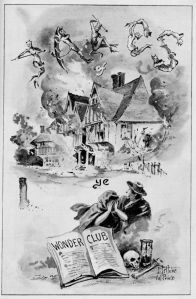
I learned of his existence when I found out about the three volumes of Tales of the Wonder Club, a collection of “club stories” about a bunch of individuals that meet in a pub (the quaintly-named “Ye Headless Lady”) to trade strange and chilling stories.

A small clique or brotherhood, known as “The Wonder Club,” had been nightly in the habit of assembling here for years, and this served to bring grist to the mill. Some of the eminent men from the neighbouring village, among whom were the doctor, the lawyer, an antiquary, an analytical chemist, and others, had formed among themselves a club, which was to consist only of very choice spirits, like themselves, and if any guest were introduced among them, it was only to be with a letter of introduction and the full consent of all parties. By these strict rules they hoped to keep the club select. A room at the inn was set apart for them, into which no one not belonging to the club ever presumed to enter, unless it was the landlord, who would be called every now and then to[7] replenish the bowl, and whom sometimes the guests of the club would “draw out,” as it was whispered in the village that the landlord of the “Headless Lady” knew a rare lot of stories, he did; also how to tell ’em, too, my word! but these he generally reserved for his more intimate customers. One strict law of the club that we have not yet mentioned was that no guest invited was to be a “business man.”

The set-up is strikingly similar to Ike Asimov’s Black Widowers stories, but here the slant is towards the weird, the horrific and the supernatural. With a bit of humor thrown in for good measure.
And to make things more fun for collectors, Huth that was Halidom published the first book of the series under another alias, Dryasdust.

Interested parties can find an illustrated edition of the three volumes of Tales from the Wonder Club on the Project Gutenberg.
I will probably post on each of the three volumes separately. Continue reading


2 Comments

Explorer Pulp – out now!

So it’s officially out and apparently, somebody already had the opportunity to read it: Explorer Pulp, the latest collection of stories by Pro Se Press features four pulp stories of adventure and exploration… and one of them is mine.

You can get the book through Amazon, or the publisher’s own website, or through Smashwords.
It’s available both as an ebook and a paperback, and it features a great cover and three great stories by three excellent writers.
And then mine – Queen of the Dead Lizards.
Check it out, and let me know what you think of it!


Leave a comment

Neo-mythology: Translating the peplums

The true problem, of course, is that I get mortally bored when I translate something I wrote. I think it is because I already know how the story is going, and so there’s no fun in translating it. But we’ll talk about this later. Maybe.

Because you see, considering that right now about 90% of my Amazon income comes from English-language sales, I’ve been thinking about translating some of the things I published in Italian, to see how they would work on the international market.
Right now I’d like to give it a try with my Asteria series of sword & sandal novelettes, but here I crash against two problems.
The first, as mentioned above, is the fact that I find translating myself mindbogglingly boring.
The second is the matter of the titles.
Which brings us to Maciste – or Samson,or The Son of Hercules, as it was sold in the US of A. Continue reading


Leave a comment

Lawrence Block’s lives in crime

It has been observed—I forget where or by whom—that only kids have heroes. I’m not entirely sure that’s true, but I do think you have to stop being a fan in order to become wholly a professional. You can continue to admire and delight in the work of another writer, but if you’re slavish in your devotion, if you’re stuck in the role of full-blown fan, your own growth will be limited.

51O0k6c2kXL._SX331_BO1,204,203,200_I can really relate to that.
It’s taken from The Crime of Our Lives, an excellent book by Lawrence Block, collecting the author’s essays, introductions and columns about his colleagues and his experiences in the field of genre fiction. It is not as one might think, an autobiography (and I realize the title of this post is misleading), but a collection of personal reminiscences about other people1.
It’s quite a good read – but then, I am a fan… or rather, I admire and delight in his work, without giving in to slavish devotion, and I consider Block’s Telling Lies for Fun and Profit one of the best books about writing I ever read2. And I did read a few.

Continue reading