 The second part of Marina’s merciless (but, for my money, fair) overview of the Italian indie book market.
Enjoy, if you can… Continue reading

The second part of Marina’s merciless (but, for my money, fair) overview of the Italian indie book market.
Enjoy, if you can… Continue reading
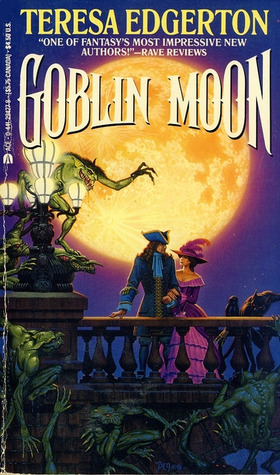 Born in 1949, Teresa Edgerton made her debut in her forties, at the end of the 1980s with the first Celydonn trilogy – also known as the Green Lion Trilogy.
Apparently Edgerton is a regular at Renaissance fairs, a tarot reader and a puppet creator – in addition to having worked as a psychic – and her first novels construct a secondary Dumasian world of alchemy and intrigue.
The three volumes come out for ACE types – which in 1991 published Goblin Moon, a stand-alone novel that is probably Edgerton’s most popular and beloved work.
With its sinister magicians, romantic intrigues, a masked hero that recalls the Scarlet Pimpernel and an urban and eighteenth-century setting, the novel belatedly fits into that interregnum of which I have written in other posts – that period when the fantasy it is popular but not yet imprisoned in a standard scheme designed to please an audience who simply wants some variation on the theme. These are the glorious years in which the market was testing the waters, and on the shelves appear different and exciting works that then, mysteriously, disappeared. Continue reading
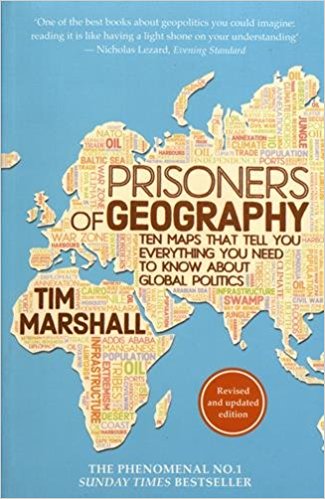 I am currently reading a book1 that’s extremely interesting, and that touches on a variety of interests of mine – from history to current events to maps and geography to good old worldbuilding.
It’s called Prisoners of Geography: Ten maps that tell you everything you need to know about global politics, and was written by Tim Marshall.
The Italian branch of Amazon was offering the ebook edition for less than the prize of a small ice cream, and there is no ice cream parlor here where I live anyway, and so I grabbed a copy2.
The book is a good antidote to the horde of experts in geopolitics that crowd our pubs and bus stations and Facebook every time some issue of international politics is at hand3, and provides the basic tools to understand stuff like conflicts old and new, ethnic confrontations, migratory processes and Ivan the Terrible’s attack as defence theory, among many other things.
Great stuff.
It’s a nice, quick and very to the point crash course in the connection between history, geography and politics.
“What is now the EU was set up so that France and Germany could hug each other so tightly in a loving embrace that neither would be able to get an arm free with which to punch the other.”
It’s also good as a took when you have to design your own world, as it makes it very clear that politics and geography go hand in hand even in fantasy worlds.
Good book, reasonably cheap in ebook, and highly recommended.
My friend Mauro (who also happens to be a fine game designer and an equally fine writer) just turned forty and he made a long list of fantasy novels he intends to read or re-read in the next five years.
I suggested a few additions to his list, and was absolutely impressed by his commitment and his ability to plan ahead.
Or by his cheek.
But let’s say he’s much more committed than I am,and much better at planning and sticking at it.
Could I do something similar? Continue reading
Phil Rickman is an English author with a background in music and a deep knowledge of the traditions, legends and atmospheres of that region of the British Isles straddling the England-Wales border.
In this territory Rickman has set his series of novels focused on the Anglican exorcist Merrily Watkins, mixing detective fiction with a supernatural that is more hinted at than made explicit. In this Rickman is admirable author in his ability to intercept two sectors of the public – that of horror and that of the British-style mystery (not necessarily a cozy), which are usually considered to be mutually exclusive.
Rickman is also the author of a series of mystery novels set in Elizabethan England and featuring Dr John Dee and the Earl of Essex as a team of sui generis, sort-of-X-files investigators.
At the same time, Rickman produced a number of stand-alone novels, more frankly horrific and generally ascribable to that typically British genre of “folk horror” or “rural horror” that is going through a renaissance in these last years1.
December belongs to this batch of stand-alone books. I originally reviewed it last year, for an Italian magazine – a friend borrowed me her copy, and I was able to meet the publisher’s expectations. I recently bought the book (together with four other stand-alone Rickman books), and here goes my review – suitably expanded and updated. Continue reading
My grandfather was a simple man.
He was born in the countryside in the last years of the 19th century – and the Piedmontese countryside in the 19th century was not very different from the countryside in the 18th, 17th and 16th century. My grandfather’s first brush with the twentieth century was the Great War, in which he fought as part of the Mountain Artillery.
The shock was terrible, but he survived, and moved to Turin, the industrial hub of the country, to become a mechanic. He worked in a factory by day and attended a night school to get his certification as a professional mechanic.
When the Fascist Regime took power in Italy, soon my grandfather lost his job, because he refused to join the Party. He did some small freelance jobs as a mechanic and a general handyman, but during his free time, he sat down and read the whole encyclopedia, from cover to cover. Continue reading
 Yesterday we had a little celebration, because yesterday my brother got his Nanodegree as an Android Software Developer, a professional certificate he’d been working on now for two years thanks to a Google scholarship he was awarded.
It was hard work, and there were a lot of frustrating moments because we live at the edge of the map, and there were often some very silly hang-ups; for instance, yesterday my brother had problems actually getting his certificate because the delivery system required a photo of his digital ID Card, but hereabouts we are still routinely issued with a non-digital, paper ID card. You can see how crazy it is.
I am very proud of my kid brother’s achievement, and I hope this new professional qualification will give him a ticket out of Astigianistan.
Anyway, we had a celebration (we also plan a night out and a dinner, but that’s yet to come), and I ended up splurging on some books, and as it usually happens, I bought more books for myself that I did for the guy that was the one being celebrated.
So here’s a quick overview of my unexpected book haul, that doubles as a collection of recommendations. Continue reading
 Karavansara