I like fantasy. I like genre fiction in general – I read it, I write it, sometimes I play evangelist (which sounds better than “sometimes I bore my friends’ socks off talking about fantasy books”). Like this morning, when a friend told me
I was never able to go beyond Tom Bombadil, and just like with Harry Potter, I think the films were better. I guess I don’t like fantasy so much.
If you felt like a cold Hyrkanian blade piecing your heart at the above lines, if you felt the burn of some obscure Melnibonean poison course through your veins, you know how I felt.
I was talking with a friend, about one hour ago, about books. Yeah, I know, I know… I should go out more, but that’s what we book people talk about when we have a chat – books. We are both working on some new material (I’ll tell you one of these days) and we are both staying away from fiction right now, and reading non fiction.
And it turned out we’ve been learning new things recently, and we keep trying to learn more. And that’s seen as something unnatural by many – there’s this idea you go to school, learn what you need to learn… learn all you need to learn, and you’re set. Off to getting a job you go, a job you’ll do for the rest of your life, hating it every minute, until you retire or die, whatever comes first.
Looks like I chose the right time to brush up my French: yesterday, French publisher Les Moutons Electrique (which is the French for Philip K. Dick’s Electric Sheep) announced the launch, in March 2020, of a new line of novels, collectively known as La Ligue des écrivaines extraordinaires – The League of Extraordinary Lady Writers, that is: five novels written by five popular French writers, featuring a bunch of popular writers against a bunch of popular creatures of the night, the lot currently open as a crowdfunding.
There was a time, more or less when I was in high-school, when horror was big. And I mean BIG. I have this clear memory of the girls in my high-school class swapping big fat books: Stephen King, Peter Straub, Dean Koontz and V.C. Andrews most of all. There was this sort of underground book club going, and there were always new titles coming, mostly from a paperback publisher called Sperling & Kupfer. Boys did not read, or if they did they went for science fiction or comic books, and fantasy was small and read by both boys and girls, but at least in my biased memory, it was the female of the species that really loved horror novels.
About twenty years ago (my goodness, is it really been this long?) while my mother was resting after a major surgery event, she used to spend her afternoons watching German-produced TV movies based on the novels by Rosamunde Pilcher. She said she found the locations beautiful, and the stories were engaging, “even if in the end they are all the same story.”
I sat with her on a few of these afternoons, and at a certain point, I picked up a notebook and started sketching a diagram – I had seen three movies, and they all shared the same structure, that I could sketch quite easily. I made a point of catching a few others and yes, there was a formula, not only in the sequence of events, but in the characters and their relations. Just as in the Commedia dell’Arte or in any good pantomime, the cast was the same, the roles were the same, the interactions were the same.
I am pleased to announce that Tales from Dry Gulch, the weird western collection edited by David B. Riley, is available in both ebook and paperback via Amazon. The volume features my short story Hank’s Ghosts.
Welcome to Dry Gulch, Colorado. The year is 1881 or so, the gold mine has played out, but there’s talk some company from back east is supposedly putting in a zinc mine near town. Folks are friendly in Dry Gulch. Don’t forget to stop by the bakery for a loaf of sourdough bread from Miss Wendy’s secret recipe, then wet your whistle in the saloon next door. Just be sure to tip that piano player. You can get your prospecting supplies from the Dry Goods Store. And you can catch up on Mrs. Duncan’s cat in the pages of the Gazette. Keep an eye out for Henry, the town drunk. He likes to tell folks about the ghosts he sees, if you buy him a drink.Dry Gulch is easy to get to. Just saddle up and take a ride out to the weird, weird west.
As you can see, in my messy and dark workspace, I am well pleased to have my own copy handy.
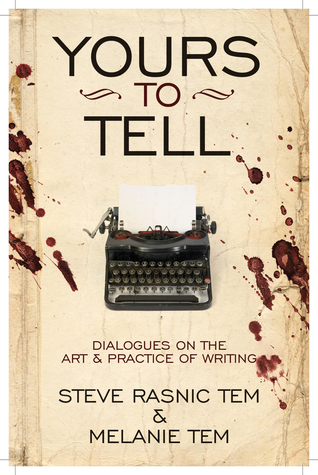
I have finally finished reading Yours to Tell, Dialogues on the Art & Practice of Writing, by Steven Rasnic Tem and Melanie Tem, that I had started back at the end of may, and then had somehow slid down the reading pile, for a number of reasons. I collect writing handbooks, and this one came back to me at the right time to offer some diversion and a different and fresh outlook on what I do. Because sometimes while we can’t write (for whatever reason), we still can read about writing
As the title says, the book is built in the form of a dialogue between the two authors, and it has a very relaxed, informal tone. It is probably not the best choice as a first handbook for the totally uninitiated, but if you’ve tried your hand at writing, you’ll find a lot of interesting insights in this one. While all the classic topics one finds in various writing primers are here, the approach is much more personal, and the book feels like you’re sitting somewhere, having a drink with your writer friends, and they start talking shop – as writers will often do.
The wide range of topics is handled with class and the authors manage to have a very sophisticated approach while keeping the text fresh, accessible and fun.


 Karavansara