The subject of ancient curses is always popular on Karavansara, so why not post another selection.
I did some reading, and found some funny Factoids, so here’s another list.
Turns out the Egyptians (them again!) were liable to swear by their gods in pretty creative ways.
Nephthys (portrayed here on the right), goddess of the netherworld, was sometimes called “female without a vulva”. Thoth was described as “motherless god”.
Even Ra, the sun god himself, is in some papyruses called “an empty prickhead”.
Which is not certainly very modern, if you think about it, but not polite, not polite at all. Continue reading →
The temple of Isis at Philae used to stand guard at the first cataract of the Nile.
With the construction of the Aswan Dam the area was flooded, and later the temple was moved to a new location.
The original Philae is mentioned by numerous ancient writers, including Strabo, Diodorus Siculus, Ptolemy, Seneca, Pliny the Elder. It was, as the plural name indicates, the appellation of two small islands, and the reputed burial place – one of the burial places – of Osiris, and only priests were allowed to live there.
And right now we can take a look at the temple and surrounding buildings in this fine animation.
The approach by water is quite the most beautiful. Seen from the level of a small boat, the island, with its palms, its colonnades, its pylons, seems to rise out of the river like a mirage. Piled rocks frame it on either side, and the purple mountains close up the distance. As the boat glides nearer between glistening boulders, those sculptured towers rise higher and even higher against the sky. They show no sign of ruin or age. All looks solid, stately, perfect. One forgets for the moment that anything is changed. If a sound of antique chanting were to be borne along the quiet air–if a procession of white-robed priests bearing aloft the veiled ark of the God, were to come sweeping round between the palms and pylons–we should not think it strange.
(Amelia Edwards – 1873-1874)
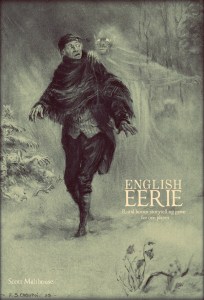
I write a lot about games, these days. English Eerie is a single player roleplaying game written by Scott Malthouse.
Described as a Rural Horror Storytelling Game for One Player, that’s what it does, and it does it quite nicely – using narrative cues to help the player tell a ghostly story in the form of a diary or journal.
Inspired by the works of M.R. James, Algernon Blackwood and Arthur Machen, English Eerie is a writing game – the player is required to build a story, and write it down, based on a set of details presented in a “scenario”, plus random factors represented by playing cards and a die. Continue reading →
This is almost an instant post: I have just closed my first game of Gold & Glory, the new Savage Worlds supplement by my friend Giuseppe Rotondo.
And boy it is a smash.
The idea behind Gold & Glory is quite simple: transform Savage Worlds into a fast, furious and fun version of the old Red Box.
Plug in Giuseppe’s rules, and you’ll be running dungeon crawls like in the good old days in no time, with the added variety of the SW rules. Continue reading →

 The subject of ancient curses is always popular on Karavansara, so why not post another selection.
 I write a lot about games, these days.

