Karavansara

East of Constantinople, West of Shanghai


2 Comments

August surprise

The 15th of August is a big holiday here in Italy, and the country – that is already working at 1/3 power – shuts down completely. Nor even the one bar in the village is open, should one want to go for an ice cream.
But it is not so elsewhere in the world.
And so, while I was about to sit down with the next volume of Yoko Tsuno, trying to keep the heat at bay, I received a mail from the publisher of my book House of the Gods.
They are in Australia, where evidently August 15 is a normal working day, and they were writing to know if I’d like to write “one or two novels” for them to publish.

Are we kidding?

And so I spent the following five evenings working on two one-page pitches, and on the 21st I mailed them off.
The following day I received two contracts.
Nice and smooth (if we except that I was so excited and exhausted I sent them back with the wrong date, and had to resend them).

And I am writing.
The two novels will come out next year (unless I am really fast) and follow two rather different plots. I designed both to serve, in case of success, as first episodes in two separate series.
I’ve told more to my Patrons, and here I’ll reveal only that

  • the first is set in the 90s, and is “Indiana Jones-style, but the hero is Belloq”
  • the second is set in the ’40s and is “Hell in the Pacific meets The Lost World”

And yes, I’ll be writing like hell, but it’s great to find out that my work is good enough and respected enough that publishers ask me for more.
It’s good for the soul.

Leave a comment

An odd plan

I’ve been putting some order in my library.
I was tired of book piling up on chair and on the floor, so I bought a new Billy bookshelf from IKEA, and started filling it up.

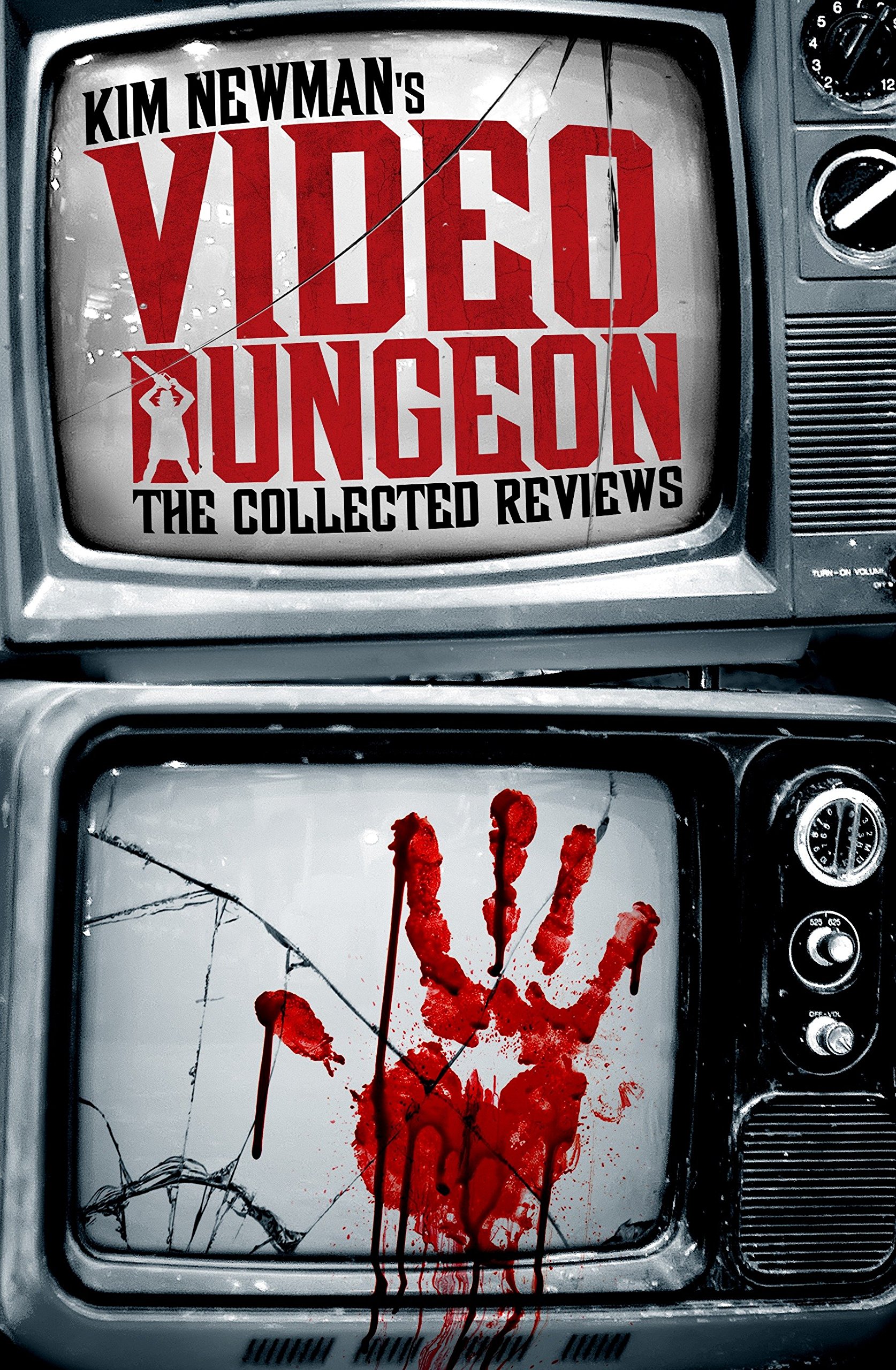
And as I was moving books around, I dug out my copy of Kim Newman’s Video Dungeon, that collects some of the reviews Kim Newman wrote for the video section of Empire Magazine.
And as I browsed it, I realized it includes a (brief, sadly) chapter called High Adventure that features – you guessed it – adventure movies.

And I thought, wouldn’t it be nice to start again my Tits & Sand and Indiana Clones/Raiders of the Lost Franchise posts, using this list to dig up some forgotten movies?
Indeed, I already covered a few in the list (the 1925 version of She, for instance), but many others remain to explore. I might even supplement the list by adding titles from the chapters about Criptids and others.Now all I have to do is find the actual films in streaming, and then I’ll begin.
Watch this space.


Leave a comment

My summer with Yoko #6: The three suns of Vinea

The series now well underway, by issue #6 a pattern has developed, or a rhythm, if you will: the series alternates between more or less science-fiction thrillers based on Earth technology, mystery and events and episodes that focus on the alien Vineans.
And in this re-read, if it was the Vineans that got me hooked, in the long run I find the human-based episodes more satisfying.
Which is a pity, because in episode #6 we are back in Vinea – literally.


The 1976 entry, Les Trois soleils de Vinéa, will be published in English as the eleventh episode, as The three suns of Vinea.

To racap – the Vineans fled their world due to the instability of their star, and founded a colony on Earth, that first fell under the control of a rogue AI, and then was menaced by an authoritarian faction.
Now, the Vineans are going back to their home planet, to check if after millennia it is again capable of sustaining life. Yoke, as usual with Vic and Pol in tow, comes along for the ride.
They find the planet in locked rotation – one side a desert, the other frozen.
There are survivors on the planet, who have rebuilt a rather primitive civilization, and are under the control of a “god” that turns out to be a rogue AI.

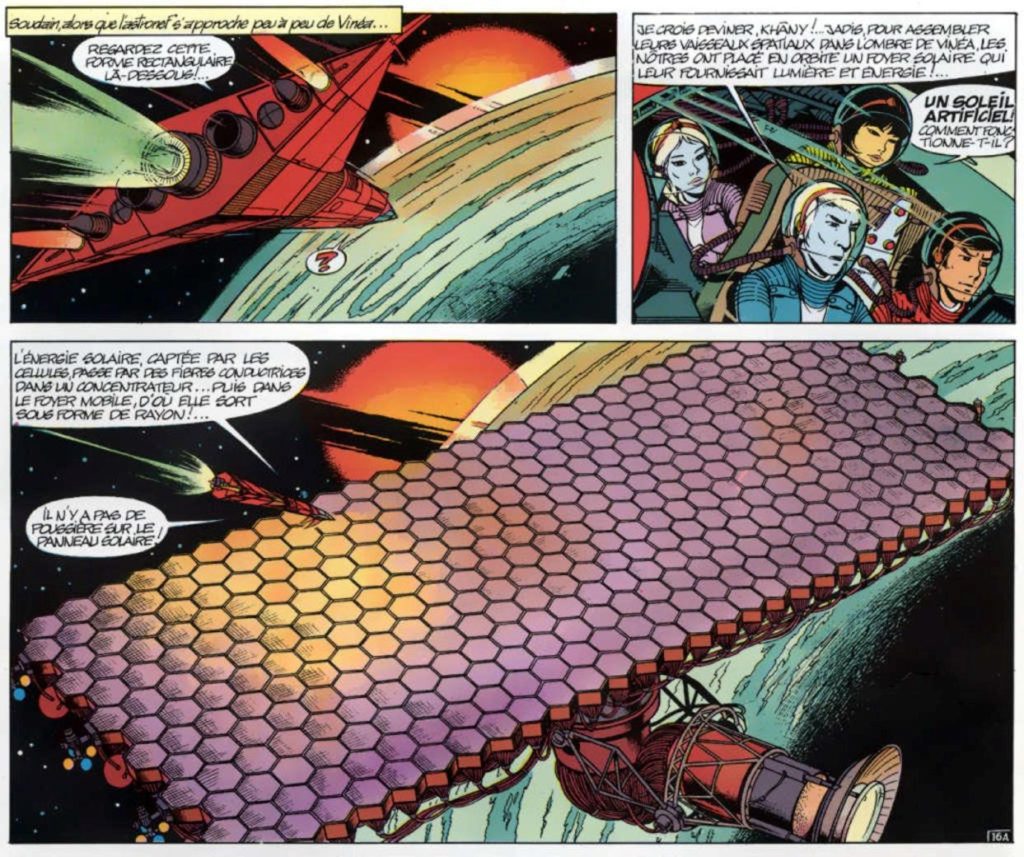
All things considered this is a solid episode, full of technology, and with an abundant serving of astronomical information, in easily digestible bits for the younger readers. It is also a very Star Trek-y episode, with Yoko and her team solving problems with diplomacy and ideas, rather than by zapping the bad guys (although a fair amount of zapping takes place anyway).
As for hardware, we get variants on the Vineans spacecraft, and some nicely designed robots.


For some mysterious reasons, some plates portray Yoko and her Vinean friend Khany in a suggestive way that has contributed through the years to the fan theory that Yoko is bisexual.
And I mean, who can tell?
But I doubt that Roger LeLoup would explicitly go in that direction in a kids comic in the ’70s.
Or would he?


Leave a comment

There’s something dark in Eldritchwood

Soitaire, one-player RPGs have gained popularity in recent years – or maybe it’s just me, growing more sensitive to the subject. I have played a few games of Four Against Darkness, and I have contributed material to the game – and I was pretty curious about Andrea Sfiligoi’s new project, Eldritchwood.
Now I’ve given it a try, and I must say I was not disappointed.


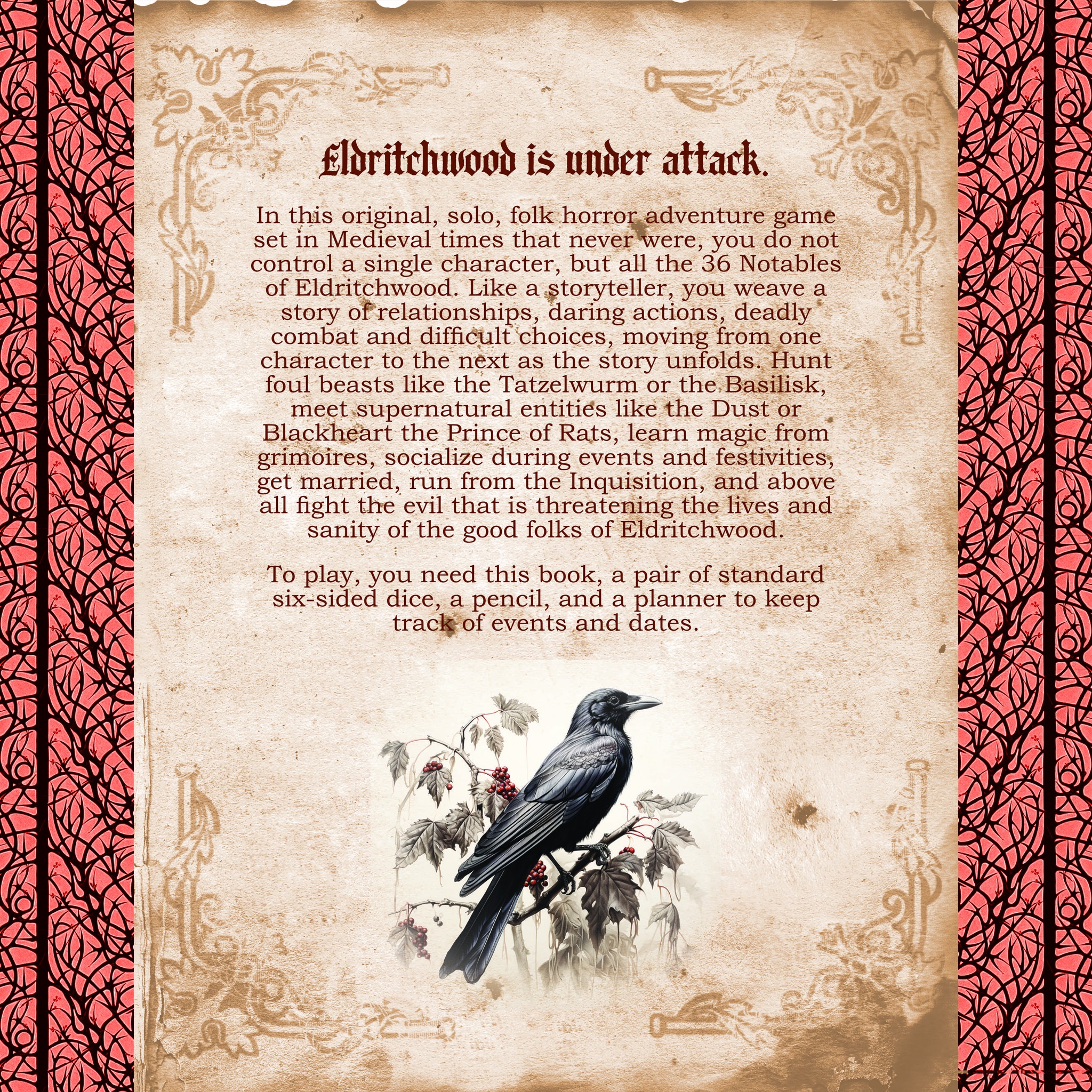
Eldritchwood, by Andrea Sfiligoi and Anna Pashchenko, is a single player (but there are options for collaborative, multy-player gaming) investigative fantasy RPG that takes a novel (to me, at least) approach to solo roleplaying – the player handles a number of characters, alternating point of view during the development of the adventure.


The basic premise is that the peaceful village of Eldritchwood is menaced by one of the numerous supernatural entities that live in the nearby woods. Dark deeds are afoot, and the good villagers have to investigate the occurrences, identify the bad guys, and find a solution.

Drawing a random cast of characters by a pool provided in the handbook, you switch point of view much like in a choral TV series, and face the challenges of a random generated storyline with the help of the various skills of the leads, and two common dice.
With its unusual structure and gameplay, Eldritchwood is the only fantasy RPG apparently designed to play a fantasy like Hope Mirrlees’ Lud-in-the-Mist. I don’t think this is by design, but is the similarities are uncanny.
The game also caters for those that look for a folk horror angle in their games,


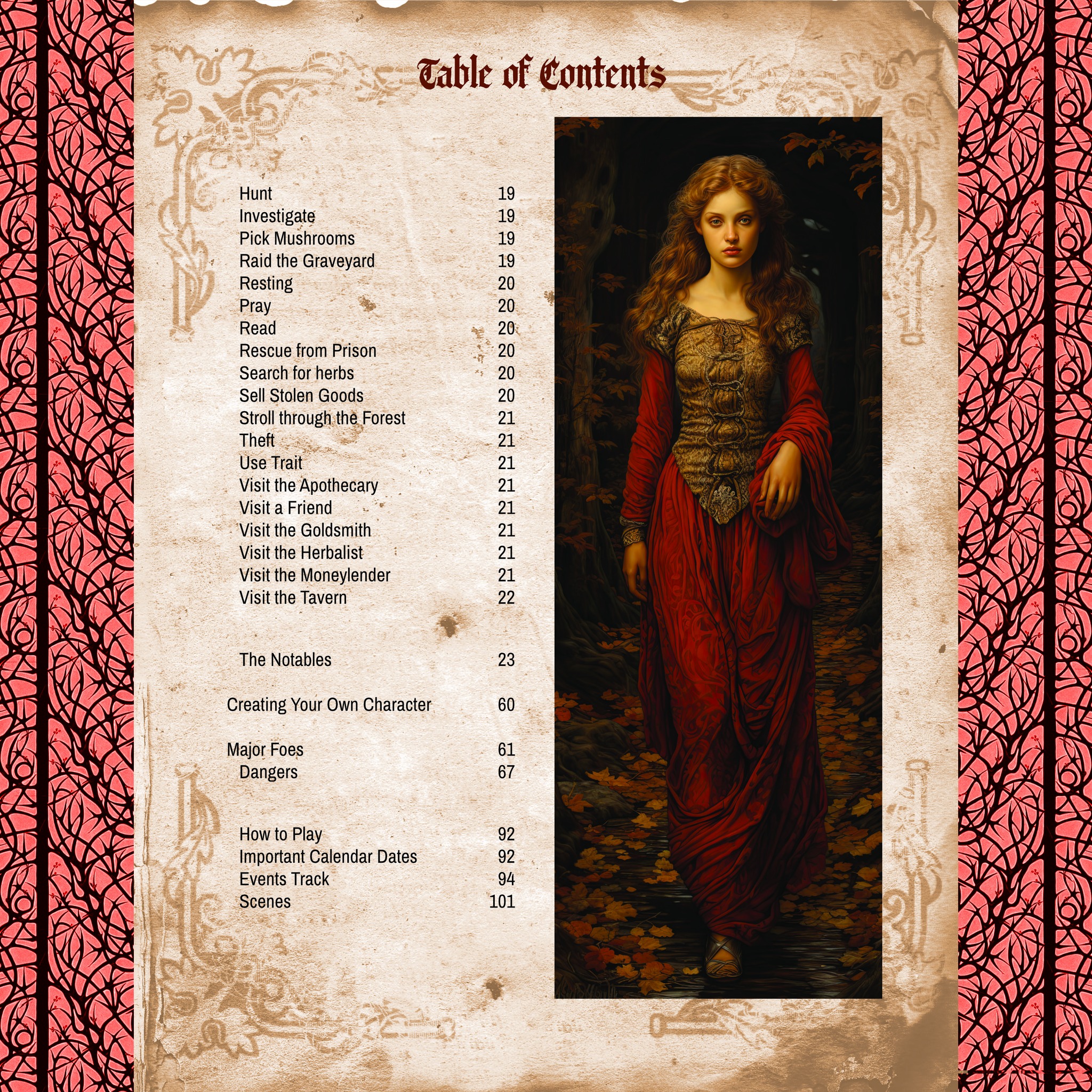
The 109-pages manual includes the 36 pre-generated charecters, the system (including spells) and a cast of bad guys. It is fully illustrated in color, and while I have the PDF version, the paperback does look like a beautiful object.


Leave a comment

My summer with Yoko #5: Message for Eternity

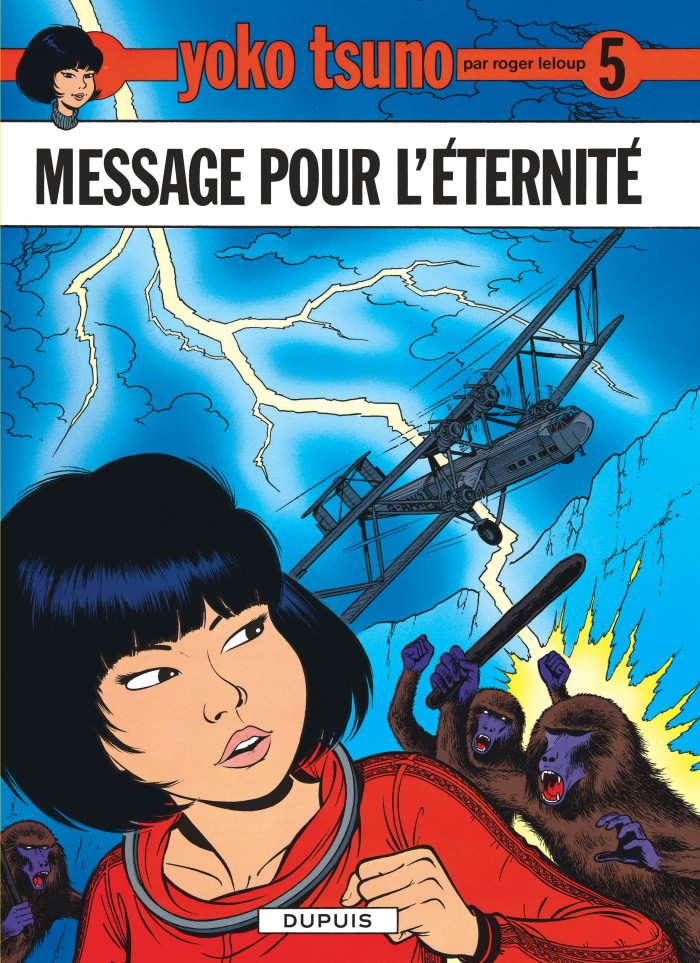
It’s 1975,and the fifth Yoko Tsuno adventure hits the shelves: after the collection of shorts the previous year, it’s again a full 46 page story, called Message pour l’éternité; it will appear as the tenth volume in English, as Message for Eternity.


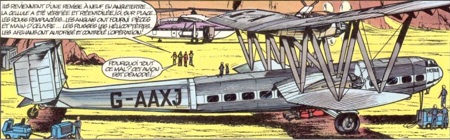
The story is possibly the most tech-oriented so far, and Roger Leloup gives us a whole cotalog of planes, drawn in the most accurate way. We get gliders, helicopters, stratospheric jets, Russian Mig 21…
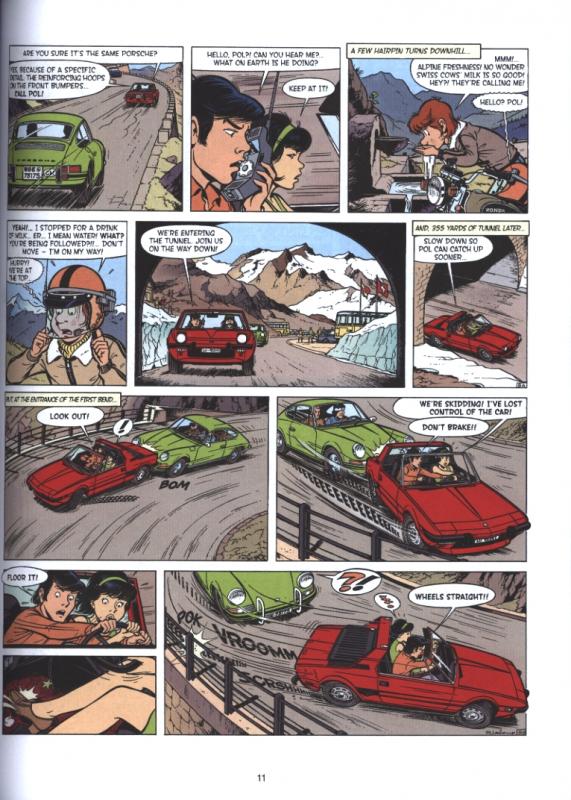
And then a car chase, an international mystery, espionage, intrigue, a “lost world” situation of sorts…

Following a fortuitous landing while flying her glider, Yoko is hired by a mysterious British gentleman: for ten thousand dollars (quite a figure, in ’75), she will fly an experimental glider in a strange crater at the Russian-Afghan border. Apparently this is the site of the crash of a Hadley Heracles plane in the 1930s. The plane was carrying some secret documents, and Yoko will have ti recover them.

But of course there are enemy agents trying to track the wreckage, and once found, the Heracles will turn out to hold more secrets than expected.
Including an army of baboons.
Ne, really, it does make sense.

Once again, the comic has some very verbose expository passages, but by now Yoko and Leloup have found their pace, and the story delivers perfectly.
The tech is spot-on, and quite up-to-date for 1975 – indeed one of the best bits of reading this in the 70s was seeing on the page what we often had just seen in the science & technology segment of the TV news.
The James Bond plot is lightweight (this is still a comic for young teenagers), but it hits all the required plot points.

We also get a better glimpse at the main protagonist. Yoko is stranded in the mysterious crater for the last ten pages, and we get the opportunity to see her resourceful, determined self, as she used the stuff at hand to craft herself a way out.

A joy for kids that in the 70s were into James Bond movies, adventure yarns, and ultra-cool planes and other aircraft. By volume 5, we were all hooked.