There’s a new story coming.
First in a series, hopefully – with two other shorts in the works.
The beta readers just sent in their reports, my editrix did her magic on the text, the cover’s ready, now time for a final re-reading and a check of my sometimes quirky (as in “wrong”) English, and we’ll be all set to go.
The story has a strange genesis.
The main characters, Roman centurion Aculeo and Aegyptian princess Amunet, began their life and their unlikely partnership on my Italian-language blog (strategie evolutive), in a series of posts I did on how to use the web and other resources to try and hoodwink the reader into believing the author does know a lot more about a lot of stuff when he writes some kind of historical fiction.
“Let’s say I’m writing a story about a Roman centurion saving a plucky Egyptian princess from some lovecraftian horror. Let’s start with their names…”
Using Aculeo and Amunet as examples, I built an outline and sketched some characters, throwing in some handy references and a few details; and I did in fact hoodwink my blog readers into believing I knew what I was talking about.
Nice and smooth.
While of limited interest for my English-speaking readers, here’s news worth spreading: starting tomorrow, the 13th of September, at 00 am, Pacific Standard Time (7 am GMT), and for the whole weekend, my pulp-non-fiction ebook, Avventurieri sul Crocevia del Mondo (Italian Edition), will be available for free on Amazon worldwide.
The Free Adventurers Weekend ends on September the 15th, at midnight PST.
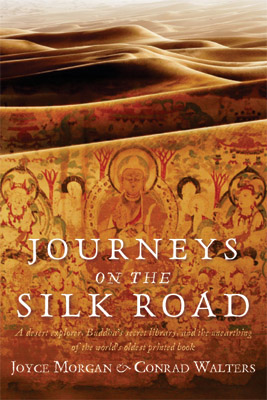
The latest addition to my ever-growing library of books about the Silk Road is Journeys on the Silk Road *, by Joyce Morgan and Conrad Walters.
The book was published in 2012 and was a gift from my brother.
The book focuses on Aurel Stein‘s second Silk Road expedition, between 1906 and 1908.
Following his passion for the history of Central Asia and a series of often unlikely leads, Stein reached the Mogao Caves – also known as the Caves of Thousand Buddhas – in the Taklamakan region, and there he started playing a bargaining game with the local monk, the Daoist Wang.
At the end of a long battle of wits, the monk agreed to part with a few thousand ancient texts, which had been waiting in a cave for eight centuries.
The collection – which Stein acquired somewhat wholesale for 130 sterling pounds – included texts in a number of languages, and on a variety of subjects, from sacred texts to personal letters.
A veritable cross-cut of a multicultural community whose existence had never been suspected by western scholars.
The bundle included the oldest printed book known – a woodblock print copy of the Diamond Sutra, one of the central texts in the Buddhist canon.
Morgan & Walter’s text does therefore shift its attention from the old explorer to the text, outlining its importance for the development of Buddhist culture in Asia, but also its impact on Western culture.
All in all, a book that touches on so many interests of mine, it was impossible for me not to like it a lot – I started and finished it in one day, also thanks a very long train journey.
The volume is highly enjoyable and gives a sympathetic, humane portrait of Stein, a giant of archaeology who’s been somewhat forgotten by the public, and whose activities in Cantral Asia are often portrayed as piracy and plunder, not excavation and research.
The book keeps a balanced view of Stein’s work, while presenting the reader with a character that is, as they say, larger than life.
Filled with anecdotes, quotes from Stein’s diaries, books and letters and a good number of funny bits.
Stein’s companions on the road and his competitors in the race for the Mogao Caves are a gallery of unique characters.
Great reading.
And the book is also supported by a nice and informative website.
————————————————–
* The title “Journeys on the Silk Road”, and variations thereof, must be the most widely used when Central Asian travel and Silk Road exploration are concerned.
Which is not bad – dial it in the Amazon search window, and you’ll find a treasure trove of great reads, and excellent music.
One of the straightforward, instant side-effects of reading Christopher C. Beckwith’s excellent Empires of the Silk Road is, one sort of starts thinking we are all at least a little Indo-Europeans/Euro-Asians in the end.
While the approach might initially seem rambling to the uneducated (such as myself), in the long run the Princeton University Press book builds data upon data, creating a very organic, concise but complete picture of the comings and goings of our Indo-European ancestors in the last… make it ten thousand years.
Now, while I like the later part very much as it provides tons of information which I might use to tighten up the revision of my non-fiction ebook about the Silk Road, I must admit the first chapter, with its catalogue of creation myths, really got me hooked.
There is this very consistent myth, found almost everywhere from China to the Mediterranean and Western Europe, which goes more or less like this… Continue reading →
44.8009288.410531
Just stumbled on this short little free essay about Chinese influence as a hub for the Silk Road and beyond.
I’ll review it soon, but in the meantime…
OK, so this is my blog, here I talk about my passions.
Now, passions are interesting, because once you start along a certain path, once you develop a deep interest in a certain subject, it starts popping up in the weirdest places.
Like this…
In the august of 2004 I was in Florence for the 32nd International Geological Conference.
I had some research to show, some people to meet, it was my first big night on the town.
Held on the hottest days of the year in the most expensive town in Italy, the conference was an unmissable opportunity for a freelance researcher like me – well worth the expenses, and the less-than-confortable hotel room 50 kms from the seat of the conference.
My mother contributed with money from her pension to my trip and participation.
The 32nd IGC in Florence was seen by many as the first big international outing for Chinese geology – and certainly the Chinese presence was impressive.
Among the many show-pieces of the Chinese area at the conference, was a huge geological map of the Himalayas and Transhimalayas, a big colorful map taking up a whole wall. Continue reading →


 , will be available for free on Amazon worldwide.


 Karavansara