A quick, unscheduled post to point out the online translation of the Weilue – “The Peoples of the West”, an overview of the Roman Empire by Chinese scholar, compiled in the third century.
This text was transalted by John E. Hill, and is available through the servers of the university of Washington.
This is the West through Eastern eyes, in the third century.
“The ruler of this country [Rome] is not permanent. When disasters result from unusual phenomena, they unceremoniously replace him, installing a virtuous man as king, and release the old king, who does not dare show resentment.”
… well, sorta.
Considering the title and the topics covered in Karavansara, this link will appear obvious.
This is also part of the documentation for the sword & sorcery stories I’m writing – as I’m planning to move my heroes Eastwards.
Great find, thanks to a link on the Io9 website.
In the years following the huge success of the first Indiana Jones movie, something like a pulp renaissance seemed to be about to sweep the movie halls of the planet.
It never worked out properly, but a number of films actually hit the screens that were plain good fun.
Of the lot, there’s two of them I never tire of re-watching.
Today I think I’ll write about the first.
High Road to China (Photo credit: Wikipedia)
Released two years after Raiders, High Road to China was a strange beast from the start.
Based on a fine novel by an Australian novelist, set along the Silk Road, co-produced by Warner Bros. and by a Hong Kong company, directed by an American and shot in Yugoslavia by an international crew.
The set-up in a nutshell: flapper heiress Eve Tozer has to hire alcoholic pilot Patrick O’Malley to fly her from Istambul to somewhere in China, in order to save her father and/or protect her inheritance. Adventures ensue.
Pretty straightforward – an uncomplicated yarn, and quite enjoyable.
An Hawksian comedy of sorts, with adventure interludes.
It features good flight scenes, a great interpretation by Brian Blessed of tribal chieftain Suleman Khan, there’s an air duel, there’s some warlord-era Chinese action.
And then there’s the chemistry between the characters.
Just my cup of tea.
The 1977 Jon Cleary novel – which is highly recommended, if you can track down a copy – is much more complex, has a more varied cast, and has Eve’s flying circus starting from Paris, not from Istambul.
It is a perfect example of the paradigm of adventure being narrative applied to geography.
But the simplified plot is ok.
There’s a wonderful score by John Barry – which I posted on this blog in its earlier days.
Stars Tom Selleck and Bess Armstrong are more than adequate to their roles, and their endless bickering is believable and delivered with obvious fun – and yes, Bess Armstrong is beautiful.
Sure, director Brian G. Hutton abandoned his directing career after this movie, to become a plumber.
And after previews they had to add scenes featuring Robert Morley as a petulant bad guy.
And everybody considered this film to be a cheap attempt at riding the Raiders’ popularity – but High Road had been in the works since the late ’70s, and should have starred Roger Moore and Jacqueline Bisset, directed by either John Huston or Sidney J. Furie (that one would have been fun to see!)
And it surely failed in the attempt of establishing Tom Selleck as the new Clark Gable.
But despite what-might-have-beens, this is still one of those films I really enjoy whenever I have the opportunity of catching it on the TV (or, when the telly does not cooperate, popping my DVD in the DVD-machine).
This week, something different – the teaser for a documentary on the long forgotten pulp hero, Dr Obsidian!
Judging from the teaser, the the planned documentary will cover both the movie serials and the pulp novels, and will feature commentary from well known luminaries in the field of pulp collecting and pulp writing.
This is really worth a look – and thanks to my friend Story Foru, back at Miskatonic University, for suggesting it!
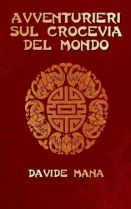
My Italian-language non fiction ebook, Avventurieri sul Crocevia del Mondo, my pulp-history overview of adventurers in Central Asia between the wars, is doing fine on Amazon – good sales, excellent reviews, nice Top 100 position.
But.
But I get lots of requests for graphical contents – maps, photographs of the characters whose stories I’m telling.
It figures.
Now, putting graphical contents in a Kindle book is not that easy – and maybe not even worth the time and the effort, considering that older, cheaper readers (like the one I use) are not that good at displaying images.
Can you really appreciate a map of Central Asia on a 6″ b/w screen?
Old grainy pictures?
Very large, garish paintings?
Also, a graphically-intensive ebook can be huge – and Amazon charges you some extra cents for big files.
And finally, there’s the lengthy (and expensive!) matter of the rights to the images.
And yet, it’s the sort of content that would make my ebook more appealing to the paying public.
So, I did a Pinboard on Pinterest – pinning the maps, and the photos of the historical characters.
As hi-quality as possible, with Italian captions, in the proper order – so that as you read my ebook, you can browse the pinboard and meet the characters.
Not only this free extra web-content allows my readers to finally get a good look at those faces, at their leisure, on the bright, colored display of their device of choice.
It could also work for the undecided – now they can look at the pictures, and decide whether they’d like to purchase the book or not.
And it can be updated.
With the next update of my text, I’ll place a link and a short note at the very beginning of my ebook – and at that point, it should all be nice and fine.
I’ll certainly adopt the same strategy for my next non-fiction book – which, after all, is about Dinosaurs!
You’ve got to have pictures in a dino book!
Today’s video comes complete with a rant.
A very short rant.
I hate those individuals that proudly proclaim their being “Grammar Nazis”.
First – and it’s a purely ideological thing – I find anything, but anything, coupled with “Nazi” and then displayed proudly to be highly offensive.
Secondly, I find these characters’ obsession with grammar, synthax and phrase morphology (whatever that is) a poor excuse for the fact that they are as creative as gnats, but more self-centerd.
And it’s interesting to discover (see link down below) that the term originally referred to those that make mistakes, not those that correct them!
But enough of this.
Here’s a very fun, and highly intelligent video, featuring Stephen Fry‘s voice and opinions (which I undersign fully).





 Karavansara