
Booo!
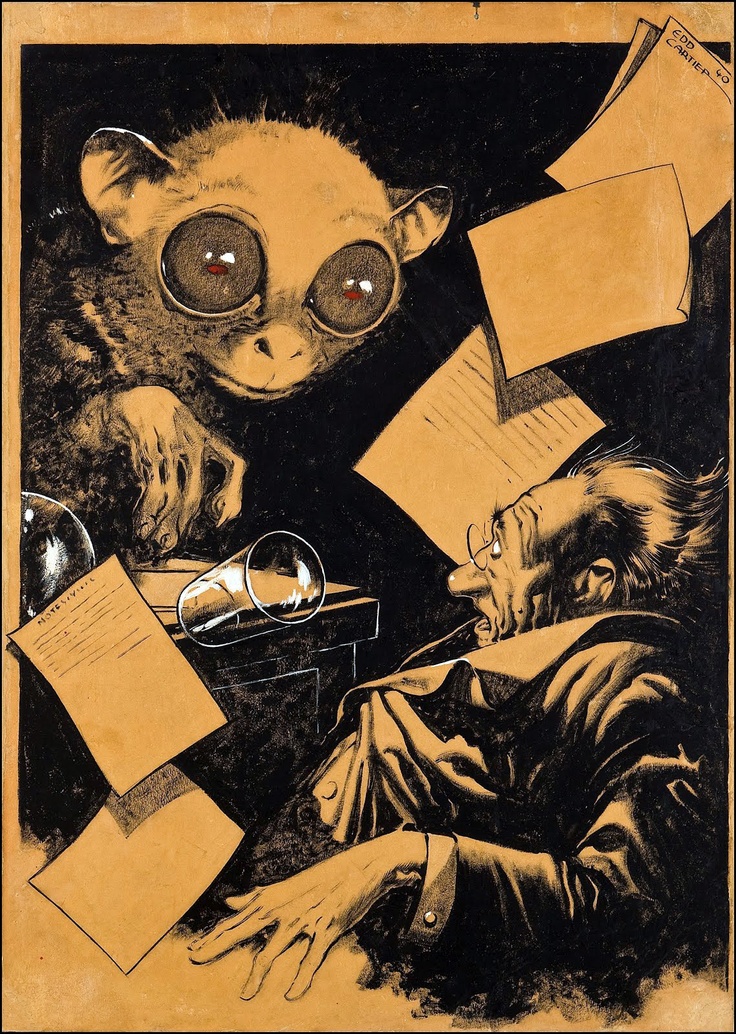
Edd Cartier illustration, circa 1940

Edd Cartier illustration, circa 1940
Good ideas don’t grow on trees.
The good idea behind this post was stolen from author Barry Reese‘s blog.
A top ten of my favorite pulp characters.
Why not?
 I normally say that I came to the pulps in a very circuitous way – but the fact is, I’ve been reading pulps for most of my life (say, the last thirty six years), only I did not know it.
Starting at the age of ten, with Jack Williamson’s The Legion of Space, I read a lot of old SF – stuff that was published in pulp magazines like Astounding, or Amazing. Then, when two or three years later I discovered fantasy (through the books by Lyon Sprague de Camp), I started reading things that came from Unknown and Weird Tales.
And then, of course, there were hard boiled mysteries – Philip Marlowe, Sam Spade…
Pulps.
And the movies and TV, of course – Johnny Weissmuller as Tarzan, Guy Williams as Zorro…
And what about TinTin comics, or Terry and the Pirates?
What I really missed until much later were “proper” hero pulps – The Shadow, The Spider, Doc Savage etc.
I was more of a strange worlds/exotic locales sort of reader.
As a consequence of my reading history, my top ten heroes list is strange.
Maybe.
Therefore, in no particular order…
 . Leigh Brackett’s Eric John Stark
. Edmond Hamilton’s Captain Future
. Norvell Page‘s The Spider
. Robert E. Howard‘s Solomon Kane
. Edgar Rice Burroughs’ Tarzan
. Walter B. Gibson’s The Shadow
. Lester Dent’s Doc Savage
. C.L. Moore’s Northwest Smith
. Dashiell Hammett’s Continental Op
. (various authors) Sexton Blake
Double-feature special mention
. Edgar Rice Burroughs’ John Carter
. Robert E. Howard’s Conan
. Norvell Page’s Wen Tengri aka Prester John
“Is this actually pulp?” special mention
. Russell Thorndike’s Captain Clegg aka Dr Syn
And there’s still a lot of characters I have to read seriously – next on my list is Henry Kuttner’s Thunder Jim Wade.
Such was the amount of solid fiction published by pulp authors, there’s truly a world worth exploring out there.
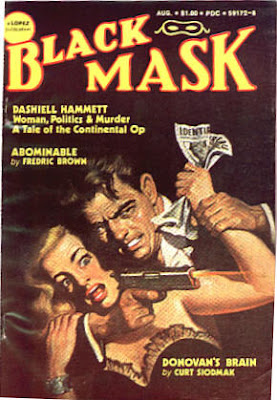
A friend just pointed out this old pulp cover to me, and I had to blog it here.
And Break the Noose Gently is a hell of a title.

Addendum: yes, both my current editors are gorgeous young ladies.
And no, I never though about boxing them and sending them elsewhere.
Just in case someone wondered.
Today something a little different.
An example of how much the Indiana Jones vibe was felt thoughout the media in the early ’80s.
About the song, YMMV – but the video has some fine touches, and nails the Bogart-Ford continuum masterfully.
Enjoy.
Interesting roundup of not-so-popular books.
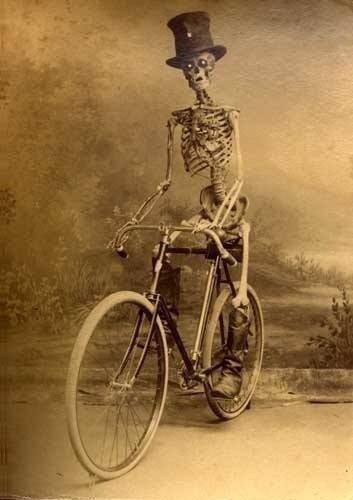
And wearing boots, now that I notice it.
What’s the story here?
It was in 2005, if I remember correctly, and I was on my third congress of the Italian Palaeontological Society.
In the 2005 congress two works were presented – a colleague’s paper on the connection between fossils and mythology, and a poster of mine on the cultural relevance of dinosaurs.
My colleague’s work featured griffins and cyclops, my poster featured Godzilla and Bruce Willis.
We were both severely thrashed, the standard question being “You call this paleontology?”
To which the reply was of course, yes – we were after all discussing ancient remains, deep time, and the perception and interpretation of those remains – but our position was not shared by a large portion of the audience*.
And yet, the idea of Geomythology was emerging in the early 21st century – and the book I’m reading these nights, part for research duties and part for the sheer pleasure of it, was one of the first works on the subject.
It was published in 2000, by Princeton University Press.
 Adrienne Mayor‘s The First Fossil Hunters – Dinosaur, Mammoths, and Myth in Greek and Roman Times (new edition, 2011) is a delightful and higly stimulating read.
The idea that a culture of fossil observation existed in ancient times – not limited to a few philosophers chancing on an old bone – is intriguing, as is the idea of a strong, direct connection between fossils and certain beasts of myth.
The book is filled with illustrations, and offers ample material in support of its central thesis.
And there’s much food for thought (and for fiction!) between its covers.
So I’m reading it both because of my job as a paleontologist (as long as I have one) and as documentation for my writing.
And anything providing a different angle on the perception we have of ancient times, is sure to slip straight on top of my reading list.
This one is highly recommended.
——————————————————
* one year later the situation had changed enough for two members of our hostile audience to publish in the Society’s magazine an article that followed closely my poster (curiously enough forgetting to credit my work in its very short bibliography)


 Karavansara