Karavansara

East of Constantinople, West of Shanghai


Leave a comment

Writing update and future plans

07845kj_23A short report on the state of my writing, in case someone’s interested.

The final revision of the definitive edition of my Italian-language, non-fiction, “pulp history” book Il Crocevia del Mondo (Crossroads of the World) is done.
Now I’m reading handbooks and websites to learn how to go about putting the thing up on the Kindle Store.
Once it’s done, I’ll be curious to see how it fares.
Hopefully, I’ll arrange for the publishing in July, and for a blog tour promoting it in september.

My Corsair project, about a pulp adventurer at play in the Mediterranean between the wars has just shifted and mutated into something a bit later – say set in the early 60s – but still with the same set-up and the same cast.
A tentative story (working title The Girl from Uncle) is under way – I promised it to my friend Chiara (who’s an UNCLE fan and suggested the story’s opening), so I can’t let it lay for long.
ETA for the Girl is august.

There might be an Italian-language story coming – even tho’ I said I will not write fiction in Italian anymore – should the Alia project take wing again.
The original idea was doing a space opera-themed anthology, but already I heard stuff about stories involving elven warrior-princesses, so maybe the space opera angle is gone.
Pity.
The deadline is september – I’ll have to dream up something.

I’m also grappling with a naughty story for an adult market, but that’s a hush-hush thing, so no more details.
But it’s really a learning experience – they say write what’s unfamiliar and does not make you feel at ease, well, in this case I nailed it.

And finally something burst trough my neocortex two days ago, and is currently haunting me and my keyboard – once again a pulpish thing, an attempt at playing my own take on the mystical adventurer clichĂ©.
Something borrowing from both Indiana Jones and The Shadow – taking what I consider the best bits from the characters, and trying to find a balance.
H.P. Lovecraft’s spirit is also hovering by as I write.
I blame my recent readings for this unespected but so far highly satisfactory writing bout – the first 300 words screamed out of my fingers and onto the screen, and they kick some butt, if I say so myself. The rest is a little more tricky, but when one starts so good, it’s a crime dropping the story.
I’ll probably post more about this, as writing what’s bugging me helps me solve the bugging bits – and I may as well do it in public.
I’ve no ETA for this one, but I’d love to try and making it available through the web at a popular fee (say 99 eurocents).

And the as yet undisclosed translation project is still going – as you can see from the meter here on the right.
It’s tough going, but it’s a fun project.

And this is it, I guess.
More news as stuff happens.
Cheers!


4 Comments

Lazarus Gray and my weekend plans

laz3coverMy plans for the weekend (including the updating of this blog) went belly up when Pro Se Press released, early this week, the third volume in Barry Reese‘s The Adventures of Lazarus Gray series.
As soon as I was aware of the book’s availability, I grabbed myself a copy (ebooks are just great – they are cheap and there’s no waiting for the postman!) and shelved every other project for a while.
The fun bit being, after all I can file the hours spent reading this baby as “research” (but more on that later).

For the uninitiated, Lazarus Gray is the central character in Barry Reese’s series of pulp stories set in Sovereign City in the 1930s, and featuring crime-busting, evil-thwarting team, Assistance Unlimited.
An obvious, heartfelt homage to such Lester Dent classics as Doc Savage and The Avenger, Lazarus Gray is a man of mystery and action – his past gone, he swears to bring justice to the city, and assistance to anyone in need.
And so he does.

The Lazarus Gray stories feature all the classic pulp elements – the stalwart, omnicompetent hero, his varied team of quirky assistants, a choice of villains, thrilling locations, superscience, ancient mysteries, the supernatural…
In a proper new pulp twist, Mr Reese approaches his materials with a modern sensibility, sidestepping the trap of political correctedness by providing us with a fresh, modern, intelligent take on “delicate” issues such as gender, race, politics.
This is pulp like in the days of old, but without the outdated and unpleasent biases of our grandfathers.

The third book picks up where the earlier entry in the series (Die Glocke) left off, and shows us that the universe in which the characters move is still evolving – there’s big changes in the air, there’s lots of stuff happening, old enemies are back in the game, new enemies are in, too.
The author’s willingness to let his characters grow, change and mutate is another element of fun and interest in the series. There is a dynamic quality, in Sovereign City and its denizens, that keeps the reader’s attention up.

This is new pulp as it’s meant to be, and to me, the Lazarus Gray stories are an almost perfect template of how it’s done – they are complex, tightly-plotted, hard-hitting, fun.
There’s a lot to learn, here, for someone trying to crack the genre.
That’s why I file ’em not as entertainment, but as research.

The ebook edition of the third volume in the series – which goes by the title of Eidolon, but let’s not spoil the fun by revealing more – also includes a short, gorgeous comic and a selection of black and white illustrations.
Not bad, for something like 3 euros.

Defects?
There’s too little of it – the Lazarus Gray stories are a fast, fun read, and the new book’s over way too soon.

All in all, a highly entertaining, intelligent, stimulating read.
The whole series is highly recommended.


3 Comments

O’Neill’s Scheherazade

n320056I’ve a thing for the Arabian Nights.
I’ve collected different editions, read essays on the subject, discussed it with friends until I scared them off or bored them to death.
So yes, now it’s your turn.

As one of the founding texts of fantasy, the Arabian Nights have been to me a source of endless discovery and fascination.

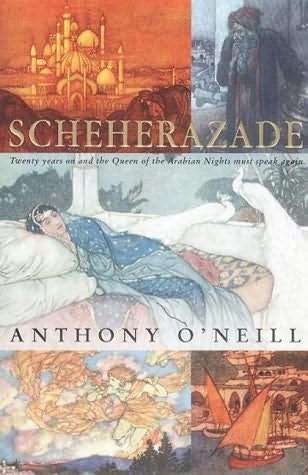
Now, I’ve found another piece of this personal puzzle of mine in Anthony O’Neill’s Scheherazade, a novel published in 2002 which is a sequel of sorts to the classic tales.
And much more.

The cover blurb says it all

It is nearly twenty years since Scheherazade spun her tales for a thousand and one nights; the tales that saved her life and immortalised the city that she had never seen — until now. Scheherazade and her husband, King Shahriyar, arrive in Baghdad to a rapturous welcome from the Caliph and his people, but within hours the Queen is kidnapped from her bathhouse, and disappears. An ancient prophecy leads the Caliph to despatch a motley crew of sailors on a rescue mission. As the seven unlikely saviours venture deeper into the unforgiving desert, losing camels, supplies, and all sense of direction, Scheherazade must face her abductors alone. And once again she begins to spin a tale to save her life…

But it’s much more complicated than that – and therefore, to me, much more satisfactory.

Scheherazade is not just a fantasy and an adventure story, and it’s more than a literate and literary game.
It’s a book about how stories change not only those that read or listen to them, but also those that tell or write them – which is a subject very dear to me in this moment.
By being writers, by being storytellers, we write ourselves, we narrate our own existance.
And by doing so, we can make ourselves better – or let our stories make us different.
Anthony O’Neill’s book brings that idea to its extreme consequences – and it is both a fantasy and a historical novel, a comedy and a tragedy, a phylosophical novel and a sexy romp, a tale of friendship, betraial and sailors away from the sea.

Scheherazade is a good, complex read, filled with characters and stories.
It starts low and grows slowly, but there’s nothing out of place in its pages.

A novel I’ll have to re-read once in a while, as it does promise new discoveries.

PS – I have to thank my friend Marco Siena, of Vanishing in the Mist, for suggesting me this great book in the first place.
Grazie, Marco!


Leave a comment

Some of my non fiction

It’s the hard life of the indie writer.
Or something like that.
You write your stuff, you get it to the editor, the ditor likes it.
The publisher publishes it, the people buy it and like it.
You get your copies for your swank shelf, you tell your friends (they do not buy a copy), and then start working on something else, on something new.
And in the meantime, people forget.
“But… did he ever actually publish anything?”
Some like to forget, they are very happy to forget.

Two nights ago, I received a sound thrashing from friend.
I was told to strut my stuff, because it’s worth it.
Or so she said.

So, never ignore a sound advice, delivered with passion: here’s three of the works of which I am more proud!

It was a pleasure and a privilege, as a long time Fritz Leiber fan, to be part of Fritz Leiber: Critical Essays, edited by Benjamin Szumskyj and published by MacFarland.
Taking an eccentric angle, I wrote Thank God They Are on Our Side (I think): The Cat as Alien in Fritz Leiber’s Fiction, which mixes literary analysis, cat ecology, and my veneration for Leiber’s genius, and mixes the lot.

One year later, with the same editor and the same publisher, I was part of the volume Dissecting Hannibal Lecter: Essays on the Novels of Thomas Harris. Once again it was a great, fun experience, and I contributed apiece on the noir aspects of one of Harris’ classics – This is the Blind Leading the Blind: Noir, Horror and Reality in Thomas Harris’ Red Dragon.

The ball was rolling, so when Benjamin proposed a third contribution, I was happy to join his team once again – this time writing about an author, William Peter Blatty, whose work has been to long in the shadow of the movies based on it. And as a ghost-story aficionado, it was great fun writing It Ain’t Over Until the Fat Lady Sings: William Peter Blatty’s Elswhere and the Haunted House Formula.
The essay appears in American Exorcist: Critical Essays on William Peter Blatty

So here they are, my early professional sales as a non-fiction writer.
I can strut my stuff with the best of ’em!


Leave a comment

Ghost Ships

61PY+t3T-+L._BO2,204,203,200_PIsitb-sticker-arrow-click,TopRight,35,-76_AA278_PIkin4,BottomRight,-57,22_AA300_SH20_OU01_A quick post that will have a limited interest for my English-speaking readers, but which is very close to my heart.
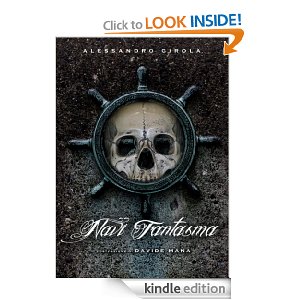
My good friend Alessandro Girola has made available through the Amazon Kindle store his volume Navi Fantasma (Ghosts Ships) – a collection of short essays on some of the most interesting mysteries of the sea.
Cursed vessels, haunted ships, mysterious disappearances…
Alex was so kind, he asked me to provide an extra essay as an afterword.
It was fun.

I repeat, the ebook is in Italian, and is a fast, interesting read.

Navi Fantasma in Kindle marks the next step in the development of a small little project we set up long ago as a lark.

More mystery/pulp/adventure related essays will be published.
Hopefully in English, too.


3 Comments >

10000 visitasA very quick post to thank you all.
Karavansarra just passed the 10.000 hits mark – not bad for a small scale, eccentric blog talking about writing, the East and pulp fiction.

I’m having lots of fun, writing this blog.
I hope you have at least as much fun reading it.

Thank you again.


6 Comments

Finding an alias

secret-identity_designI’m not particularly hot about pen names.
I happen to like the name my father and my mother gave me – and I like to have my achievements marked with my name.

On the other hand, while the vast majority of my colleagues in academia tend to find my activity as a fiction and gaming author perfectly all right, a few sometimes make a face at the idea.

How can you reconcile your work as a scientist and the fact that you write stories about little green men?

Now, disocunting the facts that
a . finding work as a scientist is getting harder by the hour
b . I never wrote a story about little green men

Discounting this, I was saying, I normally reply that I like to think about my readers as smart enough to tell scientific papers from fantasies.
If nothing else, scientific papers tend not to have weapons and monsters in them.
Usually.
But anyway, it can get hawkward.

Also, should things get really going, an author might need a number of alternate identities in order to place his or her stories on a variety of different markets at the same time – or on the same market!
Henry Kuttner used at least 21 pseudonyms, often appearing with more than one story in the same magazine, under different names.

name-tagSo, what if I wanted to find me a pen name?
Is it enough to open the phone directory at random two or three times, jotting down and mixing&matching first and last names?
Well, not exactly.

First, the author’s name on the cover influences the voice in which the reader perceives the narrative.
That’s why romance stories are usually presented as written by female authors – the female “voice” ringing in the reader’s head is considered more or less a given.

Which makes me wonder – is there a connection between the default “voice” of science fiction and fantasy and the fact that a lot of authors go by their initials?
H.P. Lovecraft. E.R. Burroughs, C.L. Moore, J.R.R. Tolkien, George R.R. Martin, C.J. Cherry…

Second, the name should fit the genre.
Sometimes it’s clear it’s a pen name, so why not use it to reinforce the product?
P.J. Storm does not write the same genre as Mary Walker.

And as we are at it, and we design our pen name as part of our marketing strategy – let’s check if the name’s already in use on the web.
can we use it as part of our email address, of our website URL, of our Twitter or Facebook account?
Will our alter ego be the first to pop up in a Google search?

All of this, plus the fact that we want our alias to be easy to remember, hard to get wrong (ever thought about what it means to be called J. Michael Straczynski, in terms of typos and bad searches?), and fast to sign (who knows, we may make it big with our stories, and find ourselves at conventions signing huge piles of books for the fans*.)

Finally, we should decide if our pen name will be just that – a name – or if we need to create a full alternate character, with a bio, a photo, the works.
This, again, might be part of our marketing strategy.
We are selling not just the story, but the author.

All of which means, it’s a lot of work.
But – with a little luck – I’ll be doing it soon.
If a certain story sells.

—————————

* As Blondie used to sing, dreaming is free.