Karavansara

East of Constantinople, West of Shanghai


5 Comments

Author-Publisher, please

This is an impromptu post.
Chuck Wendig just posted another fine piece about… authors that publish their own stuff.
About the name you slap on such individuals.
Something I’m interested in, as I’m one of those that get slapped.

Let’s see.
The most common labels are:

. self-published author
. independent author
. self-produced author

copierLet’s admit it – they do suck.
At best, they aremisleading.
In my language, the label is usually (autore) Autopubblicato – and it reads as a mark of infamy.
It means, more or less, “you sucker, a real publisher would not touch your rubbish with a ten foot pole”.
And in my case might as well be correct – I’ve this thing which seems to ruffle the feathers of most publishers.

Incidentally – I do prefer author to writer, because it describes more precisely who I am.
A writer could be writing under dictation.
He could be a graffiti artist.
I’m an author.

Or, here’s another definition which is quite fun, content crafter.
Which is fine when I’m authoring stuff that’s not orthodox book- stuff – online articles, blog posts, slide text, infographics, etcetera.
Beats any day of the week the horrid web-writer so many people seem to enjoy (so much so there’s people out there actually selling “professional web-writer” certifications, these days!)

When it comes to publishing my stuff, anyway, the standard labels suck, but there are two other definitions I like much better.

The first is artisanal publisher, coined by Guy Kawasaki and Shawn Welsh in his excellent APE: Author, Publisher, Entrepreneur-How to Publish a Book.
I’ve been using that a lot – it removes the stigma of the guy working in his basement with an old HP printer and adds a touch of highly marketable mistique.

The second, which was recently proposed by Chuck Wendig, is author-publisher.
Which, and I have to agree with the man, sounds just like a multi-class character in a role playing game – like wizard-rogue, which I have played once in a while in my long gaming career.
And is mighty fine.
Sounds great.
It’s classy.

So here we go – from this moment on, I am Davide Mana, author-publisher.
I’m into artisanal publishing, actually.


5 Comments

Back to the Gold Monkey

Tales of the Gold Monkey

Tales of the Gold Monkey (Photo credit: Wikipedia)

As I said already, we’ve got very little pulp on the telly, these days.
So I went back to the old DVD collection, and dusted off my copy of Tales of the Gold Monkey.

For those who missed it, Tales of the Gold Monkey was a short-lived series, produced in 1982 (yes, thirty years ago) by Donald P. Bellisario, of Magnum P.I., Quantum Leap and JAG (among others) fame.

The show features a lot of stuff – this is somewhat a standard in pulp-themed material, and as I mentioned before, it is not really a bad thing.
But more on that later.

The set-up: we’re somewhere in the late 1930s on the island of Bora Gora, out in the Pacific. Here, former Flying Tiger Jack Cutter (Stephen Collins) is a bush pilot and all-around adventurer, trying to make ends meet.
In the pilot episode, he gets to save a plucky USA OSS agent (Caitlin O’Heaney), and recover a golden idol from an island inhabited by aggressive big apes and neolithic natives.
Nice and smooth.
The mix also includes Jack’s alcoholic mechanic, his one-eyed dog, a French guy managing a bar in the jungle, a false priest that’s actually a Nazi and a bad & sexy (well, bad & sexy for 1980s TV standards) Dragon Lady with a samurai for a bodyguard.

Quite a nice set-up, all things considered.
And one that was refreshingly different, in 1982 – and yet also familiar… as in Indiana Jones-style familiar.

Continue reading


Leave a comment

On my (old) radio – A Pail of Air

It’s nice listening to old time radio on a sunday.

So here’s another masterpiece – Fritz Leiber’s A Pail of Air, from X Minus One, a series that often adapted and broadcast stories from Horace Gold‘s mag, Galaxy.

The show was recorded in 1956.
Enjoy!


Leave a comment

Writing for a solid target

Targets are important.
Important in general, and important when you are writing.
The basic target for a writer is finishing the damn story, of course*.
But there are other targets – word counts, word per day, are classics.
And then, paying the bills is another extremely good target – highly motivational.

LONCON3_logo_270wRight now, I’m setting myself a new target – an important one, one for which I feel strongly.
I plan to write and publish enough stories (mostly in English) and non-fiction (mostly in Italian), so that I can put together enough money to go to London in August 2014, and meet my friends for the 2014 WorldCon, also known as Loncon 3.
I have less than 12 months, but I will make it.

I was supposed to go to the Worldcon in Japan, in 2009, but the sudden death of my mother forced me to change my plans.
And this year I had planned a trip to Texas for the 2013 Worldcon – but unfinished business with my university, the horrid state of my country’s finance and the worse state of my own finances forced me to drop that idea too.

Now, I want to go to Loncon 3.
And I think it would be just great to pay for the trip with my writing.

It’s a big target, and one that is very dear to my heart.
But I’ll put everything in to make it.
And now it’s public, I can’t back down.

—————————–
*There’s two kind of writers: those that finish the story, and those that do not.


5 Comments

Self-publishing according to Chuck Wendig

Author and writing guru Chuck Wendig posted on his blog a good, intelligent, fun list of points to keep in mind when taking the self-publishing path.

Being self-published in this day and age is no longer the albatross around your neck it regrettably was — once, if you told people you were self-published, they’d look at you like you were a smelly old jobless hobo just come off a dusty boxcar with soupcan shoes and a hat made from a coyote skull. Though sometimes even still you get that look, as if the person listening is thinking, oh, you’re one of THOSE.

Called 25 Steps to Becoming a Self-Published Author, it is highly recommended, and I’m posting the link here for future reference.


Leave a comment

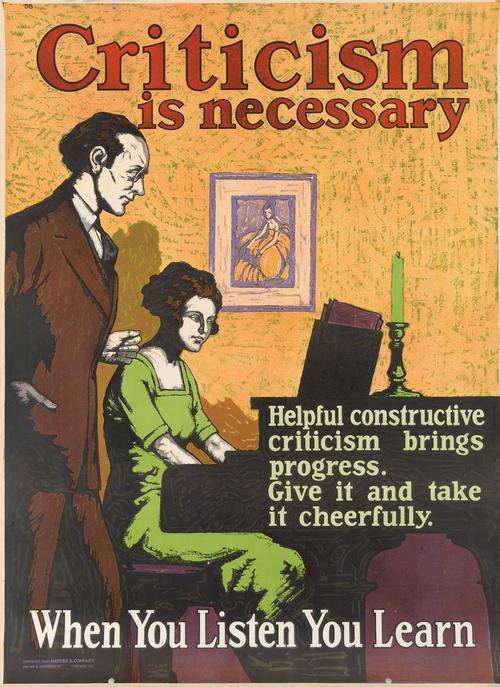
Give it and take it cheerfully

A friend of mine posted this on Facebook, and I liked it so much I decided to post it here as a reminder.
It’s from the 1920s, a time in which criticism was not a form of aggression through the web.

1239422_510480492371844_1873372067_n

Yesterday I was asking about helping my fans lose their shyness.
Now I’d also like to point out that criticism – public or private, in the form of a review posted somewhere or a direct message to the author – is what keeps writers going, and what helps them improving.
Give it and take it cheerfully.