
 Some things start just like that…
Despite my very busy schedule, I’m going to try and track me down a copy of The Perils of Pauline, the 1914 serial featuring Pearl White (I guess that was not her true name1).
Fact is, you see, I’ve been told in detail how movie serials were a phenomenon in ’40s and ’50s American cinema, by yet another expert that apparently failed to check out Wikipedia to get the full story.
I heard that and thought… but what of Pauline?2
Extremes under the rain
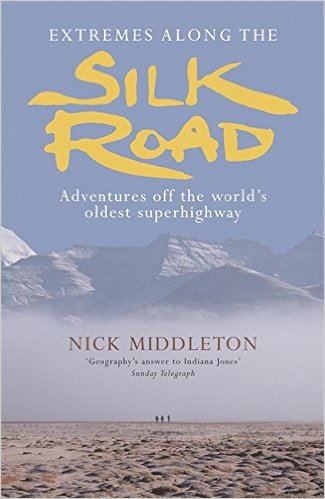 Yesterday the postman delivered a nice hardback copy of Nick Middleton’s Extremes along the Silk Road, thus stopping a gaping hole in my collection of Silk Road-themed books. The volume details Middleton’s expedition from China to Istanbul following the classic routes through Central Asia.
The book had been on my to-read list forever, but so far I always had something more urgent to add to the collection. Then I spotted this copy, and it was a wonderful bargain and a nice catch: a used book I paid about five bucks, and in pristine condition.
Or rather I should say, it was in pristine conditions.
You see, I was not at home when the postman came, and he decided to slip the book package between the bars of my courtyard’s gate.
It’s now three days that it rains heavily.
Yesterday I was out for various errands, and I came back home around 8 p.m.: the packet remained under heavy rain for about ten hours.
The effect was the same as leaving it under an open faucet for the best part of the day.
So now I have a water-damaged, second-hand copy of Nick Middleton’s Extremes along the Silk Road.
A little warped, but still readable. Which is more that I can say of the gas bill that was left together with the book, and that spent the night drying on the stove.
I’ll let you know about the book. Just give it time to dry.
The Leica III
Both Fleming and Maillart carry a Leika camera.
Based on the writings of Peter Fleming, the camera has been identified as a Leica III (also known as a Leika F), a model produced between 1933 and 1939.

It has been argued that Maillart (that carried two cameras) had discovered the Leica – a very advanced camera, for the time – through her photographer friend (and possibli lover) Annemarie Schwarzenbach, and had later suggested the same model to Fleming1. Continue reading
The train leaves at midnight
And so it begins.
On the night of the 16th of February 1935, Peter Fleming and Ella “Kini” Maillart leave Peking in the company of the Smigunov, Stepan and Nina, two Russians that will act as guides and interpreters for a part of the trip.
Both Fleming and Maillart are journalists, and they both want to see what’s goin on in Sinkiang, or Chinese Turkistan, a region that was last visited almost ten years before by Owen Lattimore and has been sinking in civil war and chaos ever since.
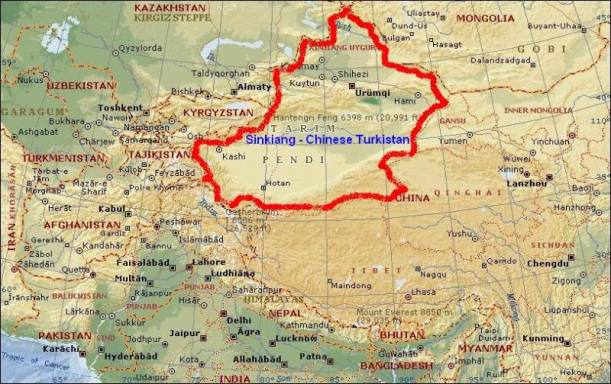
Their plan is to travel from Peking to British India, following a southern route through Western China – the hardest route, but also, they hope, the least guarded.
The two journalists are officially going to Koku Nor to shoot some game. They are traveling light1, and they are not exactly friends.
Or are they? Continue reading
Trail Provisions
So apart from old clothes, a few books, two compasses and two portable typewriters, we took with us from Peking only the following supplies: 2lb. of marmalade, 4 tins of cocoa, 6 bottles of brandy, 1 bottle of Worcester sauce, 1 lb. of coffee, 3 small packets of chocolate, some soap, and a good deal of tobacco…
Ready to go?1
- Ella Maillart adds pasta, curry, mustard and porridge to the list. ↩
How to be a pulp hero on the cheap
Back in the old days, when heroes were an everyday occurrence on the pulps, Doc Savage Magazine published a series of articles on the minimal physical exercise you needed to become like Doc himself.
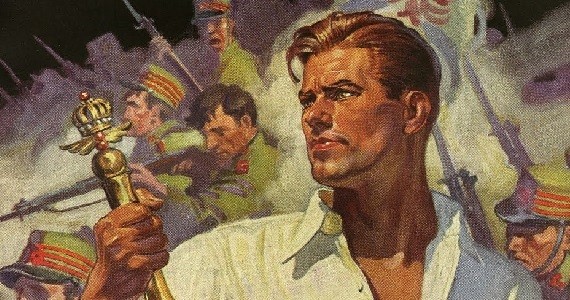
In 23 installments, between 1935 and 1937, the Doc Savage Method of Self Development offered readers young and old a variety of physical exercises, but also an introduction to speed reading, to practices akin to what we’d refer today to as “mindfulness” and “cold reading”, plus other techniques of mental discipline and observation, the lot together with a moral and ethical set of guidelines.
Later, in 1938, came the Doc Savage self-defence course.
Times have changed, but the question is intriguing: can we define a curriculum, a training path, that anyone of us could follow to become a pulp hero? Continue reading
 Karavansara