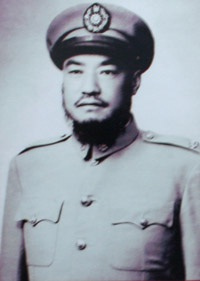
 While stranded in Sinin, Peter Fleming and Ella Maillart try to meet governor Ma Bufang (or Ma Bu-Fang in Fleming’s book), as they seek official authorization to proceed along their route.
We already know from his Ma that the man is a Muslim (Ma being the shortening of “Muhammad”), and a member of the powerful “Ma Clique”.
Members of the Ma extended family/clan had been de facto governors of northwestern China under the Qing dynasty and had become warlords between 1918 and 1928, holding sway in the provinces of Qinghai, Gansu and Ningxia.
The Ma Clique was composed of three families, so that they were often known as Xibei San Ma, as to say, the Three Ma of the Northwest.
At the time of Peter and Ella’s travel, the three families were led by Ma Hongbin, Ma Hongkui and Ma Bufang.
Due to various misadventures, Peter and Ella will never meet Ma Bufang
who is by all accounts a tough and energetic autocrat.
Indeed, Ma Bufang demonstrated by his actions his skill, toughness and political ability to shift from one role to the other.
Ma Bufang had trained as an imam – his brother Ma Buqing being the one destined to a military career – but at the age of nineteen he joined the troops.
Rising to prominence through a series of feuds and backstabbings, Ma Bufang demonstrated his battle prowness and ruthlessness in 1932, participating iun the defeat of the Tibetan troops as they tried to invade and take control of the Qinghai province.
Later, sponsored by the Kuomintang, Ma Bufang led seven extermination campaigns against the Ngolok tribes – traditionally considered a people whose only activity was banditry, and were supposedly aligned with the Communist party. Ma Bufang’s actions against the Ngolok have all the markings of an ethnic/religious genocide.
In 1937, Ma Bufang refused to side with the Japanese army, and in fact later fought against the Japanese in the early 1940s.
From a strictly political point of view, Ma Bufang was what might be called an illuminated tyrant – promoting reforestation, granting extended rights to women.
Boasting an army of 50.000 elite fighters (belonging to various northwestern ethnicities), Ma Bufang held his position as governor of the northwest during the Chinese revolution and only in 1949 he was forced to leave China and relocate to Saudi Arabia.
Ma Bufang was also close to the Panchen Lama, a character that we – together with Peter and Ella – will meet in a while.
But as things stand now, it looks like the long stay in Sining is about to end, and the road beckons.

 According to his obituary