I am back online, having scrapped one PC and set up a new one – with the usual corollary of backups, lost passwords and money I would have rather not spent.
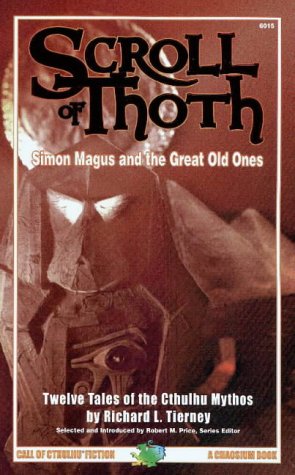
And while I was offline, working on my system, I received the news of the passing of author Richard L. Tierney, at the age of 86. I had discovered Tierney with a book by Fedogan & Bremmer called The House of the Toad – a solid entry in the Cthulhu Mythos catalogue. If that book was what put Tierney on my radar, it was the collection The Scroll of Thoth that turned me into a fan – because in Tierney’s stories about Simon of Gitta I found everything I liked in my sword & sorcery: a historical setting, a cast of intriguing characters, a modicum of Yog-Sothotheries, and a first class style of writing. What else could anyone ask?
Indeed, I usually mention the stories in that old Chaosium anthology as one of the main influences on my own sword & sorcery stories.
Through the years, Tierney became one of those writers whose work I was always on the lookout for, but that seemed to appear only in small press/limited editions, hard to find volumes.
In the last two years, the reprinting of the Simon of Gitta stories in the volume Sorcery against Caesar, and of the massive novel Drums of Chaos had been a welcome opportunity to spread the knowledge of this writer, by giving away ebooks as gifts to my friends.
Richard L. Tierney’s passing hit me like the loss of a loved uncle, the sort that you see only occasionally, but whose appearance is always a welcome occasion. He will be sorely missed.
I’ve just got my contributor copy of The Nefarious Villains of Sherlock Holmes, edited by David Marcum for Belanger Books. The volume includes my story “The Tiger and the Bear”, featuring Sebastian Moran.
As for the photo, I can quote the late Leonard Cohen and point out “I don’t usually look this good, or this bad (depending on your politics)”.
Queens walk in the dusk Thomas Burnett Swann, 1977
What an unusual book!
Thomas Burnett Swann was a critic, a poet and a writer of fantasy. He used classic mythology and history in his stories, and Queen walks in the dusk, while the first of the Latium Trilogy dealing with the origin of Rome, was in fact is last book, published posthumously – Swann died in 1976.
Swann’s name had been on my radar for ages – mentioned in articles and essays, sometimes compared to Jack Vance for his prose. That’s high praise indeed, and reason enough to check this guy out. It was a while now I wanted to read his books, and I decided to start from this one. And I was impressed, baffled, and utterly fascinated.
Queens walk in the dusk is a retelling of the story of Dido and Aeneas. I understand that to English-speaking readers, the story is familiar, if at all, through Henry Purcell’s opera, but to us in Italy, it is part of the school curriculum, and as such we know it well, and hate it (because we often hate what is imposed on us by school programs). So there is this sense of deja-vu, in the story Swann is telling us. But the strangeness and the charm of this book is not in the story itself – that is good, mind you – but in the style.
The world in which the story is set is the one of the ancient Greeks and Romans – a world peopled with monsters and gods that enter the everyday lives of the inhabitants, a world in which you can hold a conversation with a ship’s spirit. The sense of wonder of this state of affairs lays not in the extraordinary, but in its commonplace status. This is a wonderful world because everywhere is magic, and power. It is also quite cosmopolitan, the characters being aware not only of the various kingdoms and peoples of the Mediterranean, but also of far-away India (we visit an elephant town in Africa in which Ganesha is worshiped by the elephant population). And the story is told in such a world in a way that reminds one of the ancient epics – not for its bombast, but for its straightforward manner in which wonders and magic are presented, and for its economy. Dido loves Glaucus. He is killed by her brother Pygmalion. She flees Thyre, stealing half the fleet, and builds Carthage. Aeneas flees the burning Troy and seven years later lands on the coast of Carthage. All this, in thirty, forty pages. Not a word is wasted, and yet at the same time the language is rich, with a tempo that recalls a ballad or an oral tradition more than a book, a modern novel. The thoughts and the actions of the characters are thoughts and actions from the ancient world, guided and informed by different mores, and a different morality. This makes some situations particularly grating – Ascanius, Aeneas’ ten-years-old son is appalling in his role as a sex-obsessed smartass who tries in the bluntest of ways to get his dad a woman to replace his dead mother. But the character is historically realistic and true to the version in the Aeneid – and let’s admit it, we hated the little runt even in Virgil’s original, back in high school.
And yet, for all of these classically-derived elements, Queens walk in the dusk is a thoroughly modern tale, and one that gives us characters with complex and fully-developed psychologies.
The final result is strange, but highly entertaining and quite good. I will read more of Thomas Burnett Swann’s novels, and I fully understand why, while many seem to have forgotten him, those that remember his work cherish it and consider it a classic.
(WAIT! What happened to Book #2?! Apparently, WordPress decided to lose the programmed post – I will reload it in a few days. Sorry for the inconvenience)
I am happy to announce that the new Pro Se Press collection, The Further Adventures of Ned Land is now available for purchase in the bookshop of Mr Jeffrey Bezos, Esq. The volume collects a series of stories that focus on Ned Land, the Canadian whaler that first appeared in Jules Verne’s 20.000 Leagues under the Seas.
The book, which features a simply stunning cover by Lo Iacono & Marzia Marina, includes a story of mine: in The Mother of Lightning, Ned will make a stop in Shanghai and will have to face the menace of the Soochow Creek Dragon. Things will happen.
It’s been a while since I last reviewed a Tits & Sand movie – to use the label coined by Maureen O’Hara. These 1001 Nights-style movies were a staple of my childhood, and I thought I had seen them all, repeatedly. And yet, I’ve just found a movie I had missed – which is quite strange.
The film is called The Adventures of Hajji Baba, and it was directed in 1954 by Don Weiss, a director with a long TV experience, whose best known films are probably The Affairs of Dobie Gills and the beach party classic The Ghost in the Invisible Bikini, with Boris Karlof. The Adventures of Hajji Baba features John Derek, an actor I always found insufferable, and this might explain why I never watched this specific film. Opposite Derek – who portrays the titular Persian barber – is Elaine Stewart, in the role of bratty, spoiled princess Fawzia of Ispharan.
Everybody’s having a party for Halloween, that is still twenty days away. And it’s fine, because we all love a spooky story, and it’s mighty fine.
I was thinking the other day that in the end I seem to like both kinds of horror – both ghost stories and vampire stories. And what I mean is, doing a quick inventory of the horror books and the horror movies on my shelves, it looks like ghosts and vampires are the main form of spooks I like to read about and watch on the screen.
I was never big on slashers, zombies and the like. I love a good mummy story or movie, and I still like the Creature from the Black Lagoon, that’s criminally under-represented in literature. But the modern horrors leave me cold.
The reason, I believe, is that ghost stories (in print) and the Hammer vampire movies (on the screen) were the first form of horror stories I enjoyed. I guess I should throw in the original run of Scooby Doo in there, too.
And so, while my friends cheer the new gorefests available on paper and on film, I think I will spend the days that precede Halloween reading old ghost stories, after diner, in my darkened room. There’s a lot of them available out there – there’s some fine new collections and there’s the old classics on Project Gutenberg. And on Youtube we can find a lot of Ghost Stories for Christmas, and spooky Old Time Radio shows. It’s a good world.
Maybe I am not avant gard, but really, who cares? In the next few days I’ll publish a reading, watching and listening list for anyone who’s interested.
Breaking a finger was not a good idea. Right now the finger’s doing well (thanks for asking), the doctor likes what he sees in the X-ray shots, and I’ve made froends with the X-ray technician, so everything’s for the best. BUT, writing is a drag.
Right now I have a full right hand and two fingers and a thumb on the left – but I must go carefully, because i don’t want to hit or press the broken finger. So, I’m writing slow – or at least slower than my standard.
This would not a problem were it not that I am to deliver a full RPG campaign by the end of December, a full fantasy novel by the end of January, and more or less between those two, a 20-pages piece of geographical/historical worldbuilding for another RPG.
Three very exciting projects – I’m having a blast, writing them… well, sort of a slow-mo blast.
And because I am doing all of these things… why not get something else on the cooker, just to make sure I won’t have a moment for myself?



 Karavansara