Karavansara

East of Constantinople, West of Shanghai


2 Comments

Dieselpunk is Pulp Misspelled

12195894_1047804378566091_7030728815196741204_nSo, today is the International Dieselpunk Day.
Now, I love most of what’s been produced under the label of dieselpunk – possibly more than the catalog of the genre’s older brothers, cyberpunk and steampunk.
The reason is, to me, dieselpunk is just pulp misspelled… I even built a Pinboard on Pinterest, on the subject…

Also, because being less codified and clean-cut than standard steampunk, dieselpunk is, at the moment, freer and more open to creative approaches.
So, what am I going to do for the International Dieselpunk Day?
Well, I think I’m going to ramble a bit, taking a stroll through what I think about when I think dieselpunk
Continue reading


Leave a comment

Other People’s Pulp: James De Mille’s Copper Cylinder

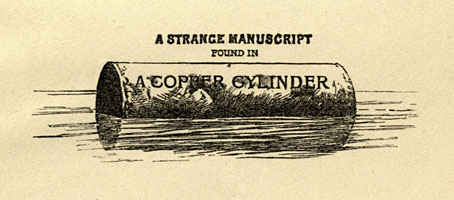
It occurred as far back as February 15, 1850. It happened on that day that the yacht Falcon lay becalmed upon the ocean between the Canaries and the Madeira Islands. This yacht Falcon was the property of Lord Featherstone, who, being weary of life in England, had taken a few congenial friends for a winter’s cruise in these southern latitudes. They had visited the Azores, the Canaries, and the Madeira Islands, and were now on their way to the Mediterranean.

strange02

I’ll spend the weekend reading the recent Italian translation of James De Mille‘s A Strange Manuscript Found in a Copper Cylinder.
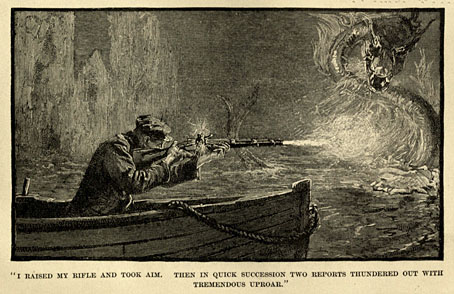
An early example of lost world novel, De Mille’s book was published as a serial by Harper’s Weekly in 1888 – eight years after the author’s death – and it was greeted as a rip-off of Henry Rider Haggard‘s bestsellers.

The idea of a “tropical” volcanic island in the Antarctic was to become a standard cliché in pulp and adventure literature, but De Mille (a prolific Canadian author of popular fiction in the 19th century) is probably one of the earlier proponents of this concept in popular adventure fiction.
strange04

But maybe adventure was not what De Milel had in mind.
Copper Cylinder is often compared to the works of Verne, but its satyrical intents place it closer to the works of Albert Robida, and his Voyages très extraordinaires de Saturnin Farandoul.

English-speaking readers have the good fortune of being able to peruse De Mille’s book thanks to Project Gutenberg, while Francophone readers might like to take a look at Robida’s story in the Internet Archive.
Me, I’ll be curling up with the Italian version of the Copper Cylinder.
Project Gutenberg holds ten other novels by James De Mille, and they might be worth a look, too.
Happy reading!


12 Comments

The Silent Cinema Blogathon: Cabiria (1914)

indexIt’s the Silent Cinema Blogathon, hosted by In the Good Old Days of Classic Hollywood – follow the link to get the full list of blogs participating and movies being reviewed.
Join the fun.

Now, here at Karavansara, we go for pulp adventure, historical fiction and other less-than-sophisticated forms of entertainment, and it is therefore fitting that we take a look at a movie that was the mother of all sword & sandal flicks, of all the historical movie fantasies and Greco-Roman “peplums”.
A movie that almost exactly one century ago, was the first movie to be shown in the White House.

Continue reading


Leave a comment

Other People’s Pulp: The Thirty-Nine Steps

buchan-thirty-nine-steps-bookcoverLast week it was the centenary of the first book publication of John Buchan‘s The Thirty-Nine Styeps.
Buchan’s book about a single man – Richard Hannay – on the run from both unknown enemies and the authorities, and trying to solve a mystery in order to save his own life, became the template for a lot of subsequent “thrillers” – a genre which Buchan called “shocker”, and that he contributed in creating, together with Erskine Childres.

If we are to believe Wikipedia (how could we not?), Buchan

described a “shocker” as an adventure where the events in the story are unlikely and the reader is only just able to believe that they really happened.

Sounds pulpy enough, right?
So influential was the book, that most of us today discovered it through one of its movie adaptations – possibly Hitchcock’s from 1935.
Continue reading


Leave a comment

Other People’s Pulp: Krimi, Giallo & Slasher (Part 4), a Guest Post

91Last installment of this lengthy but fun overview of the connections between Krimi, Giallo and Slasher movies.
The previous three episodes can be found here, here and here.
And we are about to close with a bang.

But before the bang, I must once again thank Lucia Patrizi for her contribution, and wish you all a happy reading.

Last time we discovered Mario Bava‘s Reazione a Catena

And yet, if analyzed in depth and compared to the Giallos by Argento (and in part with those by Martino), it is easy to notice how little of the formula is maintained, and what seeds of the future Slasher movie it carries within its frames.

So, let’s do it!
Continue reading


Leave a comment

Other People’s Pulp: The Hawksian woman

62c6a44de21381ca7e7aedd4f06a0a6fIt was all because of Carole Lombard.
So beautiful it hurt, and very talented, actress Carole Lombard1 was the queen of the screwball comedy movies, and back in the days she was the highest paid star in Hollywood.

I think I first got struck by Lombard when I first saw Ernst Lubitsch‘s To Be or Not to Be, and afterwards I tried to track as many of her movies as possible.
I like her very much2.
It was by reading up on Lombard that I got deeper into screwball comedies, the so called sex comedies without sex that Hollywood developed to counter the Hays Code.

What fascinates me to this day is the fact that screwball comedy is sort of the mirror opposite of the noir genre.
Sexual tension, gender politics and the roles of man and woman in society, class struggle and social critique are all there, as is the idea of the male lead being somewhat dazed and confused, and a victim of his own role – it was all there in both genres, played for thrills in noir, and for laughs in screwball comedy. Continue reading