Karavansara

East of Constantinople, West of Shanghai


Leave a comment

A Robert Abbett gallery

31948661_10216048628478867_190594267591213056_oOne never stops learning.
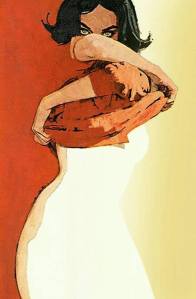
I was trying to impress a lady with my knowledge of vintage paperback illustrators, and I promptly identified the image here on the right as the work of Robert McGinnis.
Thankfully I was smart enough to add “… or someone that got McGinnis’ technique down to pat”, because it is not McGinnis, after all.
It’s Robert Abbett.
Oh, damn.
I can blame the poor state in which my insomnia has reduced me. But still…

Abbett (1926-2015) worked on a number of different genres, such as war novels, detective novels, thrillers, historical fiction and science fiction. He illustrated a number of Edgar Rice Burroughs titles. He was also a fine nature and wildlife illustrator, often featuring hunt-related subjects.

And so, to atone for my blunder, here is a gallery of Robert Abbett’s illustrations.
Enjoy! Continue reading


1 Comment

Night of the Demon (1957)

It has been written since the beginning of time, even unto these ancient stones, that evil supernatural creatures exist in a world of darkness. And it is also said man using the magic power of the ancient runic symbols can call forth these powers of darkness, the demons of Hell.


The real problem with Night of the Demon (aka Curse of the Demon, originally supposed to be called The Haunted) is, of course, the demon. Director Jacques Tourneur of Cat People fame was all against it, but the producer apparently ignored the director’s choice, and had the scenes with the demon that bookend the movie shot by a second unit.

The demon looks cheap and fake and borders on laugh-out-loud ridiculous, and it’s a pity, because without it Night of the Demon would be an otherwise impeccable horror movie.
As things stand, it’s still one of the best horror thrillers ever produced.
Continue reading


3 Comments

Insomnia – Five Books

If you can’t beat them, join them.
Isn’t that what they say?
My insomnia rages on. I sleep (badly) by day and I am wide awake through the night.
I work, I write, I watch old movies, I read books, and wonder what will become of me. Who knows, maybe that last bit is the reason why I am suffering from insomnia, who knows.
But anyway, I thought about doing something about it, and I decided to write about it. Big surprise, uh?melatonin on the rocks

I’ll start with blog posts, and then see where that takes me. I could setup a minimalist blog on some ultralight platform. Or do a podcast. A small, minimalist podcast.
I’d call it Melatonin On the Rocks.
A podcast that goes on air only when I can’t sleep.
Or I could set-up a live hangout every time I can’t sleep.
Or something.
This post is sort of a prototype.
A test run. Continue reading


2 Comments

Cast away on the island of Tambu

Vortice_libriThis is becoming one of those down-the-rabbit-hole sort of things.
It all started with the exhibition in Lyon about Hugo Pratt and Corto Maltese. I did a follow-up about the Corto series, and I got this idea of doing a re-read of the whole Corto Maltese opus, starting with A Ballad of the Salt Sea.
Which led me back to The Blue Lagoon by Henry De Vere Stacpoole, and from there, while casting glances at Folco Quilici and Thor Heyerdahl, to Morgan Andrew Robertson (that was probably an influence on Edgar Rice Burroughs too).
Whew!
But it gets weirder than that, and as the rabbit hole gets deeper, I feel compelled to talk about The Lost Islands. Boy but I loved that show as a kid! Continue reading


Leave a comment

The man who invented the periscope

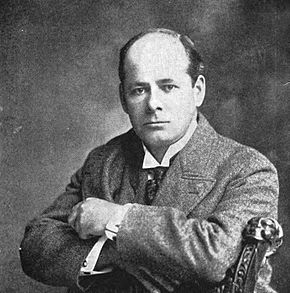
Photo_of_Morgan_RobertsonMorgan Andrew Robertson said he had invented the periscope. He had written a story, called The Submarine Destroyer, in 1905, which featured a submarine provided with a telescoping periscope, and called it a periscope, so he claimed he had invented the thing.
A former jeweler that had to find another job due to a loss of eyesight, Robertson mostly wrote sea stories, being the son of a Great Lakes captain and having spent ten years in the Merchant Marines (he had ran away from home at the age of 16, in 1877).

He mostly wrote short stories and novellas, that he sold to the story magazines that came before the pulps. He started writing, apparently, after reading some rather bad sea stories and going “What the heck! I can do better than that!”

He never made much money with his writing, but he sort of did better than that. Continue reading