Karavansara

East of Constantinople, West of Shanghai


4 Comments

Some notes on dinosaur hunting – part 2

Bring ’em back alive!

We discussed hunting dinosaurs in the classic one shot-one kill style.
A gentleman’s pursuit.

But let’s say our interest is more scientific and we want to collect live specimens…
What should we do?

scf4327-082The obvious choice is stealing the eggs and then incubate them.
A brief moment of panic and a hectic run might save us a lot of trouble.
After all, it worked for Professor Challenger, right?

But ok, let’s say we want to collect a live dinosaur.
We must somehow knock the beasties down.

The best sleeping drugs for reptiles is Isoflorane, an alogenated ether which is administered by inhalation.
Yes, we can gas the dinos.

People interested in the old sleeping gun way, the dart in our gun can be loaded with any of the classics:
Ketaamine
Tiletamine
Midolazam
Diazepam
Zolazepam
Telazol
Propofol

Most veterinarians swear by a cocktail of Ketamine (a dissociational drug) and either Diazepan or Medetomitine (a muscular relaxant).
The volume depends on the bulk of the animal – its total weight.
It works in ten minutes.
Or it should, anyway.
It’s better to be out of the way after thirty minutes after sedation.

Now we face two problems.
The first problem is mechanical – injecting the drug.
The best way should be to inject the drug cocktail between two scales – as perforating the scale is painful for the animal and ineffective as a way to sedate it.
In other words, we might end up with a an enraged, fully awake dinosaur.
If we are dealing with carnivores or saprophages, the best policy should be shooting the dino in the neck, and from behind, thus taking advantage of the scale orientation.

But the real problem is the second: estimating the dosage.
The cocktail described above is suggested in doses of 15 milligrams per kg of mass.
This means that, for big specimens, we should shoot or anyway inject them with many litres of drugs.
Better to look for youngs, and focus on smaller species.


4 Comments

Some notes on Dinosaur Hunting – part 1

Two years ago, a friend asked me about those B-movies in which Army types face rampaging dinosaurs, firing tons of bullets to no avail.
Were the dinosaurs really so hard to kill?

I wrote a post on the subject, on my Italian blog, which sparked a long discussion with further Q&A.
This led to a series of articles about dinosaur hunting.

I’m currently translating and re-editing that material, planning a small ebook for the curious – what follows is the first part of a this revised stuff.
More will follow.
But for starters… let’s talk weapons.

First idea: military-grade personal weapons can be a match for dinos.
A bit of metal accelerated to ultrasonic speed (such as a P90 bullett) carves a cavity in the target as large as a basket ball, so you can be a dino, but a burst from a modern automatic weapon hurts all the same.

But it gets better, and more complicated than that.

The idea that dinosaurs had thick, armored hides comes from the early years of paleontology – working by analogy with modern pachiderms, the first fossil hunters imagined dinosaurs to be thick-skinned like rhinos and elephants
Modern studies on fossil dinosaur hide tell us a different story – dinosaur skin is just reptile skin, often revealing clear signs of bite from predators.
Tough, but not enough to shrug off a direct hit from an automatic weapon.

Does this solve the T. rex vs AK47 debate?
Not exactly.

First of all, underneath the often garishly colored, supple reptile skin we find thick bands of compact muscle.
And then there’s the matter of bone plates – normally found on herbivores, on the back, rump and neck areas.

Both can somewhat soak the impact damage from our bullets.

And with really big beasts, it can take a few seconds, from the moment the bullet impacts to the moment the pain and damage registers in the brain of the animal – due to the distance the electric signal has to cover from the periphery of the body to the head.
And a charging dinosaur can do a lot of damage in a few seconds.

Which leads us to the old problem of the riunning dinosaur…

An elephant weighs—let’s see—four to six tons. You’re proposing to shoot reptiles weighing two or three times as much as an elephant and with much greater tenacity of life.

The quotes comes from the basic required reading on dinosaur hunting, Lyon Sprague De Camp’s A Gun for a Dinosaur – which you can find and listen to, here in the X minus One archive, as an mp3.

The bottom line of the charging dino problem – you can kill it, but before it realizes it’s dead, he can still rush you and squash you.

So what?
Sprague De camp offers a classic solution

Here you are: my own private gun for that work, a Continental .600. Does look like a shotgun, doesn’t it? But it’s rifled, as you can see by looking through the barrels. Shoots a pair of .600 Nitro Express cartridges the size of bananas; weighs fourteen and a half pounds and has a muzzle energy of over seven thousand foot-pounds. Costs fourteen hundred and fifty dollars. Lot of money for a gun, what?
I have some spares I rent to the sahibs. Designed for knocking down elephant. Not just wounding them, knocking them base-over-apex. That’s why they don’t make guns like this in America, though I suppose they will if hunting parties keep going back in time.

Holland & Holland Nitro Express .700 (in the ’50s, when Sprague De camp wrote his story, H&H and Continental only manufactured a .600).
Because we don’t want just to kill it – we want to drop him on the spot.

Of course, we are talking a 7kgs (15 lbs) weapon, that kicks like a mule – not the most confortable weapon to carry around Dinosaur Valley.

We can find today even better calibres – JDJ .950 and such.
There’s even a thing called Tyrannosaurus Rex.
But the .600 and .700 Nitro Express are still the discerning dino hunter weapon of choice.

Note that we are talking single, large dinosaurs.
Dealing with velociraptors – which are small and attack in coordinated groups – is quite another story.
In these cases, suppressive fire fropm full-auto weapons might be the only choice.

We close this first article, by reminding our readers of the Servadec Principle (thus called from the classic Jules Verne novel) – accustomed tothe rumblings of the savage wilderness around them, the dinosaurs might not be scared at all by explosions, and rather react with curiosity to the bangs of our weapons, coming closer to investigate.

In the next installment – Bring ’em back alive!


3 Comments

Fishing with Dynamite

mentaThis post is being written on a dare.
Sometimes I do posts on demand – when a friend or one of my regular readers asks for something I find interesting, and fun to write.
But a few days ago, my friend Alessandro Girola, a fine writer and a blogger, decided to call my bluff.
So, he will pay me a large glass of menthé a’l’eau (mint flavored water), if I’ll write him a post about the practice of fishing with dynamite.
And it’s getting hot here.
And I’m thirsty.
And I did some research for my sea-based stories, so…
So here we go.

What Alex calls “fishing with dynamite” (which is actually the name of a restaurant in Manhattan Beach, Ca.) is more properly known as “blast fishing”, has been around ever since explosives were invented, and it goes more or less like this:

  • dynamiteyou go to a place were live fish can be found, say, the ocean, or any large body of water
  • you throw in an explosive charge – TNT being the classic, but not exclusive (as we’ll see), bait of choice
  • the blast kills (or stuns) the fish, which float to the surface
  • you harvest your catch
  • fish dinner!

Nice and smooth.
Only, it’s neither.

First of all, you may not believe this but really… blast fishing is mondo illegal.
It’s illegal because you go around carrying explosives and throwing them around – and sometimes you blast-off your own fingers.
Or somebody else’s.

Hook, line & sinker

Hook, line & sinker

The fact that in Indonesia – the place where blast fishing is most popular at the moment (roughly 30% of the fish sold to markets is blast-fished) – they use home-made cocktails of kerosene and fertilizer instead of proper explosives is only making this just more illegal.
Calcium carbide was also used in the past, but it’s become somewhat of a specialist’s choice – it used to be very popular in mining areas, and it’s still relatively cheap, but kerosene and fertilizer are clearly easier to get.

And blast fishing is illegal, and it is not nice and smooth at all, because it’s terribly damaging to the environment: the blasts not only kill or stun the fish, but seriously damage coral reefs and other carbonate-based organisms.
The environment goes belly up (…), the food chain is compromised, no more fishing (blast or otherwise) in a very short time.

Finally, were it not illegal already, blast fishing should be made illegal because it is mindboggingly stupid.
The blast from the depth charge, in fact, causes hydrostatic shockwaves that break the floating bladders of fish – this means that only a few fish float to the surface, and the largest percentage of the catch… is not caught, because it falls to the bottom.
Blast fishers catch something like 20% of what they kill.

So, yes, it looks cool on film, sounds cool in a story, but anyone caught blast-fishing should be sentenced to perpetual community service wearing an embarrassing costume.

To end on a somewhat positive note, the cost and risks connected with the use of explosives for fishing – plus the fact that it’s not exactly discreet, as a method – has caused many of the morons out there to adopt a different tool – they simply pour cyanide in the water.
This devastates the environment but grants them 100% of catches, and it’s cheaper.
Also, it kills them and their customers slowly and painfully.


Leave a comment

Strange Bedfellows

I spent last night playing Strange Bedfellows with a friend.
It’s not as bad as it sounds.

Strange Bedfellows is a parlor game inventes – as far as I know – by British novelist M. John Harrison.
It’s quite simple, but can be fun.

bookshelf-hillThe game is played indoors, wherever there are some book shelves.
The idea is to look at the books on the shelf, and pick a pair of books that sit side by side.
And now imagine: it is a dark and stormy night, and as the fury of the elements thrashes the countryside, in a small inn, two travellers are forced to share the same bed for the night.
The two authors of the two books are the two travellers.
The night is cold.
What do they talk about, laying there side by side?
Do they just talk?

It’s funny, slightly risqué, the sort of game book-lovers like to play.
Can even be played solitaire – and used as a writing prompt.
If played in two can lead to some spicy situations.
If played in a group, normally degenerates in a lot of sillyness, but fun.

Picking the fiction shelf is usually better than picking the non-fiction shelf.

The game began, last night, because my friend had been told that, on her Goodreads (virtual) bookshelf, Agatha Christie sitting side-by-side with Virginia Woolf was an unusual sight.

But then, what of Harlan Ellison and Arthur Conan Doyle, currently sticking together on my shelf?
What about Roald Dahl and the Dalai Lama sharing a bed in that lonesome hotel?
What would Louise Brooks say to H.P. Lovecraft, and what would he respond?

A messy book collection is sure to grant hours of delight, starting conversations and some quiet fun.


3 Comments

The Pope, MacGyver and me

eisenerI was strangely touched, a few hours back, when I found out, by chance, that early this week Carl Elsener, head of the Victorinox company, passed away at the age of 90.

I have to admit that for me, Herr Elsener is not the first character that comes to mind when I think about my Swiss Army knife.
I was a kid in the 80s – I was a MacGyver fan.

And yet, the photograph of the smiling, white-haired Swiss businessman sort of made me feel a pang of nostalgia.
We shared something.
I was a happy customer of his.
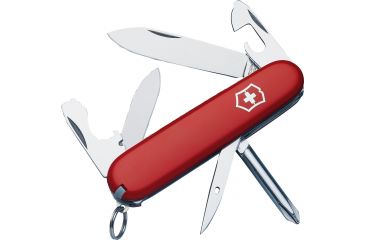
opplanet-victorinox-tinker-knife-53133I have a Victorinox Tinker in my jeans pocket, hanging by a small carabiner from a belt loop.
It’s been there for ages.
Before that, there was a heavier, wood-handled Hiker model, hanging there.
The one with the saw and the corkscrew.
I lost it somewhere in the ’90s.
The Tinker is leaner, more essential, almost minimalist.
And dirt cheap.

Together with a USB key, a D20 and some spare change, the small red knife is one of the things that I always have in my pocket.
And sure, there’s always some friend that makes some lame joke about MacGyver – but pity the guy, he probably watched some lame sitcom in the 80s.
Sad loser.

macgyver11icNow, I never defused an atom bomb or built a raft using it, but my Swiss Army Knife’s been useful all these years.
But I repaired my PC with it.
With it I cut freshly-baked bread purchased in small villages long the road, to make sandwiches.

It helps me feel adventurous.
And pull caps from bottles.
And a lot of other stuff.
And it’s sort of a lucky charm, really.

And it was fun, doing some research for this very short, pointless post, discovering that both the current Pope and the Dalai Lama carry the same kind of knife I carry.
I wonder if they are fans of MacGyver, too.


5 Comments

Hunters of Legends

Roleplaying games are great for learning languages.
Without D&D, my brother would have never learned English, and I used the gorgeous French version of Call of Cthulhu, L’Appel de Cthulhu, by Sans Detour, to brush up my French, and give it a thorough workout.
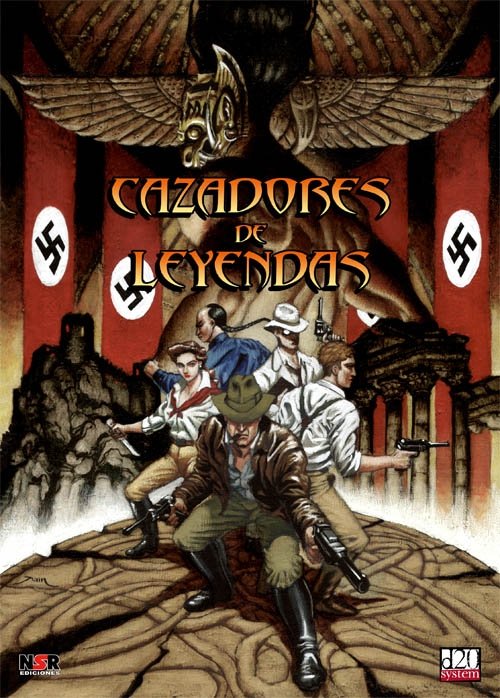
Now, it’s time for some Spanish – courtesy of NOSOLOROL Ediciones and their fine book, Cazadores de Leyendas.

cazadoresSo, ok – I’m a sucker for pulp games.
I saw the cover and I knew I had to take a look at this baby.
My birthday arrived, and my brother sort of had this vibe, and he knew somehow I was interested in it, and therefore he gave it to me as a gift.

Published in February 2013, Cazadores de Leyendas (Legend Hunters) is a 132 pages pulp adventure campaign, distributed as a PDf with color cover and black and white interior illustrations.
It was written by Ismael Diaz Sacaluga, and runs on the D20 system.

The set-up is classic – it’s the second half of the thirties, and the Nazis are looking for mystical artifacts to further their plans of world domination. The British intelligence sets up a team of adventurers to get at the artifacts before the Nazis. The players take the roles of members of this MI6 offshoot group.
Nice and smooth.

The Indiana Jones movies were clearly an inspiration – and basically, this campaign is probably the closest you can get to the Indiana Jones franchise without the Lucas & Spielberg lawyers coming after you with bullwhips and guns.
And it’s fine.

The book provides a general framework for the campaign, ample Keeper’s notes, five pre-generated, well detailed characters, and a campaign in ten episodes spanning the years 1936 and 1937:

  1. The Mask of Fu Kang
  2. The Mouth of Hell
  3. Zimmer’s Evil
  4. Venetian Masque
  5. The Devils Hunters
  6. The Last Will of Seneca
  7. The Return of Ravek
  8. The Ring of Odin
  9. The Heart of the Beast
  10. The Final Plague

Screenshot from 2013-05-29 05:07:12The book also includes a condensed, lightweight but fully functional version of the D20 system.

The campaign grants a fair amount of globe-trotting (Nepal, Egypt, Italy, England etc.) and pitches the heroes against the Thulegesellschaft.

The scenarios making up the campaign are fun, well-detailed and with some nice touches (like suggesting the music for each scene, from pulp adventure movie soundtracks). The cast of NPCs is large and varied. The artifacts are interesting, and the overall plot is well designed.
Some of the artwork is nothing to write home about, but most of it is still more than adequate, and a pair of pieces are very very good (such as the one here on the left).

I personally do not care for theD20 system, but converting this baby to a more suitable system (such as Savage Worlds, for instance) is not a big deal.
Some scenarios might require some tweaking – but the book leaves ample space for customization.

All in all, a fine addition to my collection of pulp-themed games.
And a good opportunity to improve my Spanish.


4 Comments

Celebrating the Shadows, 2013

Fact is, reality always takes you by surprise... that's why we need fantasy. To be prepared.

Fact is, reality always takes you by surprise… that’s why we need fantasy.
To be prepared.

(no, not the band that did Apache)

As I mentioned a while back, in this weekend – which marks the birthday of Peter Cushing, Christopher Lee and Vincent Price – the idea is to do something to stress and underscore the relevance and dignity of imaginative fction.
Being chiefly a writer, I’ll write.

I call it Imaginative Fiction (using the old catch-all tag coined by Lyon Sprague de Camp).
You can call it horror, fantasy, weird, science fiction, pulp adventure…
You can call it faery tale, myth, folklore…

It is not kid’s stuff.
Oh, granted, kids love it – because kids are curious, and normally don’t give a damn about being perceived as serious, mature or respectable.
They want ideas – they hunger for ideas.
And if you are looking for ideas, fantasy fiction, imaginative tales, are the best spot in which to dig…

With this I do not mean to diss “serious fiction” – as usual my problem is not with mainstream or serious fiction, is with the fools that use it as a token of tribal belonging.

I read <put the author’s name in here>, therefore I’m acceptable.

That’s how “serious books” get sold but never read.

Now, good imaginative fiction is not normally read to fit in.
In school you are mocked and overlooked.
They call you a geek.
Desirable members of the opposite sex won’t date you.
Teachers appreciate the fact that you’re a reader but might point out to your parents that “the kid has too much imagination.”
As if it were a problem – real, serious, dangerous troublemakers are those without imagination, because they normally can think of just one solution to any problem.

And even if you, being a geek, finally find a suitable community – comic book readers, fantasy fans, roleplayers – that’s supposed to be a phase you’ll leave behind when you”grow up” and start thinking about “important things”.
Important thins seem to involve being unhappy because you want them, and then being unhappy because once you get them they are not so hot after all.
Weird.

But for a fact, imaginative fiction makes us better.

In its deviations from reality, imaginative fiction questions concepts like those “important things”.
Truly, we read these stories, watch these movies, not to escape reality, but to look at it closer from a new, fresh perspective.
We need these narratives not to escape reality, but to fight the need to escape reality.

So, during this weekend I’ll celebrate watching an old movie with dinosaurs in it, and then I’ll read some weird book full of monsters.
Not because it’s cheap escapism – but because there’s a point in surrealism, there’s a strong moral drive in adventure stories, because contemplating the strange it’s easier to understand the mundane, later.

IMMAGINE-1_g4x88jsmSo let’s raise a glass to our three patron saints – men of culture and intellect, that never despided imaginative fiction, and contributed making it popular, and acceptable.
Go read a book.
Go watch some movie.
Dust off the old comics collection.
And teach the younger generations that’s where ideas come from.

Cheers!