Karavansara

East of Constantinople, West of Shanghai


4 Comments

Never pulpier than this – Big Trouble in Little China

Big Trouble in Little China

Big Trouble in Little China (Photo credit: Wikipedia)

OK, so I said there’s two pulpish adventure movies I’d never get tired of, but actually there’s another one.

Jack Burton: Well, ya see, I’m not saying that I’ve been everywhere and I’ve done everything, but I do know it’s a pretty amazing planet we live on here, and a man would have to be some kind of FOOL to think we’re alone in THIS universe.

Big Trouble in Little China came out in 1986, an unusual forage in the fields of martial arts and wuxia by horror master John Carpenter.
The movie is both a homage to Hong Kong action cinema and to those pulps of old in which Chinatown was sort of a parallel reality made of opium dens, whorehouses, strange shops and warring triads.

In Big Trouble in Little China there is it all.
And then some.
A cartload of pulpy fun, really, and the movie that really started my curiosity about Hong Kong cinema.

The set up – Jack Burton only wants his stolen truck back. But in the streets of San Francisco’s Chinatown he’ll meet beautiful women with green eyes, warring gangs, an evil immortal Chinese wizard and his three supernatural bodyguards. Jack and his unlikely allies will have to enter the Cinatown underground, and face even more strangeness*.

Kurt Russell as Jack Burton, Victor Wong as Eg...

Kurt Russell as Jack Burton, Victor Wong as Egg Shen and Kim Cattrall as Gracie Law. (Photo credit: Wikipedia)

For the standards of the 1980s, Big Trouble in Little China is fast – it’s one of the fastest actioneers ever shot, full of plot twists, fights and weirdness.
Carpenter plays his Hong Kong cards well, and Kurt Russel has a great time in the role of down-to-earth Jack.

Big Trouble in Little China is Pulp all the way through, and yet, it allows for some fun twists.
Carpenter switches the roles of hero and sidekick – so that Jack is a big-mouthed poser “whose heart is in the right place, but whose ass isn’t” (in the words of star Russell), while his sidekick Wang Chi is the fearless, competent fighter.
In the same way, the role of leading lady Gracie Law (Kim Cattrall) breaks with the standard cliches, short-circuiting the classic hero-gets-the-girl mechanic, while adopting a hawksian comedy style.

There’s a lot of magic, a lot of martial arts, a big hairy monster, and enough wisecracks and quotable dialogue to make everybody happy.
And there’s quite a bit of Chinese history and Taoist magic thrown in, which is very good.

Finally, Big Trouble in Little China develops a wonderful, deep and meaty self-contained universe – the Chinatown of the title could house dozens of great stories, be the site of a score bloody battles, and outside of its borders none would be the wiser.

———————————-
* The story was co-authored by W.D. Richter. the script doctor that had directed in 1984 that other great pulp movie, The Adventures of Buckaroo Banzai.
Which I do not rewatch every time I catch it on the telly simply because they never pass it on the telly.
But I’ll write a post about it, sooner or later.


2 Comments

Adventure & Romance – Romancing the Stone

I mentioned there’s two pulp adventure movies, released in the aftermath of Raiders of the Lost Ark, which I’ll just sit and watch every time they pop up on the telly*.
One is High Road to China.
Now let’s talk about the other.

Jack Colton: [picking up a magazine] Dammit man, the Doobie Brothers broke up! Shit! When did that happen?
Joan Wilder: How long have you been down here?
Jack Colton: Forever.

Let’s get personal: in 1984 I was in the cinema with my date, having the time of my life, when the joke about the Doobie Brothers came up.
I was the only one laughing in the whole room – and my date looked at me in a funny way**.

Romancing the Stone was released in 1984, and it was telling me I was already an outsider.
But who cares?

Romancing the Stone

The set up: when her sister is kidnapped by shady characters, romance writer Joan Wilder has to travel to Colombia to deliver a mysterious map as ramson. Lost in the Colombian jungle, she finds help in the absolutely mercenary rare birds smuggler Jack Colton. American expat gangsters, secret police thugs, drug smugglers and the cheerfully hostile nature complicate things.
And there’s a hidden treasure.
And a pit full of hungry alligators.

To me, Romancing the Stone is almost perfect.
There’s action, adventure, exotic locales, a beautiful woman in danger (Kathleen Turner is gorgeous in this movie), there’s a suitably knavish leading man (Michael Douglas has what is probably his best role). The dialogue is fun, there’s lots of in-jokes and yet the movie never winks at the viewer, never falters in its total dedication to the spirit of adventure narrative.
And it’s set in the ’80s – and therefore updates some classic pulp tropes, and shows that yes, it can be done.

There’s a sequel, called Jewel of the Nile, which sucks pretty badly.
And there’s been talk about something called Racing the Monsoon, which should be an Episode Three, but (thankfully?) was never shot.
And one wonders what would have come out of it had Sly Stallone or Christopher Reeve accepted the role of Colton, or Debra Winger as Joan.

To me, as an occasional author of adventure stories, being able to write something as tight, snappy, seriously tongue-in-cheek as Romancing the Stone would be enough.
Yes, I set myself impossibly high standards.

———————————-
* It’s actually three, now that I think about it.
** In case you’re wondering, the Doobies disbanded in 1982.


3 Comments

High Adventure – High Road to China

In the years following the huge success of the first Indiana Jones movie, something like a pulp renaissance seemed to be about to sweep the movie halls of the planet.
It never worked out properly, but a number of films actually hit the screens that were plain good fun.

Of the lot, there’s two of them I never tire of re-watching.
Today I think I’ll write about the first.

High Road to China

High Road to China (Photo credit: Wikipedia)

Released two years after Raiders, High Road to China was a strange beast from the start.
Based on a fine novel by an Australian novelist, set along the Silk Road, co-produced by Warner Bros. and by a Hong Kong company, directed by an American and shot in Yugoslavia by an international crew.

The set-up in a nutshell: flapper heiress Eve Tozer has to hire alcoholic pilot Patrick O’Malley to fly her from Istambul to somewhere in China, in order to save her father and/or protect her inheritance. Adventures ensue.

Pretty straightforward – an uncomplicated yarn, and quite enjoyable.
An Hawksian comedy of sorts, with adventure interludes.
It features good flight scenes, a great interpretation by Brian Blessed of tribal chieftain Suleman Khan, there’s an air duel, there’s some warlord-era Chinese action.
And then there’s the chemistry between the characters.
Just my cup of tea.
The 1977 Jon Cleary novel – which is highly recommended, if you can track down a copy – is much more complex, has a more varied cast, and has Eve’s flying circus starting from Paris, not from Istambul.
It is a perfect example of the paradigm of adventure being narrative applied to geography.
But the simplified plot is ok.
There’s a wonderful score by John Barry – which I posted on this blog in its earlier days.
Stars Tom Selleck and Bess Armstrong are more than adequate to their roles, and their endless bickering is believable and delivered with obvious fun – and yes, Bess Armstrong is beautiful.

Sure, director Brian G. Hutton abandoned his directing career after this movie, to become a plumber.
And after previews they had to add scenes featuring Robert Morley as a petulant bad guy.
And everybody considered this film to be a cheap attempt at riding the Raiders’ popularity – but High Road had been in the works since the late ’70s, and should have starred Roger Moore and Jacqueline Bisset, directed by either John Huston or Sidney J. Furie (that one would have been fun to see!)

And it surely failed in the attempt of establishing Tom Selleck as the new Clark Gable.

But despite what-might-have-beens, this is still one of those films I really enjoy whenever I have the opportunity of catching it on the TV (or, when the telly does not cooperate, popping my DVD in the DVD-machine).


3 Comments

Vengeance, Unlimited.

One starts thinking about pulp tv shows, and soon finds himself at the end of a very short list.
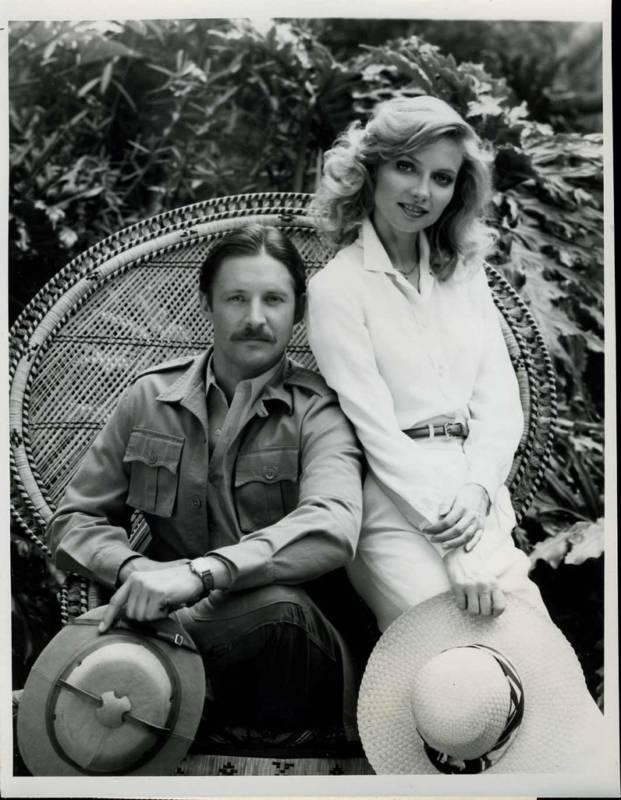
But maybe it’s just a matter of looking sharply at old series.

Now, when I think about pulp, I think chiefly about adventure pulpIndiana Jones sort of stuff.
But there was much more, to the pulps, than Indy-style adventures.

What about the great avengers of pulp fiction?
The Shadow, The Spider, the aptly named Avenger, with his Justice Inc.

Well, at the end of the twentieth century, two writers and producers, John McNamara and David Simkins, created a show for ABC, updating those avengers of old.
The show was called Vengeance Unlimited, and it featured Michael Madsen in the role of the deceptively suave, and downright menacing Mr Chapell.

The premise is simple – if you have a problem, and the forces of Law and Order cannot help you, you can hire Mr Chapell.
For one million dollars, your problem will become his problem.
And he will solve it.
If you do not have one million handy, there’s an alternative deal – you agree to owe Mr Chapell a single favor.
He will call you.
He will tell you what to do.
You’ll do it, and you’ll be free of any other obligation.
Easy.

The show is a tight, unusual crime drama – the stories are ingenious, the set-up is classy, and Mr Chapell, who “once had a very bad Monday” is a wonderful mix of ice-cold logic and of scary madness; and admittedly, few actors out there can do scary-mad-but-nice better than Michael Madsen.
The character has obvious debts with the Shadow (the “I saved you, now you’re mine” premise), with the Spider (the over-the-top gusto with which Mr Chapell hits – phisically and psichologically – his foes) and with the Avenger (the hinted trauma in the main character’s past, the idea of a corporation devoted to justice, or vengeance).

English: Head shot of actress Kathleen YorkThe cast includes a lot of well respected TV stalwarts, and Kathleen York, as the only other recurring character, is an unusual foil for Madsen.
The nocturnal sets, the quiet of suburbia being shattered by crime and violence, the humor and the spirit of the series marked this as an excellent show, one that should have been allowed to find its legs and start running.
But once again, the show did not last long, and after just sixteen one-hour episodes, the series was canceled.

Why?
Was it the violence?
Was it the idea of a hero acting outside of the law, to hit those bad guys who could work the system against itself and evade normal justice?
I do not know.
But as someone that once had a very bad Monday myself, I always loved this show, and its intelligent update of a classic pulp standard.


1 Comment

Bringing ’em back Alive

4998492-lWe discussed Tales of the Gold Monkey – now it would be bad form not mentioning the other pulp show of the ’80s.

And the other pulp show of the ’80s was, of course, Bring ’em Back Alive, which ran for 17 60 minutes (45-minutes according to other sources) episodes and then folded, in 1982.

The set-up: Frank Buck (Bruce Boxleitner in his pre-Sheridan youth) is a big game hunter turned animal collector in Southeast Asia and… well, and that’s it.

The main problem, to me, when it comes to Bring ’em back Alive is, the sense of void which lurks sometimes beneath the Gold Monkey stories, here strides frightfully across the script.

Continue reading


5 Comments

Back to the Gold Monkey

Tales of the Gold Monkey

Tales of the Gold Monkey (Photo credit: Wikipedia)

As I said already, we’ve got very little pulp on the telly, these days.
So I went back to the old DVD collection, and dusted off my copy of Tales of the Gold Monkey.

For those who missed it, Tales of the Gold Monkey was a short-lived series, produced in 1982 (yes, thirty years ago) by Donald P. Bellisario, of Magnum P.I., Quantum Leap and JAG (among others) fame.

The show features a lot of stuff – this is somewhat a standard in pulp-themed material, and as I mentioned before, it is not really a bad thing.
But more on that later.

The set-up: we’re somewhere in the late 1930s on the island of Bora Gora, out in the Pacific. Here, former Flying Tiger Jack Cutter (Stephen Collins) is a bush pilot and all-around adventurer, trying to make ends meet.
In the pilot episode, he gets to save a plucky USA OSS agent (Caitlin O’Heaney), and recover a golden idol from an island inhabited by aggressive big apes and neolithic natives.
Nice and smooth.
The mix also includes Jack’s alcoholic mechanic, his one-eyed dog, a French guy managing a bar in the jungle, a false priest that’s actually a Nazi and a bad & sexy (well, bad & sexy for 1980s TV standards) Dragon Lady with a samurai for a bodyguard.

Quite a nice set-up, all things considered.
And one that was refreshingly different, in 1982 – and yet also familiar… as in Indiana Jones-style familiar.

Continue reading


2 Comments

The (pulp) Lost World

There’s precious little pulp on TV these days – and in the past it was not better.
But sometimes I get lucky.

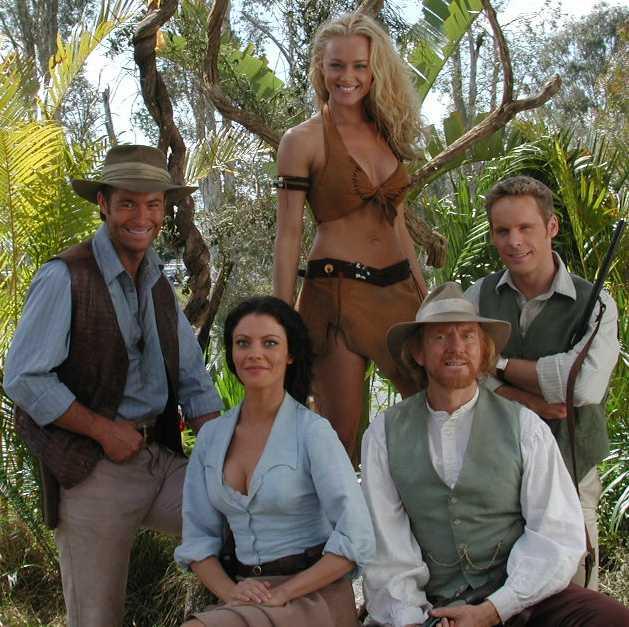
936full-the-lost-world-photoSummer has brought back to the Italian airwaves The Lost World, and I am a happy viewer again.

Now, I know many that do not like the series – not to the point of despising it, but let’s say it is not high in their appreciation where fantasy shows are concerned.
I’ll get to the main objection I registered later, because it is interesting.

Now, Sir Arthur Conan Doyle’s The Lost World (that’s the complete title) is an Australian/Canadian show which takes its lead from the classic novel, and soon ditches most of the Conan Doyle plot and develops as a dinosaur-infested, lost-civilizations-laced, weird-science-loaded feast of pulpy goodness.

The basic premise – a band of heroes gets trapped on a plateau in South America, a lost world filled with… yeah, dinosaurs, monsters, lost cities, mysterious strangers, weird civilizations, relics from other times, crashed aliens, magic…
There’s even an access to the Hollow Earth!

The writing is fairly good, the effects are cheap but fun, the cast is competent, and adequate to the over-the-top premises of many an episode.
The main characters are a fine sample of pulp clichés…

. omni-competent scientist
. fearless big game hunter
. two fisted journalist
. unreliable femme fatale*
. fierce jungle queen*

Earlier seasons feature a second scientist character (as per original novel), sparking scientific and philosophical debate, acting avuncular and more importantly allowing the screenwriters to split the team.

And I’d welcome such a team at my gaming table, as it is the kind of ensemble which just sparks off stories: such a bunch of individuals would turn a jaunt down at the supermarket for snacks into an adventure.

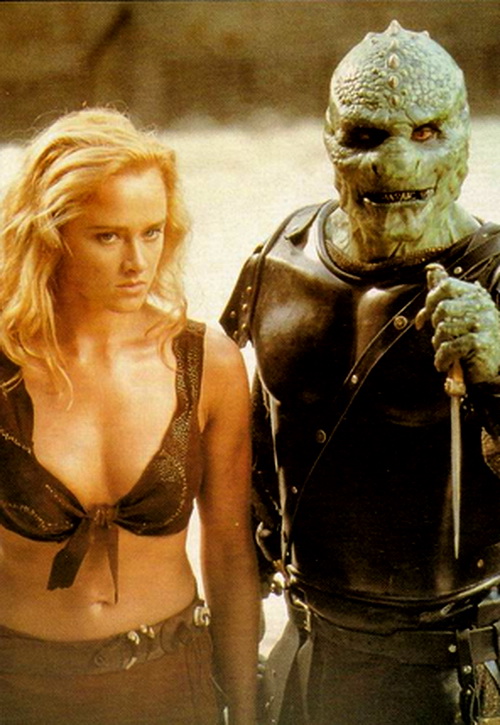
tumblr_menwbumk7U1qzr8nao1_500Some of the recurring elements in the series are also highly entertaining.
There’s a civilization of lizard-men mimicking the Roman Empire.
There’s the afore-mentioned access to the Hollow Earth.
There’s the growing idea (actually turned into a solid plot element in the later seasons of the series) that the lost world plateau is sort of a time-distortion crossroads.

And then there’s everything else – including the kitchen sink.
Which is where many friends of mine start groaning.
There’s too much stuff, they say.
C’mon – dinosaurs today, aliens last week, yet another lost civilization next week…
How comes the science guy is able to build almost any kind of gadget, and yet he can’t telegraph home for rescue?
How comes they never run out of ammo?
How comes the women are always gorgeous, the guys alway handsome and athletic?

And yet, that is exactly what I like – because it’s in line with the classics.
Well, my kind of classics, anyway.
If it was good enough for Tarzan, or Doc Savage, why shouldn’t it be fine for a team of adventurers trapped on a plateau in South America, surrounded by dinos and weirdness?
Are we really counting shots and dissecting dinosaurs for plausibility?

All in all, to me, The Lost World remains a competent, fun, lightweight fantasy show – with some hidden gems lost among the many episodes.
Maybe it’s a guilty pleasure – but it is a pleasure indeed.

NOTE
* Yes, I know there’s no femme fatales or jungle queens in Conan Doyle. There should be.

Related articles