Karavansara

East of Constantinople, West of Shanghai


1 Comment

The 9th Panchen Lama

At the moment of writing the Panchen Lama is still en route: it was from Kumbum that he dispatched to the British Ambassador in Peking a telegram of condolence on the death of King George V.

Having left Sining, Peter Fleming and Ella Maillart have reached Tangar and joined a camel caravan due west.

Soon they find hospitality in a monastery – and here the main topic of discussion is the imminent return to Tibet of the exiled Pancehn Lama – which Peter Fleming calls also the Tashi-Lama, from the name of the Panchen Lama’s traditional seat, Tashilhunpo Monastery in Shigatse.

asia8

Now, who’s this exiled lama guy? Continue reading


Leave a comment

The governor that was not there – Ma Bufang

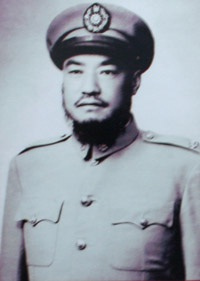
ma bufangWhile stranded in Sinin, Peter Fleming and Ella Maillart try to meet governor Ma Bufang (or Ma Bu-Fang in Fleming’s book), as they seek official authorization to proceed along their route.

We already know from his Ma that the man is a Muslim (Ma being the shortening of “Muhammad”), and a member of the powerful “Ma Clique”.
Members of the Ma extended family/clan had been de facto governors of northwestern China under the Qing dynasty and had become warlords between 1918 and 1928, holding sway in the provinces of Qinghai, Gansu and Ningxia.
The Ma Clique was composed of three families, so that they were often known as Xibei San Ma, as to say, the Three Ma of the Northwest.
At the time of Peter and Ella’s travel, the three families were led by Ma Hongbin, Ma Hongkui and Ma Bufang.

Due to various misadventures, Peter and Ella will never meet Ma Bufang

who is by all accounts a tough and energetic autocrat.

Indeed, Ma Bufang demonstrated by his actions his skill, toughness and political ability to shift from one role to the other.

Ma Bufang had trained as an imam – his brother Ma Buqing being the one destined to a military career – but at the age of nineteen he joined the troops.
Rising to prominence through a series of feuds and backstabbings, Ma Bufang demonstrated his battle prowness and ruthlessness in 1932, participating iun the defeat of the Tibetan troops as they tried to invade and take control of the Qinghai province.
Later, sponsored by the Kuomintang, Ma Bufang led seven extermination campaigns against the Ngolok tribes – traditionally considered a people whose only activity was banditry, and were supposedly aligned with the Communist party. Ma Bufang’s actions against the Ngolok have all the markings of an ethnic/religious genocide.

In 1937, Ma Bufang refused to side with the Japanese army, and in fact later fought against the Japanese in the early 1940s.
From a strictly political point of view, Ma Bufang was what might be called an illuminated tyrant – promoting reforestation, granting extended rights to women.
Boasting an army of 50.000 elite fighters (belonging to various northwestern ethnicities), Ma Bufang held his position as governor of the northwest during the Chinese revolution and only in 1949 he was forced to leave China and relocate to Saudi Arabia.

Ma Bufang was also close to the Panchen Lama, a character that we – together with Peter and Ella – will meet in a while.
But as things stand now, it looks like the long stay in Sining is about to end, and the road beckons.


1 Comment

Tsamba

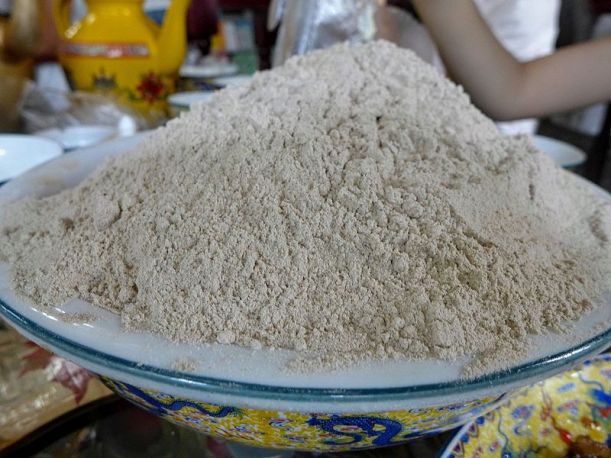
Stuck in Sinin while the authorities evaluate the opportunity of letting two Europeans go forth west into the wilderness, Peter Fleming and Ella Maillart try to have some kind of social life, visit Kumbum and have their first meeting with tsamba – a travel companion with which they will become well acquainted.At first mistaken for ash, tsamba (or tsampa) is one of the staples of Tibetan and Nepalese cooking, and it is worth a little space here.

TsampaInABowl

At first mistaken for ash, tsamba (or tsampa) is one of the staples of Tibetan and Nepalese cooking, and it is worth a little space here. Continue reading


2 Comments

A blog to follow

While I try to recover from a week of extremey bad weather, ill health and computer problems, I suggest you guys point your browsers to our friend Carlos’ new blog Toils and Trouble in Xinjiang Province, which is following our same path together with Ella Maillart and Peter Fleming.

Selezione_001

And again – he is seeking travel companions for a real trip in the Taklamakan.
Think about it.


Leave a comment

Afternoon on the Nile

Isn’t this writing business just great.
In what other field could I spend the afternoon re-watching the great Peter Ustinov as Hercule Poirot in Death on the Nile, and still call it research?

And by the way, the movie is from 1978, not 1974 as the trailer caption puts it.
And yes, I might inflict my opinions about the movie on you, one of these nights.


2 Comments

The African Queen (1951)

The-african-queen-1-As I said, I rewatched John Huston’s The African Queen, from 1951.
And I’m pretty glad I did – because I’ve seen it so often that I knew the story almost by heart, and this time I concentrated on a number of details that, when I was younger, I missed.So, let’s do away with the plot.

So, let’s do away with the basic plot.
According to IMDb…

In Africa during WWI, a gin-swilling riverboat captain is persuaded by a strait-laced missionary to use his boat to attack an enemy warship.

Which is pretty straightforward.
The film – based on a book by C.S. Forester, is set in 1914 and it does involve the hare-brained plan cooked up by Rose Sayer (Katharine Hepburn) and Charlie Allnut (Humphrey Bogart) to sink the Luisa, a German gunboat patrolling a lake 1The movie’s a great adventure yarn, a comedy, a drama, a love story. One of the greatest film of all time. Do they still make them like this? I doubt it. Continue reading