Karavansara

East of Constantinople, West of Shanghai


5 Comments

Author-Publisher, please

This is an impromptu post.
Chuck Wendig just posted another fine piece about… authors that publish their own stuff.
About the name you slap on such individuals.
Something I’m interested in, as I’m one of those that get slapped.

Let’s see.
The most common labels are:

. self-published author
. independent author
. self-produced author

copierLet’s admit it – they do suck.
At best, they aremisleading.
In my language, the label is usually (autore) Autopubblicato – and it reads as a mark of infamy.
It means, more or less, “you sucker, a real publisher would not touch your rubbish with a ten foot pole”.
And in my case might as well be correct – I’ve this thing which seems to ruffle the feathers of most publishers.

Incidentally – I do prefer author to writer, because it describes more precisely who I am.
A writer could be writing under dictation.
He could be a graffiti artist.
I’m an author.

Or, here’s another definition which is quite fun, content crafter.
Which is fine when I’m authoring stuff that’s not orthodox book- stuff – online articles, blog posts, slide text, infographics, etcetera.
Beats any day of the week the horrid web-writer so many people seem to enjoy (so much so there’s people out there actually selling “professional web-writer” certifications, these days!)

When it comes to publishing my stuff, anyway, the standard labels suck, but there are two other definitions I like much better.

The first is artisanal publisher, coined by Guy Kawasaki and Shawn Welsh in his excellent APE: Author, Publisher, Entrepreneur-How to Publish a Book.
I’ve been using that a lot – it removes the stigma of the guy working in his basement with an old HP printer and adds a touch of highly marketable mistique.

The second, which was recently proposed by Chuck Wendig, is author-publisher.
Which, and I have to agree with the man, sounds just like a multi-class character in a role playing game – like wizard-rogue, which I have played once in a while in my long gaming career.
And is mighty fine.
Sounds great.
It’s classy.

So here we go – from this moment on, I am Davide Mana, author-publisher.
I’m into artisanal publishing, actually.


2 Comments

Flogging the Sea

This is not the post I was planning.
But something happened, and while my common sense tells me it would be wiser to shut the hell up and keep going my way…
Ah, you know I can’t, right?
So, let’s call this a pork-chop express, shall we?

What happened?
Here in my sector of the world wide web, twice, in the past seven days, two digital publishers reacted in a highly counter-productive way – in my opinion, of course – to what amounted to simple instances of people (a customer in one case, a writer in another) expressing their legitimate concerns online.

Mind you – I’m not siding with one or another.
I don’t care if the opinions vented by those guys were legit or preposterous.
This post is not an attack on somebody or a defense of someone else.
I’m just trying to put down what I think failed here.
And I am convinced that failing is not bad in itself – it’s bad only if, failing, we do not learn from failure.

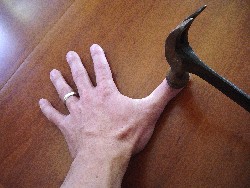
hammer_thumbThe idea is – if you work through the web (say, as a publisher of digital books), you cannot blame the web if things do not go the way you planned it.
It would be like cursing the hammer because you hit your thumb.

I know it smarts.
I know we all try to project an aura of infallibility, and of high professionalism.
It’s the way to go.
But then, we cannot allow ourselves to spin out of shape when our infallibility and professionalism are questioned.
Because that way, we give definitive proof of our lack in both fields.

And I know it’s hard going, publishing books – digital or otherwise – in the European country with the lowest number of books bought per capita, but reacting with a siege mentality, in which anything but the highest praise is to be interpreted as an attack and a potential damage to sales, is suicidal.

The people out there – customers, writers, bloggers, facebook punters, innocent bystanders – are not your subjects.
They are not there to do your bidding.
And when they express ideas or opinions that you do not like, they are not rioting.
So there’s no need to read them the riot act.
It’s called communication – and by reacting with rants, menaces or general aggression, you fail at communication.
And that’s not good, because writing (or publishing, or selling goods) is communicating.

In these cases, the good old hypocrite way is probably the best course – you thank your counterpart for pointing out the problem, promise you’ll get the guys (it’s always “the guys”, btw – never make it personal) to fix it, and then, in the quiet of your offline world, you curse them for a fool, scream and thrash a bit to release your pent-up anger, and then forget about the whole thing.
Or maybe, you look into the thing – because maybe the problem that was pointed out to you really is a problem, and fixing it might make your work easier and your counterparts happier.

Just being aggressive, in these cases, is counterproductive – you loose customers if you publicly thrash a customer.

whipseaAnd huge, sarcasm-loaded scattershot rants are certainly a great way to get an endorphine rush and feel cool and badass, and probably will gather a few accolades from the usual bootlickers, but in the long run, they feel like the time Xerxes had the sea flogged for disobeying his orders.


11 Comments

Mediterranean pulp?

mediterranean_food[I’ll explain the groceries in a minute…]
Now, there’s an Italian, a Spaniard and an American…
No, it’s not a silly joke.
It’s what happened in a quick exchange of tweets, a few nights back, with two fine gentlemen from America and Spain respectively.
The subject was pulp.
New Pulp, if you will.
The question was – what about stories not set in the United States?

What about some international setting?

I contributed tha suggestion that, preserving the time-frame (stories set somewhere between the ’30s and ’40s), and the overall structure (character-driven thrills and derring-do), the Mediterranean area would be the perfect setting.

Just consider…

Continue reading


7 Comments

In the land of the up-and-coming

Ok, short (?) post stimulated by this post by the always stimulating Seth Godin.
And yes, it does have to do with writing.

Now, I like Seth Godin’s piece a lot, I love his suggestions, the post in question gave me a lot of ideas, but it all collides in a rather unpleasant way with my experience.
I tell myself it’s because I’m in Italy, and he’s in the great big world out there, and yet, it is not a completely satisfactory explanation.

The idea is…

If you’re an up-and-coming band building an audience, then yes, free, free, free. It’s always worth it for you to gig, because you get at least as much out of the gig as the organizer and the audience do. But when you’ve upped and come, then no, it’s not clear you ought to bring your light and your soul and your reputation along just because some promoter asked you to.

Great.
I love that.
But, what if up-and-comingdom is the default setting of your environment? Continue reading