Karavansara

East of Constantinople, West of Shanghai


6 Comments

Hobson-Jobson

Sir Henry Yule was a Scottish gentleman and an army man who – among other things – translated in English Il Milione, Marco Polo’s travelogue and indispensable Silk Road narrative.
Arthur Coke Burnell (yes, his middle name was really Coke) was an expert in the Sanskrit language, but he was also handy with Tibetan, Arabic, Kawi, Javanese and Coptic.5746976-M A well-rounded scholar, so to speak.

These two fine gentlemen got together and in 1886 published a wonderful book which is called Hobson-Jobson or, to be more precise and wonderfully Victorian, Hobson-Jobson: A Glossary of Colloquial Anglo-Indian Words and Phrases, and of Kindred Terms, Etymological, Historical, Geographical and Discursive.
And no kidding.

So, yes, the Hobson-Jobson had nothing to do with any gentleman ever named Hobson, or, for that matter, Jobson.
Sure, a guy called William Crooke also did some later work on it, but no Jobsons, or Hobsons, at all.
What gives? Continue reading


3 Comments

The Pulp Baker Street Detective

Sexton Blake

Sexton Blake (Photo credit: Wikipedia)

We talked about Biggles, last week, and the little spotlight the British pulp heroes are getting these days.
And yet, they were (and are) an interesting bunch.
The only one, apparently, that still gets around a lot is Sexton Blake.
Hard putting to sleep a character which appeared in over 4000 stories, penned by no less than 200 different authors.

And I’m particularly fond of Blake because he might well be the first true pulp hero I ever met.
It was in Baker Street, a long time ago…

Sexton Blake goes a long way back – he first appeared in the wonderfully titled Halfpenny Marvel, in December 1893.
One hundred and twenty years ago, actually.
And yes, the same year in which Conan Doyle decided to off his increasingly overwhelming character, the Baker Street Detective.

Part of a number of investigators which flooded the popular magazines with their adventures to fill the gap left by Holmes’ fall down Reichenbach Falls, Blake played the role of Holmes clone for about twenty years, being so cheeky he actually moved to Baker Street, and rented an apartment in front of the one occupied by his more famous counterpart.

blakeThen, in 1919, something changed, and Blake – while keeping his Holmes-like looks and manners – shifted to far more outrageous pulp territories.
Outrageous as in killer carnivore plants and zombie cannibal pigmies stalking the streets of London.
That sort of stuff.
Also, Blake showed a penchant for muscular action and a passion for innovation and technology that put him in the same league of, say, Doc Savage.
And did he travel!
There’s quite a bit of globetrotting in Blake’s stories.
And women – Blake had quite a number of ladies involved in his adventures.

And finally, the bad guys, first and foremost Zenith the Albino, but go on, check the excellent page Jess Nevins set up for Blake, and read the bad guys entries.

The character starred in stories, comics, movies, radio dramas and a TV series.

The Casebook of Sexton Blake

I chanced upon a Sexton Blake omnibus, called Sexton Blake Wins, in the late ’80s.
And I was blown away*.
Blake’s stories were hard to get by, but today something is moving.
There’s a few very good collections, available relatively on the cheap (the David Stuart Davies-edited selection published by Wordsworth goes for less than a fiver), and the character deserves a read, in my opinion.
He’s not the Poor Man’s Sherlock Holmes, as some say.
He’s a quite different sort of character – at least in his “golden age”, between the wars.
He’s a pulp hero**.

————————————————————-

* Being still a teenager I actually wrote a pastiche, in which Blake is hired by Count Dracula – who is stalked by a Dutch weirdo called Van Helsing who’s convinced the Rumanian nobleman is a vampire. Turns out Dracula was actually looking for Holmes, but he got the wrong address.

** And come to think about it, the quite fun movies starring Robert Downey Jr actually feel a lot like good old Sexton Blake fare.


1 Comment

Himmler’s Geologists

It all began talking with some friends about pulp gaming and pulp literature.

Q: Great pulp villains?
A: Nazis!

Layout 2In fact the Nazi as bad guy is not sch a given in pulp fiction – Nazis arrived late to be central villains during the Golden Age of pulps.
Sure, there were a lot of quasi-Nazis, of more-or-less thinly disguised Reich references, in the pulps; such as the fascistic and evil (obviously) Black Police which seizes power in New York in the Norvell Page “Black Police” trilogy, featuring The Spider.
The series dates back to 1938 – and indeed, in ’37, brown shirts and other unsavory tipes were making their appearence on pulp mag covers.
But it was only when the USA entered the Second World War that Nazis made it big in the pulps- and in movie matinee serials.
I havethe suspect that in Britain things were different – I’ve got this hunch that Biggles tackled the Reich earlier than his Yankee counterparts.

But anyway, you know how it happens with pulp fans – you start talking Nazis and Indiana Jones, and two hours later you are discussing the Hollow earth and lost tribes of Vikings fighting against dinosaurs.
Or stuff like that.

And, talking about pulp Nazis and the Hollow Earth, I remembered the infamous SS-Wehrgeologen Bataillon 500 – a German unit which was involved in a series of atrocities in northeastern Itali in 1944 and 1945.

My interest for this unit arises from the fact they were actually colleagues of mine – the SS-WGB 500 was a unit composed almost entirely of geologists, with a few archaeologists thrown in for good measure.
Many of them had a splendid CV, and a long list of learned publications.
Then, they joined the SS.

The unit was founded in 1941 by Himmler himself – already a sign of pulp goodness – and featured a multinational membership: there were German, Scandinavian, Dutch and Italian geologists involved.
The geologists were primarily specialist in underground mining and mining engineering.
SS-WGB 500 operated only in Europe, and had strong connections with the Ahnenerbe (the Nazi-sponsored institution dealing with the past and the Aryan heritage). They were in Holland and inNormandy just before the D-Day, and then they were moved east, to the Italian Alps – apparently to design and set up a line of defecnce to hold the Russians from spilling in the plains of Northern Italy.
Or something.

One of the main connections with the Ahnenerbe was the unit leader, Rolf Höhne, an archaeologist.
Before he became the leader of the mysterious Geologist Battalion, he was one of the men responsible for the excavations in search of the body of Heinrich the First (the German king Himmler considered himself a reincarnation of), as part of a huge propaganda campaign that was afterwards strangely silenced.
Höhne’s articles on archaeology (and psaeudo-archaeology) appeared regularly on Schwartze Korps, the SS official magazine.
Höhne was the direct link between the Geologist Battallion and the Ahnenerbe, and was a notorious crackpot and a supporter of a lot of weird fringe theories including, you guessed it, the Hollow Earth Hypothesis.
Höhne was also in contact with Bruno Beger and Hernst Schafer, the two anthropologists and SS poster boys that led the infamous SS Himalayan expedition – they were searching for traces of the Aryan ancestors.
Or maybe of the gate to subterrannean Agartha.
Or they were there to steal the Kanghyur (however that’s spelled) – a supposedly powerful tome of Atlantean knowledge.

Great source material for stories and games.
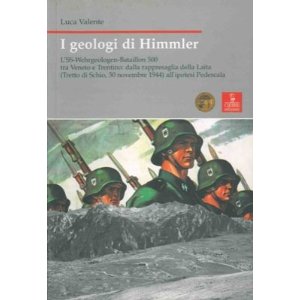
41j88edMsKL._SL500_AA300_Then, there is the historical detail – whatever their pulp mission could have been, the geologists and archaeologists of SS WGB 500 were involved in two terrible reprisal operations in the Italian Alps – in one case, executing the men in a village, and then shelling the houses from a distance, killing by firebomb women and children.
Luca Valente’s highly detailed I Geologi di Himmler is only available in Italian, but covers the events with precision, and a great documentary apparatus.

And of course, both Bager and Schafer ended up doing human experimentation on prisoners in concentration camps.

Alas, history is a lot crueler than the pulps.


2 Comments

Hunting sunken treasures

The first comment I got when I shouted “Wow! This is just great!” was along the lines of “Sounds like the sort of junk Clive Cussler writes.”
Talk about feeling alienated.
But let’s proceed with order.

1111bigOne of the few perks of living smack in the middle of Southern Piedmont is, in two hours I can be on the Cote d’Azure.
The sun, the sea, acres and acres of nubile, scantly clad young women stretching on the beaches…
And I normally end up in some antiquarian bookstore.
They even publish (or used to) a map of antiquarian bookshops in the Nice area.

So a few years back I was browsing the stalls of one such small Alladin caves of librarian wonder, and I caught me the three volumes of the Born Free series, first edition, and to round up the bill, I threw in a weird little book called Treasure Diving Holidays, by Jane and Barney Crile.
The book – a 1954 first edition – once bought and brought home, was placed on a high shelf together with other sea-oriented books, and soon forgotten.
Which is all right – I’m quite convinced books should be read at the right moment, so sometimes forgetting them on a high shelf is just what’s needed.
Then, when the time comes… I need some color and information for some seafaring stories I’m planning, and I go and rediscover this hidden gem.

What’s it all about? Continue reading


7 Comments

John Blofeld

His father was the inspiration for the James Bond villain.

6273610-MI discovered John Blofeld‘s The Secret and the Sublime when I was sixteen.
The book, in its gaudy, cheap Italian paperback edition, was interesting for two reasons.
First, because it connected with my growing interest for zen and taoism.
Second, because it promised to reveal Taoist Mysteries and Magic – which was extremely good, because I was tired of the standard, psaeudo-celtic, or D&D-derived magic in fantasy stories, and was looking for some off-beat inspiration*.

In the end, the book was useless in developing my own magic system – but in retrospect, it was probably instrumental in convincing me that “magic system” is the wrong idea when writing fantasy.
Magic should be magic – and sure as hell it feels that way in Blofeld’s book.
On the other hand, Blofeld’s book fueled my interest in the East, which is one of the reasons I’m writing this blog, and I still feel a strong affection for this small book. Continue reading


7 Comments

Learning to Fly (or to write about it)

I’m a sucker for teach-yourself manuals.

9780340966143Now, in 1938, a British gentleman by the name of Nigel Tangye published with Hodder & Stoughton a small handbook called Teach Yourself to Fly.
The volume was reissued in 1941, as a quick-and-dirty crash course for RAF newbies.

Now, c’mon, this is the 21st century – we are leery, and pretty skeptical, of one-package crash courses and Idiot’s/Dummies books about using Twitter or Mexican cooking.
And here’s a 75-years-old, 170-pages booklet, claiming to be the one-stop beginner’s course for fighter pilots?
In war situations?
One has to scratch one’s head, and wonder how gullible were they back in those days. Continue reading