Karavansara

East of Constantinople, West of Shanghai


Leave a comment

Karavansara Free Library: Six books by Emily Hahn

The Internet Archive is a treasure trove of free ebooks somehow related to Karavansara’s themes and topics.
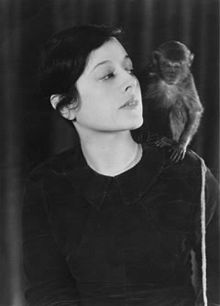
220px-Emily_HahnWe started the Karavansara Free Library with a few titles from Rosita Forbes, and now we follow up with another woman I find absolutely fascinating: Emily Hahn.
Another traveler, journalist and adventuress, American Emily Hahn was the woman that attended posh parties in Shanghai in the ’30s in the company of a diaper-wearing monkey – a fact that I mentioned in my novel The Ministry of Thunder, and I was criticized for writing rubbish. Ah!

Emily Hahn was also an expert on primates, a walking, breathing scandal, an opium addict (for a while), and a damn fine writer.
In her career as a writer she did comedy, politics, history, science and biography, art and travel memoirs.
When she was arrested by the Japanese after the fall of Hong Kong and was asked how could she have given birth to a child out of wedlock, she replied

I am a bad girl.

The Internet Archive has four books from her huge catalog ready for download…

1941 – The Soong Sisters

1946 – Raffles of Singapore, a Biography

1956 – All About Leonardo da Vinci

1959 – The Tiger House Party: The Last Days Of The Maharajas

hahn… and as a little extra, there’s two more volumes in the Gutenberg Project, Emily Hahn’s first two books.

1930 – Seductio ad Absurdum

1931 – Beginners Luck

All in all a fair selection, that shows the style, wit, skill and versatility of Hahn’s writing.

More books by Emily Hahn are currently being reprinted by Open Road Media, and are highly recommended.

14 Comments

Karavansara Free Library: Nine books by Rosita Forbes

I was putting together my latest post, the one about the reading list, and I got back to thinking about Rosita Forbes.
Old-time readers of Karavansara will remember that I did a post about Rosita Forbes in the earliest days of this blog, basically because I am in love with the lady.
To recap: independent and adventurous, Rosita married young, divorced, sold her wedding ring and left for good. She did a gig driving an ambulance during the Great War. Then she embarked in a tour of the world with a friend, gatecrashed the Paris Peace Conference, did a bit of spying for the British, and was a pioneer of documentary cinema. And found a lost city in the Sahara desert.
She met both Hitler and Mussolini, and Gandhi, and wrote about it.
And she also wrote a number of travel books and memoirs.

rosita_2886011b

And these are the books we are interested in, of course, because they provide us with the opportunity of seeing the world in the first half of the 20th century through the eyes of an adventuress. And an adventuress that could write.
Perfect.
And even better now that (mostly) the Digital Library of India has uploaded a fat stack of Rosita Forbes books on the Internet Archive – so that you can go there and download and read them, and what’s not to love about it?

Selection_630

So here it is, for the love of adventure, good books and Rosita Forbes, a selection of links1.

1919 – Unconducted Wanderers

1921 – The Secret of the Sahara: Kufara

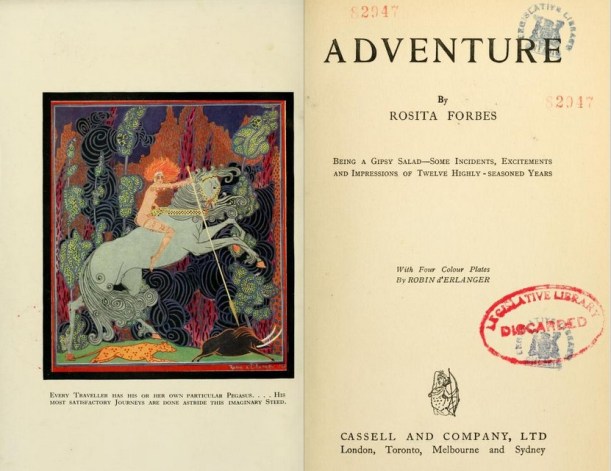
1921 – Adventure : being a gipsy–some incidents, excitements and impressions of twelve highly – seasoned years

1925 – From Red Sea To Blue Nile, Abyssinian Adventure

1927 – Forbidden Road: Kabul to Samarkand

1939 – India of the Princes

1940 – These men I knew

1944 – Gypsy in the Sun

1946 – Appointment with destiny

Not a bad selection, what?
I hope you enjoy these books – and any comment is welcome, as usual.


  1. and why not start a new series of posts, called Karavansara Free Library – legally free ebooks, a selection curated by yours truly. Might be fun, don’t you think? 


8 Comments

A story of two books

I mentioned this story in the past, but never wrote about it in detail – here goes.

I’ve been reading about the Silk Road for ages.
I started as a kid, with a much-edited and simplified version of Marco Polo’s Il Milione, and then with the Arabian Nights and then all the rest.
Journey to the West was another instigating read.
Then, one day, during a raid in a Turin bookstore, I chanced upon Luce Boulnois’ La Via della Seta, the Italian translation of a book called Silk Road: Monks, Warriors & Merchants. The book had actually been written in French, and published in 2001, as a summation of the research the author had carried out since 1963, and has been translated in a number of languages (nine, according to Wikipedia).
Boulnois was probably one of the top researchers on the subject of the history and culture of Silk Road, and the book is a classic. She was fluent in both Russian and Chinese, and she had traveled extensively, when she worked as a translator, in places often forbidden to Western scholars, collecting a wealth of information that she used as the basis for her studies.
But let me tell you about that Italian edition. Continue reading


5 Comments

Wild West Spooks

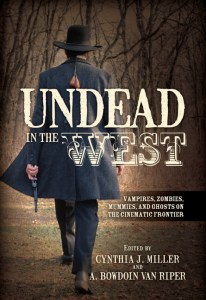
Selection_614I took some time with a good book this weekend – Undead in the West, that with the subtitle Vampires, Zombies, Mummies, and Ghosts on the Cinematic Frontier is exactly what the doctor ordered to lighten up my current black mood.

Published in 2012 by Scarecrow Press, the 300+ pages volume edited by Cynthia J. Miller and A. Bowdoin Van Riper is a collection of essays on supernatural horror movies and TV series set in the West, and/or using western movie elements or tropes such as John Carpenter’s Vampire$. Indeed, the films set in modern times covered in the book are just as many as those set in classical western age. Continue reading


Leave a comment

Pulp History: Savitri Devi

Writing historical fiction and historical fantasy can sometimes lead to the discovery of less-than-pleasant characters.
Yesterday I made the acquaintance of someone I only knew passingly: Savitri Devi – the woman who, among other things,  was convinced that Hitler was an avatar (or incarnation) of Vishnu. Which I’d file under crackpot were it not for the fact that the lady in question is a character worth of pulp fiction, and shows us an aspect of history some of us might have missed.

Savitri_Devi

Born of a Greek/Italian French father and an English mother, Savitri Devi started out as Maximiani Julia Portas in 1905. Graduated in chemistry and philosophy inLyon, she went on an archaeological expedition to Grece and developed an early interest in Aryan culture because of Schlieman’s discovery of a swastika in Anatolia.
Having renounced her French nationality to become a Greek national, she moved close to National Socialist political positions and travelled to India in search of the roots of the Aryan civilisation. She converted to Hinduism (if, most likely, her own version of Hinduism), and she was a spy for the Axis in India, keeping an eye on the British. Continue reading


Leave a comment

The Desert Island Whatever, part one – books

desert-island-adsThere is this game, you know about it of course. It’s the Desert Island Whatever… books, records, movies…

The idea is, you are stranded on a desert island, what books (or records, or movies) do you bring with you?

Now, let’s look at the thing from another perspective: you are sitting in a room filled with books, just like the one in which I’m sitting, and in a short while, say two or three weeks, you will have to take it to the road, and you’ll be able to carry with you just a small box filled with books, that you’ll be able to park somewhere – your uncle’s house, for instance.
All the rest you will have to leave behind.
What do you take with you?

I’ve been playing this game, that is still just a game, in the last few days, and it’s as hard as hell.
Because if you are a book lover, and you grew up with books, you have a connection with each and every book in your library, and losing them, or leaving them behind, is a soul-rending experience.
But anyway, let’s play the game. Continue reading


Leave a comment

80 years with and without Lovecraft

Today is the 80th anniversary of H.P. Lovecraft’s death.
I think I read all of the Gentleman’s stories, multiple times, and I liked them quite a bit.
I discovered HPL in high school, when I was reading all the fantasy and SF and horror (but not much horror) I could lay my hands on. Then I re-read it while in university, back when all of a sudden HPL was starting to make the news, to be critically appreciated. And I still read some of his better stories now and then, for nostalgia’s sake.
Now, according to a sort of scientific study I did with my old friend Fabrizio, the Lovecraftian reader’s evolution goes through three phases: Continue reading