
 One thing I’ve mentioned already, I think, is how, writing in both Italian and English, my writing changes.
Clearly, the two languages syntaxes are different, but it’s also my way of building phrases, and the rhythm of the phrases.
The dialogues change, the interplay between characters.
It’s not like I’m two different writers but, well, almost.
It’s clearly two different voices I’m dealing with – voices that go deeper than the tone and language of the individual stories.
 The thing has a direct impact on my writing.
Yesterday I picked up the old outline of a story for my sword & sorcery series, Asteria, and toyed with it for about two hours.
The story will be set in the steppes of Central Asia, and features swordfighting, adventure and what not. It will also be a nice chance to go back to a character I like a lot.
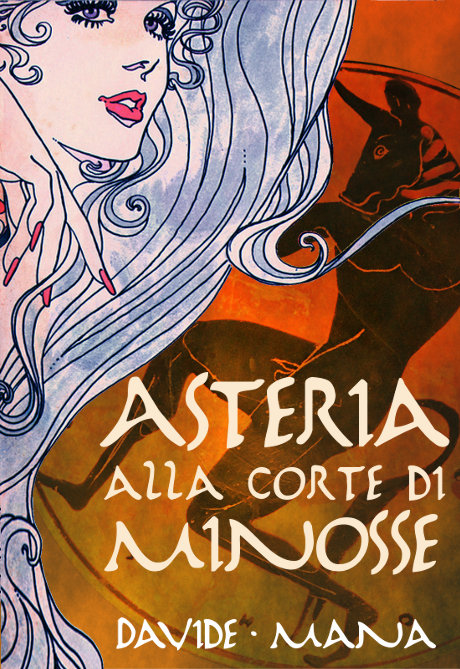
Now the first Asteria story – Asteria alla Corte di Minosse, a peplum-inspired, somewhat revisionist fantasy – was published in Italian.
A friend suggested I might write the new story in English.
They would have a wider market, and it might be more fun.
And well, I had to say no.
There’s the fact that the Asteria stories are pretty tough to write in the first place, for me. But more than this, quite simply, I do not think an Asteria story in English would work the way I think it should.
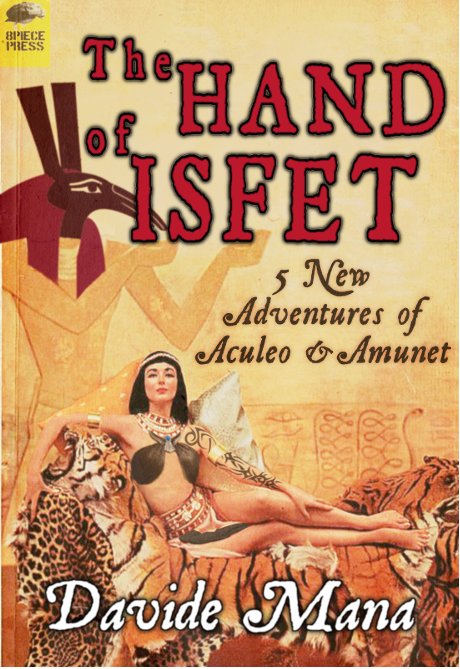 Fact is, I have tried it with my other s&s series, with a story of Aculeo & Amunet, and the result was not to my complete satisfaction.
Oh, it’s as fine a story as I can write, but the English version published in The Hand of Isfet is better.
Tighter, edgier. Faster.
The Aculeo & Amunet stories are the easiest for me to write – I have a nice feeling for the characters and their chemistry, I can simply point them in a certain direction and watch them go.
But they have to do it in English.
See, the Asteria story I wrote in Italian is equally tight and edgy, and features some of my best action scenes (if I do say so myself).
It’s not that my writing is better or worse in one language or the other. The point is, I created asteria in Italian and I “hear” the flow of the narrative, the tempo of the dialogues, the structure of the action scenes in Italian.
Conversely, to me Aculeo & Amunet are English-language characters – trying to write them in another language leads to something else.
Not necessarily bad – but not an Aculeo & Amunet story.
I have yet to decide if this is an inescapable fact, or a limit of mine I’ll sooner or later be able to overcome.
For the time being, I’m writing an Aculeo & Amunet story in English, and an Asteria story in Italian.
The plan is to have both ready by May.
It’s good.

 Karavansara
21 April 2015 at 08:48
The fun thing is: I noticed too that if I write a story in English and then translate it in Italian, it sounds strange, off. It sounds like I have two voices and if a story was born in English, it has a very specific flow and rythm.
So, yeah, I should have thought of it before suggesting an English Asteria 🙂
LikeLike
21 April 2015 at 08:59
For an English Asteria we’ll have to hire a translator.
LikeLiked by 1 person