
A few hours back I was chatting with my friend Lucy about one of the trickiest part of publishing.
Synopses, Amazon calls them.
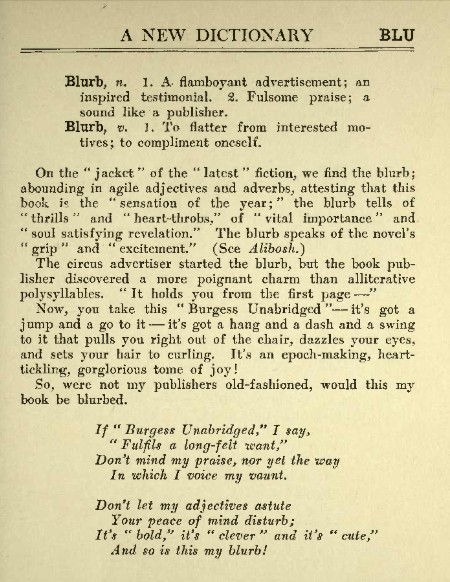
But I prefer blurbs.
You know, the digital equivalent of the book’s back cover copy.
The text that’s splattered under your book details on the Amazon page, and probably you attach to your ebook as part of the metadata.
It’s not the first thing the readers sees about the book – title, cover, author name and price come first – and yet it’s important as hell.
Because if it’s true that often the cover sells the book, the blurb has the all-important purpose of tipping the scales, helping the undecided to go on and shell out their hard-earned money.
There might be a job, in there – blurb-writer.
A sure-fire, 100%-hits writer of blurbs could sell them for five bucks per copy and make a living out of it.
 Now, as an author/publisher, I often do my own blurbs.
Which is not such a good idea – if you have a few beta readers, a nice thing might be asking them to suggest the back cover copy.
You don’t have to use any of what they suggest, but it might help.
And more generally, beta readers comments are useful, because they tell you what worked for them – and so what you might highlight in your blurb.
Because the blurb/synopsis should not tell the reader what’s in the book.
It should make the reader curious enough to know what’s in the book, he’ll pay to know.
So, while as usual there’s not a single correct way of going about it, I’d say that a few hours spent thinking about the blurb are hours well spent.
I do not have a proper formula, for my synopses.
I normally wing it.
But I have two… I don’t know, two main sources of inspiration, or crutches, or tricks.
The first, comes from ancient Chinese and Japanese poetry.
There’s a typical structure of popular Oriental poetry that (so I’ve been told) goes like this
First line – introduces the subject
Second line – defines the subject
Third line – introduces a second subject apparently at odds with the first
Fourth line – shows the deep connection between the two apparently unrelated subjects
This is a good structure.
It provides information (the first two lines), it baffles and intrigues the reader (the third line), and finally it adds the “aha!” factor with the closing line.
Of course our blurb can be longer than four lines – but it still could follow the four-part structure.
We can go with four short paragraphs.
When I have what I consider a viable blurb – built along the lines I just exposed, or whatever – I use my second tool.
His name was Don LaFontaine…
Laugh all you want – I just try and imagine my back-cover copy read out loud by the gravelly voice of the late Don LaFontaine.
Sort of like a Michael Bay movie trailer.
If it sounds good, I know it will sound good for my prospect readers, too.
What the heck, sure it’s not an exact science, but it seems to work for me.
Related articles


