
Nearly every other Station owns a ghost. There are said to be two at Simla, not counting the woman who blows the bellows at Syree dâk-bungalow on the Old Road; Mussoorie has a house haunted of a very lively Thing; a White Lady is supposed to do night-watchman round a house in Lahore; Dalhousie says that one of her houses “repeats” on autumn evenings all the incidents of a horrible horse-and-precipice accident; Murree has a merry ghost, and, now that she has been swept by cholera, will have room for a sorrowful one; there are Officers’ Quarters in Mian Mir whose doors open without reason, and whose furniture is guaranteed to creak, not with the heat of June but with the weight of Invisibles who come to lounge in the chairs; Peshawur possesses houses that none will willingly rent; and there is something—not fever—wrong with a big bungalow in Allahabad. The older Provinces simply bristle with haunted houses, and march phantom armies along their main thoroughfares.
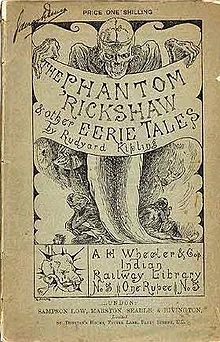 Oriental ghost stories, we said, and let’s start with Kipling’s The Phantom Rickshaw and other ghost stories, that you can find in a variety of formats on Project Gutenberg.
The book was first published in 1888, but I think the Gutenberg edition is somehow later, because it includes an extra story, The Finest Story in the World, that’s not listed in the Wikipedia page devoted to the book.
The original stories in the book were written by Kipling in his twenties, and published by The Pioneer or the Civil and Military Gazette.
 Karavansara