Karavansara

East of Constantinople, West of Shanghai


Leave a comment

My summer with Yoko #3: Vulcan’s Forge

This is where it gets personal.
The third Yoko Tsuno adventure, La Forge de Vulcain was published in 1973, and it is also the first Yoko Tsuno story I ever read, when I was about 9 or 10 – therefore, in 1976 or ’77, when it was published in Italian. The book was later published as the ninth English-language Yoko Tsuno volume, as Vulcan’s Forge.


Re-reading this about 45 years after the first time, I was impressed by how sharply I remembered some details – the Vinean jet changing configuration, shifting from standard atmospheric flight to vertical descent into the depths of the ocean and then the earth is probably what got me hooked.
But really, reading Vulcan’s Forge at such a young age clearly had consequences.


The story takes the Curious Trio to Martinique, where a Shell drilling platform has struck some unusual material – a material that Yoko recognizes as some of the mysterious metal used by the Vineans in episode #1. We soon find out that the drill perforated a pipeline built by the Vineans and carrying magma. The mix of molten rock and gas (what the Shell crew is here to tap) might cause a big blast and a tsunami, and potentially trigger an extinction-level event. Yoko (with Vic and Pol in tow) must join the Vineans in trying to set everything straight, and fast.
But a political change has taken place after episode 1 – no longer governed by a sociopath AI, the Vineans are now a somewhat fascist regime, led by the second-fiddle bad guy from episode 1, Karpan.
A dissident pro-human faction exists (mostly composed of Vinean women), but they are treated as traitors and terrorists.
So yes, this is a ego-engeneering adventure, with an extra of political intrigue and action, courtesy of the Vinean faction that is OK with exterminating humans.


This is a very hard-SF, tech-heavy comic book adventure – we get a lot of geophysics and geology, as we explore the caverns in which the Vineans live, complete with Verne-style giant mushroom forests and the remains of dead dinosaurs.
We get the usual expository passages and technical footnotes, and the mecha-design is as always absolutely top notch. – and we get to see a lot of Vinean hardware. The design of the drilling platform is also very fine and highly realistic.
This is a very hard-SF, tech-heavy comic book adventure – we get a lot of geophysics and geology, as we explore the caverns in which the Vineans live, complete with Verne-style giant mushroom forests and the remains of dead dinosaurs.
We get the usual expository passages and technical footnotes -this is supposed to be, in a way, educational or inspirational.


And as I said this is becoming personal, because 10-years-old me was getting heavily into volcanoes and dinosaurs at the time, and so maybe Yoko Tsuno had a hand in pushing me to pursue a career in earth sciences. And, I mean, why not?
And I did later work for Shell – something that might be controversial today (oil companies are not as environmentally concerned as they appear in this comic) but that contributed to make me what I am today.

Thankfully, Vic and Pol are out of the way for most of the adventure, while Yoko gets to meet a few characters from episode #1.
The character design is rapidly shifting to a classical Ligne Claire look(*), and for a young readers’ story this one looks like a million bucks. We are about to take a step back with the fourth volume, but for the moment, everything looks great.

(*) I think maybe I might need to do a post comparing the Marcinelle and Ligne Claire styles of Franco-Belgian comics. Supposing someone’s interested.

Leave a comment

My summer with Yoko #2: The Devil’s Organ

Roger Leloup’s second Yoko Tsuno adventure, L’Orgue du Diable, was published in 1973, and marks a big step forward in the series.
The first episode was a fine pilot, but as most pilot episodes do, suffered from an excess of stuff crammed in the 46 pages of the volume: characters introductions, early incidents, first big adventure complete with subterranean world, space aliens and ultra-tech.
A few months later, L’Orgue du Diable (that was published in English as The Devil’s Organ, and as volume #8 in the series) is a much leaner, meaner beast…


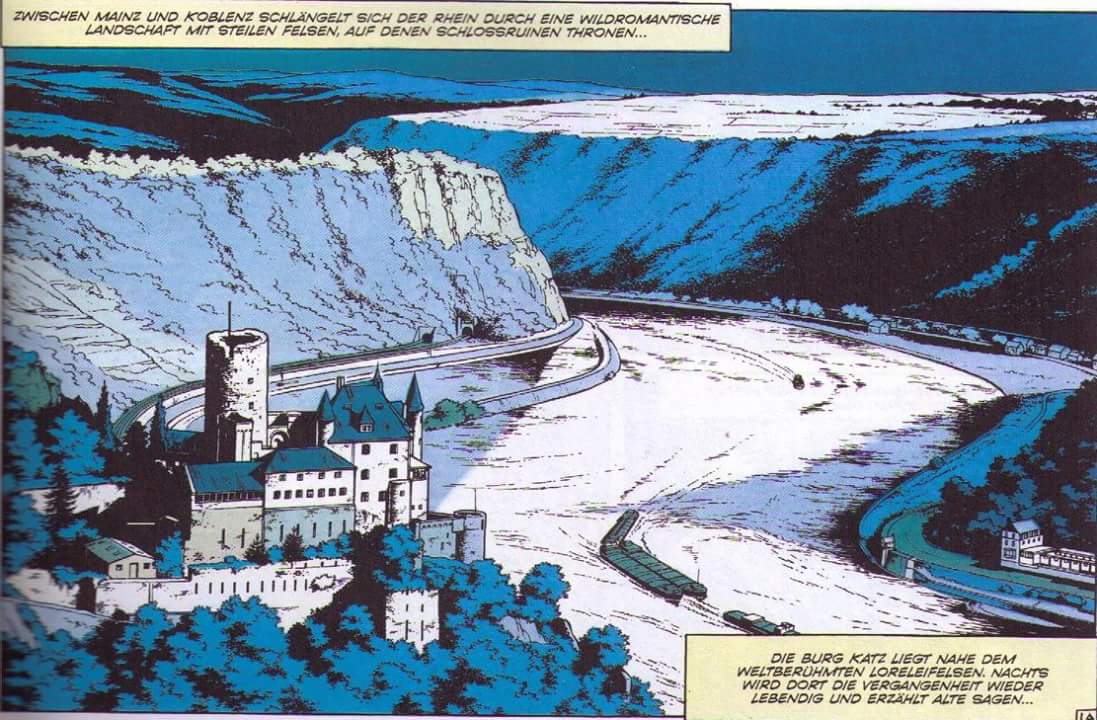
On a cruise along the Rhine, where they plan to shoot a documentary on the local folklore, Yoko, Vic and Pol come to the rescue of a young woman, Ingrid, whose father – an expert in the restoration of ancient musical instruments – was the recent victim of a mysterious “accident”.
The adventure follows the parallel tracks of a standard criminal investigation, and an exploration of an ancient local legend, about a cursed organ used during the Inquisition. Both tracks lead to the mysterious Castle Katz, where the plot goes full gothic before the very grounded, somewhat tech-savvy, and pretty gruesome resolution.

Improvements, we said.
Firstly, the art is much better than in volume #1 – as Leloup moves away from the more cartoony Marcinelle style and on to the Ligne Claire style that will characterize the later episodes in the series. The characters are less caricature-like, Yoko has lost her pony-tail to acquire her signature bangs, and Leloup’s eye for big panoramic shots and detailed mechanical designs comes to the fore.

The writing is also better: the characters are more defined, Vic and Pol are thankfully out of the way for most of the action, and plot is tighter and clearer – a basic murder mystery, somewhat in the Nancy Drew/Three Investigators/Scooby Doo style, with enough science and technology dropped in to justify the presence of an engineer as the main character. Here we deal with hydraulics, organs, and the psycho-acoustics of ultra-low sounds. And yes, this is a comic book aimed at teenagers.


Both dialogues and descriptions are still pretty verbose, and here and there the lettering makes for hard reading, but this is a minor gripe.
We can spot the bad guy before the big reveal by noticing he’s the only one to use openly racist slurs against Yoko (something that already happened in #1). This is glaringly obvious for grown-up readers, but once again, for teenagers in the early ’70s was a subtle but strong message.


The lack of a truly science-fictional twist also helps the story – the magnetic trains and the supercomputer in #1 were fine and fun, but here the more grounded, mundane plot gives more room for the characters to act, and their actions are more believable.
We also get a few nice action set-pieces, to spice the story.

In the end, everything’s solved neatly and – in an unexpected twist – Yoko decides not to report to the police her findings: the crimes have been committed, the culprit’s dead, and a scandal would benefit no-one.

It looks like the Yoko Tsuno series is finally firing on all cylinders, as we set down and wait for the second book that will see the light in 1973 – a mystery dealing with Vulcan’s Forge…


1 Comment

My summer with Yoko #1: The Curious Trio

Year in, year out, during the summer, I try and brush up on my other languages, the ones I have fewer opportunities to exercise. French, for instance. I read books, to bring back the little fluency I used to have, and refresh my vocabulary and my grammar.
This year, instead of novels or short stories, I decided to take a walk down memory lane – and having acquired decent copies of the original 29 issues of the Yoko Tsuno series, by Roger Leloup, I decided to re-read them and see how they hold up.

I have talked about the series in the past, and this re-read will be an opportunity to read the original French for the first time, and also a way to see whether the series, that was launched in 1970s, still manages to deliver on the science fiction and fantastic thrills, and still manages to hook me – after all, I was 10 the last time I read these stories.

And as I am at it, then… why not write a few posts about it?
I plan to spend the summer reading the volumes in the evening after dinner. Maybe someone is interested in my views on the subject.
Let’s try.

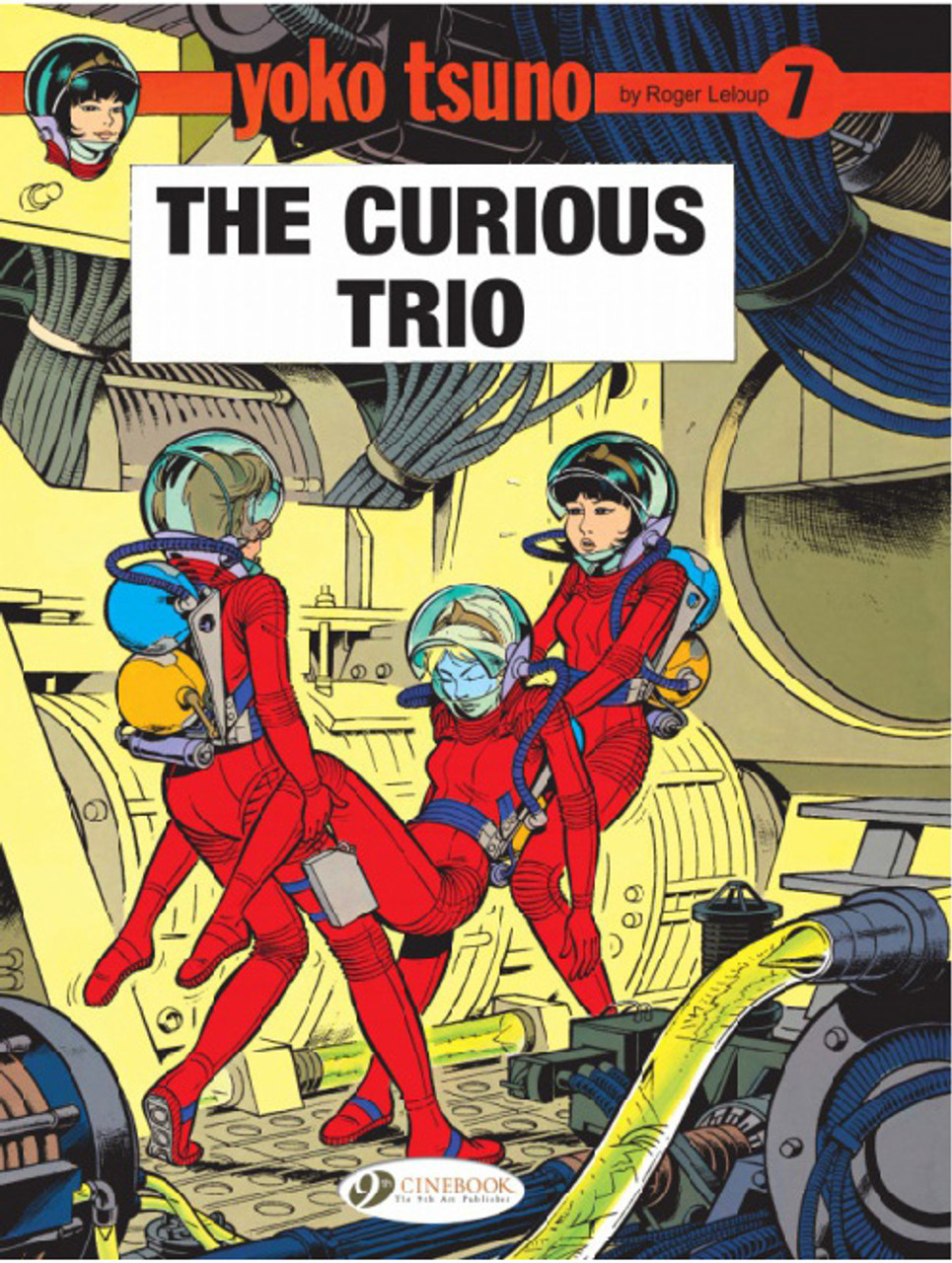
Yoko Tsuno #1, Le Trio de l’Etrange, was originally published in 1972 – Leloup had been publishing short episodes in the Belgian magazine Fantasio since 1970s, but only in ’72 the character made her debut in the libraries.
For mysterious reasons, the English version of this first adventure was published as volume #7, but for this project I’ll be following the original order.
Covers were also slightly different (spot the differences!)

Le Trio de l’Etrange has all the markings of the pilot episode in a series – we are introduced to the characters and the setting, we cram in as much action and strangeness as we can, and we close with a promise of more adventures to come.
Tune in next week… or something.

The plot, quickly: Vic and Pol (about whom, more later) are two young men working fort the Belgian State TV network in Bruxelles. They meet Yoko Tsuno, a young Japanese electric engineer that came to Europe looking for work but is currently working as troubleshooter/consultant. The three decide to set up a company producing independent documentaries – Vic’s a writer/director, Pol is a cameraman, Yoko can take care of all the engineering aspects.
Their first gig is a documentary about a subterranean lake out of town – they will try and chart the underground river that aliments it, and pinpoint the exit point. But things get weird fast, and the three find themselves as guests (or maybe prisoners) of a hi-tech subterranean civilization. The blue-skinned Vineans are refugees on our planet after their sun went nova. Their civilization is managed by a super-computer, but apparently the all-powerful AI is slowly going rogue.
Yoko, Vic and Pol face the computer menace and bring back peace to the Vineans before returning to the surface and deciding to continue on their mission of explorers of the unknown, dubbing themselves .

Nice and smooth.

This being the first Yoko adventure, the art and the writing are still pretty rough.
The art style in particular follows the Marcinelle school, which is somewhat cartoony and highly dynamic, but can sometimes have crowded scenes. Later the series will shift to a Clear Line art, crisper and more stylized.
For sure, the Yoko we first meet in this comic looks and feels very different from her later incarnations – but it’s OK.

The characters … oh.
Vic and Pol are particularly annoying, and it looks like for the first half of the story Leloup is not sure whether they’ll be the main characters or simply support cast. The two work as straight guy & funny guy, and in his role as comedy relief, Pol is particularly irritating. Granted, this is comedy aimed at ten-years-olds, and a modicum of eye-rolling is expected from older readers. The two male characters certainly work as foil for Yoko, that is sharp, hyper-competent and resourceful. In this first episode we’ll be witnesses to her technical skills, but also to her aikido prowess and even get a bit of Zen meditation.

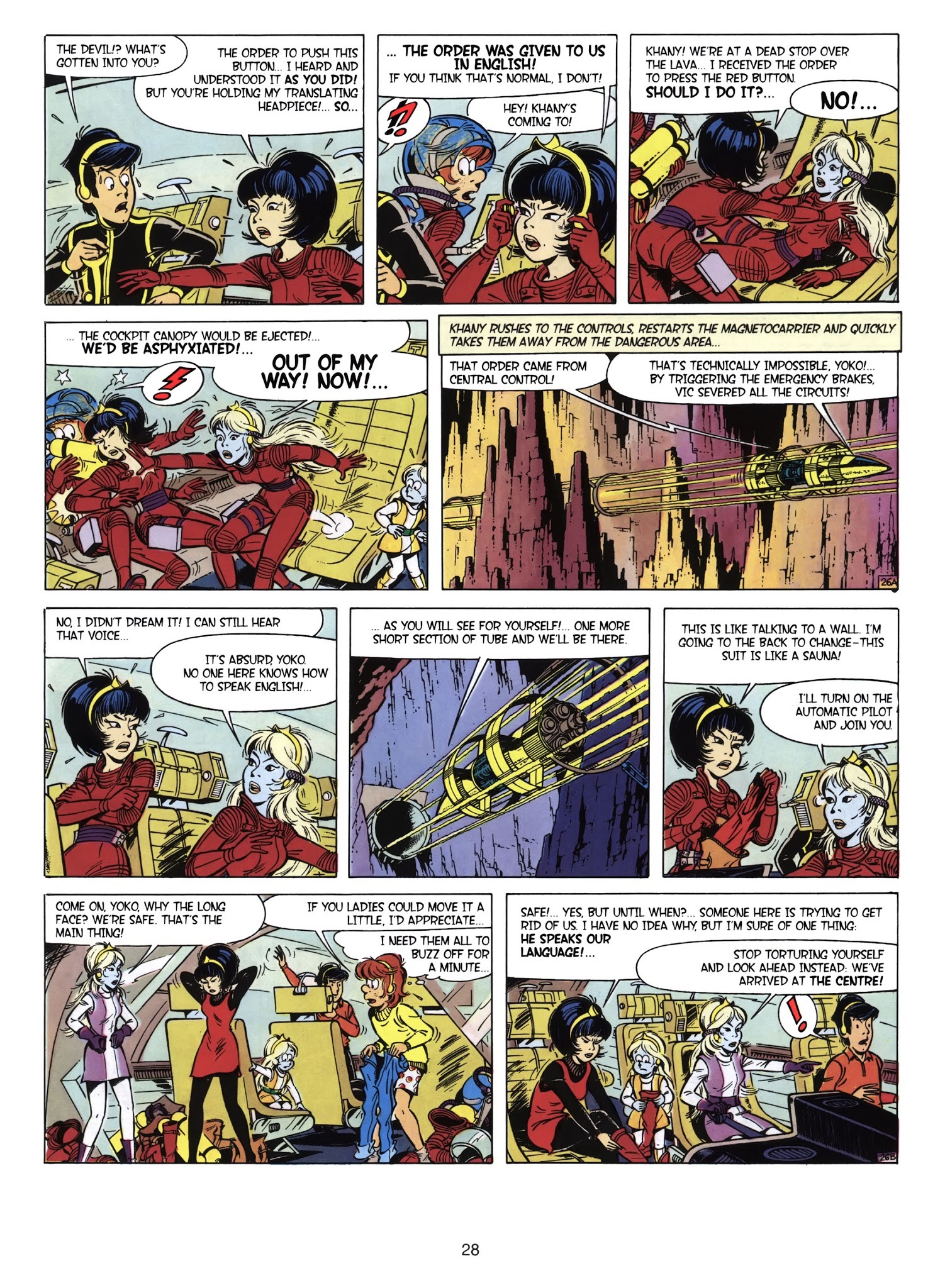
But talking about ten-years-olds – the hard-SF feel of the series is very grown up – and we even get footnotes to explain us what a Light Year is and other technicalities. The Vineans travel underground via what we’d call today maglev bullet-trains, and have a wealth of other hi-tech stuff – from instant translators to heat-guns to a huge computer-residing AI.
Everything is beautifully drawn, and this should not surprise us – before he struck out on his own, Roger Leloup used to do backgrounds and mecha design for Hergé’s Tin Tin comics.

All in all, The Curious Trio feels somewhat rushed and top-heavy, with A LOT of dialogue exposition, but delivers the thrills and the sense of wonder as promised. It’s a story of decent people in a world of decent people, where problems can be solved with smarts and conversation (and science!) instead of violence. Granted, I missed the awe I felt when, around 1976 or ’77 I first discovered the series, but I am not yet so cynical and soul-dead to find the story irritating.
And as I said, this is still the first outing for the characters and the series – we’ll see how things change with #2, L’Orgue du Diable (The Devil’s Organ).


1 Comment

Growing up with Yoko Tsuno

Today my heart broke for the second time for something that happened a long time ago – sometimes in the mid ’90s, my collection of Yoko Tsuno comics, the first ten volumes, was lost – my mom, god bless her, decided it was time to clear some space, and gave the books away, as a gift to the son of a friend of hers.
I was serving in the Air Farce at the time, and when I found out, it was too late.
Heart broken.
And today, a friend reminded me of Yoko, and my heart cracked again.

For the uninitiated, Yoko Tsuno was the main character in a series of comics created by Belgian artist Roger Leloup in 1970 – a series of science fiction thrillers featuring a young Japanese woman, an electronic engineer, as the main character. The series had a run of 29 volumes, the last being published in 2010. Leloup also wrote a novel about the character (and that I still have – hooray!)
The first adventure was The Curious Trio – in which we were introduced to the heroine, her team-mates and the blue-skinned aliens that would become a fixture of the series.

Continue reading