Here’s something pretty unusual – a restored first episode of Drums of Fu Manchu – the original, long lost 1938 movie serial, featuring Henry Brandon in the role of the Yellow Peril himself.
Note how the titles specify the story was “suggested” by Sax Rohmer‘s works.
November is NaNoWriMo month, and this year I am doing my own version of NaNoWriMo – I’m writing my doctorate thesis in one month.
Less than one month, actually.
It was not planned in advance – but real world engagements (such as, paying the bills and finding paying jobs thereof), caused the actual, sit-down-and-write work to slide further and further as the deadline loomed larger.
Then, in a final twist of fate, the email confirming the deadline was misplaced and popped up on my mail client with a delay of twenty days.
I don’t think this is going to count as a NaNoWriMo exercise (my thesis is not, after all, a novel), but actually I have to get 40.000 words – with images, bibliography and a few maps, ready for the 25th at the latest – and with ready I mean printed and sent to the Urbino University offices.
As most NaNoWriMo participants, I collected my material and coordinated my ideas well before the first of November – I have tons of notes, preliminary reports, articles, the works. The story… ehm, I mean, the dissertation paper is written in my head, illustrated with cool graphics, and accompanied by a solid map.
But I have to turn that ideal work into actual words on paper.
And ironically, this is going to engage all my pulp hack skills and tricks, this will be the final challenge, the ultimate workout.
If I come out of it alive, I will feel in the same league with the greats.
Pity I can’t use the Lester Dent formula on my thesis.
Now I’m toying with the idea of putting up a word counter, and enroll in the challenge itself.
But maybe not – after all, the judging commission might not appreciate the fact that I turned the sacred duty of writing down the results of my research in a challenge set to the standards of some weird Canadian thing.
But let’s see how it works out.
Any way it goes, it will be fun.
It’s Halloween!
Or it will be soon.
And to celebrate this pagan festivity, why not spend a few hours with the Swamp God?
Bride of the Swamp God, the first story in the Aculeo & Amunet series, is free on Kindle from the early hours (Pacific Standard Time) of October 30th to the late night (ditto) of November the first.
Now you know – tell your friends (and your enemies!)
Enjoy!
Big Trouble in Little China (Photo credit: Wikipedia)
OK, so I said there’s two pulpish adventure movies I’d never get tired of, but actually there’s another one.
Jack Burton: Well, ya see, I’m not saying that I’ve been everywhere and I’ve done everything, but I do know it’s a pretty amazing planet we live on here, and a man would have to be some kind of FOOL to think we’re alone in THIS universe.
Big Trouble in Little China came out in 1986, an unusual forage in the fields of martial arts and wuxia by horror master John Carpenter.
The movie is both a homage to Hong Kong action cinema and to those pulps of old in which Chinatown was sort of a parallel reality made of opium dens, whorehouses, strange shops and warring triads.
In Big Trouble in Little China there is it all.
And then some.
A cartload of pulpy fun, really, and the movie that really started my curiosity about Hong Kong cinema.
The set up – Jack Burton only wants his stolen truck back. But in the streets of San Francisco’s Chinatown he’ll meet beautiful women with green eyes, warring gangs, an evil immortal Chinese wizard and his three supernatural bodyguards. Jack and his unlikely allies will have to enter the Cinatown underground, and face even more strangeness*.
Kurt Russell as Jack Burton, Victor Wong as Egg Shen and Kim Cattrall as Gracie Law. (Photo credit: Wikipedia)
For the standards of the 1980s, Big Trouble in Little China is fast – it’s one of the fastest actioneers ever shot, full of plot twists, fights and weirdness.
Carpenter plays his Hong Kong cards well, and Kurt Russel has a great time in the role of down-to-earth Jack.
Big Trouble in Little China is Pulp all the way through, and yet, it allows for some fun twists.
Carpenter switches the roles of hero and sidekick – so that Jack is a big-mouthed poser “whose heart is in the right place, but whose ass isn’t” (in the words of star Russell), while his sidekick Wang Chi is the fearless, competent fighter.
In the same way, the role of leading lady Gracie Law (Kim Cattrall) breaks with the standard cliches, short-circuiting the classic hero-gets-the-girl mechanic, while adopting a hawksian comedy style.
There’s a lot of magic, a lot of martial arts, a big hairy monster, and enough wisecracks and quotable dialogue to make everybody happy.
And there’s quite a bit of Chinese history and Taoist magic thrown in, which is very good.
Finally, Big Trouble in Little China develops a wonderful, deep and meaty self-contained universe – the Chinatown of the title could house dozens of great stories, be the site of a score bloody battles, and outside of its borders none would be the wiser.
———————————-
* The story was co-authored by W.D. Richter. the script doctor that had directed in 1984 that other great pulp movie, The Adventures of Buckaroo Banzai.
Which I do not rewatch every time I catch it on the telly simply because they never pass it on the telly.
But I’ll write a post about it, sooner or later.
Homer was also called Melesigenes (son of Meles) by the name of the brook which flowed by Smyrna, and today, through İzmir. (Photo credit: Wikipedia)
The first story that really struck me was probably the Odyssey*.
Not in its original version: the Homer poem was adapted in a number of forms and media, and I guess I first found a simplified illustrated version among my uncle’s old books, in my grandmother’s attic.
A “boys library” book from the fifties of some sort.
I was six, and I was learning to read.
A TV adaptation was produced and broadcast in Italy in 1968, featuring some state-of-the-art SFX (for the time), and co-directed by Italian fantasy cinema giant, Mario Bava; I probably caught a rerun in ’73 or ’74, more or less while I was reading it in school – this time in a comic-book adaptation.
And later still I finally read some of the original, again as part of the History and Literature curriculum in school.
So, let’s say that between the ages of six and twelve, I was exposed to multiple re-tellings of the same story.
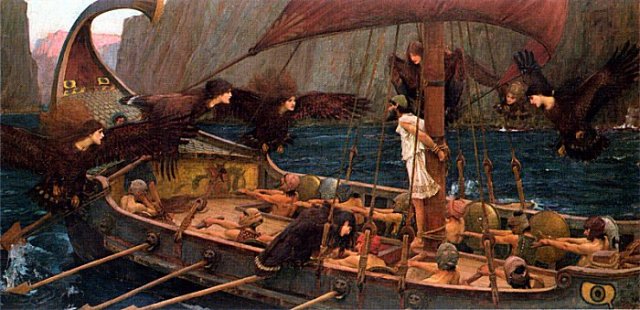
And the story is straightforward and well-known – a veteran of the War of Troy, Ulysses is on his way back home to Ithaca, together with his crew and companions. He faces a number of challenges, often being himself the instigator of the problems he is going to face. He meets mythical creatures and strange phenomena, he seduces and is seduced by dangerous women, he faces and defeats various enemies, he finally comes home to reclaim his own.
Ulysses at the court of Alcinous (Photo credit: Wikipedia)
The story is episodic, and part of it is narrated in the first person as a flashback by Ulysses himself.
The Odyssey is also used as a classic example of the so called Monomyth, or Arch-plot – not that I cared much as a kid.
What captured me as a kid and still stays with me today is the fact that Ulysses is an explorer – a man of intelligence and cunning, not just a muscular hero. His problems often arise from his cunning and his curiosity – a dumber hero would probably never get caught in some of the situations Homer describes.
Ulysses is not a martial hero, and while being an action character, he speaks for the intellectual thrills of adventure, for the fascination of the unknown, as much as he does for the more traditional challenges involving brawn and bravery.
To a rather solitary kid in a large industrial city, the adventures of Ulysses spoke loud and clear.
Then there is the world in which Ulysses moves – a world in which human intelligence is matched against supernatural occurrences, capricious gods, strange creatures.
It’s a fantasy world (or, at the time of Homer, a science fiction world), and yet it is superimposed on a real geography, a real history.
It’s a strange world, but one that to a kid – or an adult – is extraordinarily exciting.
As a kid, being able to read about cyclops and sirens, about ghosts and gods, and yet find books with photographs of the treasures of Troy, maps of the Greek isles in which the places mentioned by Homer could be found, was an exploration in itself.
And I think in the end being exposed to such a massive dose of Odyssey in my early years led to a number of personal choices in matters as different as deciding my course of studies, setting my reading tastes, and finally influencing my writing.
———————————–
* It’s a close thing with the Arabian Nights, which was heavily featured in my childhood, in the form of bedtime stories, coloring books, and assorted media adaptations. But I guess the Odyssey came first and struck deeper.
Despite my free time becoming more and more scarce as a lot of deadlines loom closer, I went and I enrolled myself in an online university course.
The course is interdisciplinary in nature, and is calledThe Future of Storytelling. It wasdesigned by the University of Applied Sciences of Potsdam, and is hosted on the Iversity platform.
This is a Massive Online Open Course (MOOC), and I am one of the 50.000 students worldwide taking part in the course.
The reasons why I am sacrificing my precious free time for this course are many, but basically I am intrigued by the idea of the Future of storytelling, by the interaction of stories and media, and also, with each passing day, I feel storytelling might after all be my future.
Also, the idea of taking part in an interdisciplinary course with a student population the size of a small town was quite exciting.
So, I went and signed up.
It will not be a painful sacrifice at all.
As part of the course, participants are given weekly creative tasks, to put the contents of each set of lecture into focus.
We are also invited to share these tasks with other students.
I’ll be posting my tasks here on Karavansara – both because it’s a valid option offered by the course designers, and because I believe in the value of growing up in public.
The first work I’ll be doing for the course, goes up tomorrow.










 Karavansara