The Weird Tales issue for March 1933 hits the readers with yet another installment of Otis Adelbert Kline’s Buccaneers of Venus (that by now has got me curious enough that I’ll probably read it in October), yet another novelette by Seabury Quinn featuring Jules de Grandin, and then two stories by Robert E. Howard and Clark Ashton Smith.
As luck would have it, The Tower of the Elephant and The Isle of the Torturers are two of my favorite stories by the respective authors. And I have already posted about both this year, so for today I will just link here what I wrote.
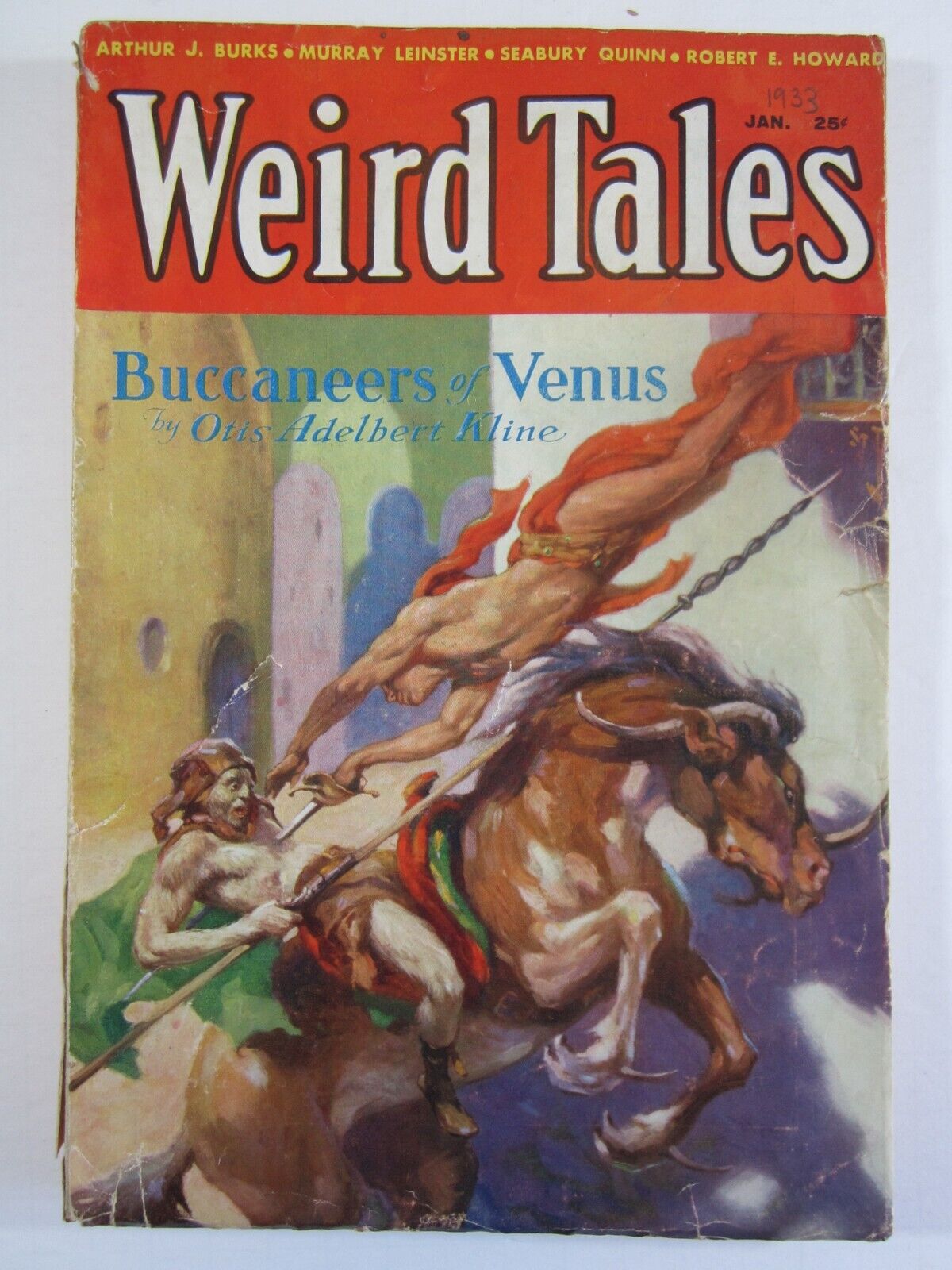
January 1933 brings a new issue of Weird Tales, featuring the works of Murray Leinster, Edmond Hamilton, Seabury Quinn and a new installment of Otis Adelbert Kline’s Buccaneers of Venus (that again gets the cover). The letters section includes one from Jack Williamson. And halfway through the issue we find a new Robert E. Howard story featuring Conan the Cimmerian, the novelette The Scarlet Citadel.
The story is an almost direct follow-up of the one in the previous issue. King Conan of Aquilonia again has to defend his throne, this time by two treacherous nearby kings, the rulers of Ophir and Koth, aided by the sinister Tsotha-lanti, a sorcerer born (or so they say) of a Zamoran dancing girl and a black demon.
And here we get what is for me the most interesting element of this story: while in Phoenix on the Sword Howard dropped a lot of names of conspirators and aristocrats, here the naming game has a clear worldbuilding purpose. Cited en-passant for color, we get nation and cities of the Hyborian world, and we get passing references at Conan’s career. The upstart mercenary of the first story now reveals a past as a pirate and an adventurer all over the map. That a map has not yet been drawn for the readers is incidental – Howard has clearly the whole of Hyboria sketched in his mind.
Meanwhile, Conan is trapped in a dark dungeon, meets a number of weird horrors, fights the first of many giant snakes, and frees Pelias, a suavely dangerous sorcerer that helps him get his revenge (and provides transportation in the shape of a giant bat-thing).
We get a massive, epic battle and we catch a glimpse of the politics Conan/Howard, that is clearly critical of monarchy. Conan is a king that actually cares for the well-being of his subjects – a fact that leaves himself surprised.
Random note: king Conan has a harem. Ah, the barbaric life!
The story is solid, while not being one of my favorites. Much probably depends by the order in which I originally read the Conan series – I always found the tales of the older Conan, dealing with politics and court conspiracies rather boring when compared to the more swashbuckling adventures of his youth.
But that’s just me. In his second outing, Conan is finding his legs, and the Hyborian world is taking shape around him.
The Cimmerian September starts tomorrow – a month in which a number of Youtubers will read all the original Conan stories written by Robert E, Howard, and post videos about it. And I thought, why not do something similar here on Karavansara?
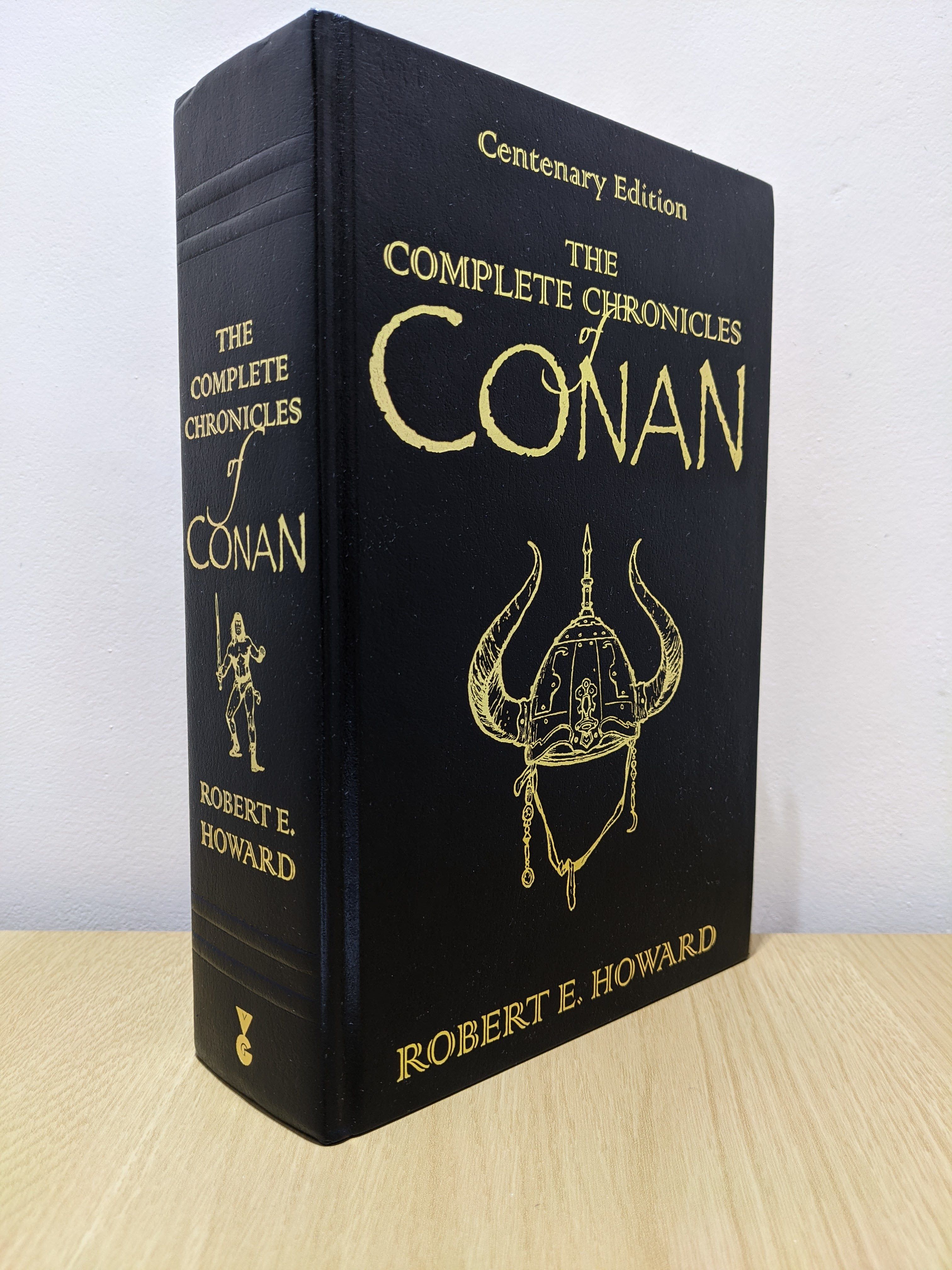
Robert E. Howard wrote only 21 stories about Conan during his life, and those are the ones I’m going to read.The reference edition I’ll be using is the Gollancz The Complete Chronicles of Conan, Centenary Edition edited by Stephen Jones.
For reason of portability I might also check The Coming of Conan the Cimmerian, published by DelRey, that collects the earliest stories of Conan, masterfully illustrated by Mark Schultz. I’ll add a simple copybook to jot down notes while reading in bed or out in the garden, and I’ll get me lots of hot tea and treats, because, why not?
The idea is to go through the series from cover to cover, and then write a post about them – possibly collecting two or three stories in one post for practical purposes.
While there are stories that I re-read regularly, most of the series belongs to a dim and distant past, and it will be fun to revisit the Hyborian Age after all this time. I will also try and squeeze in some extras, and do some extended cut for my Patrons. But anyway, tomorrow we start. Watch this space. It’s going to be fun.
I was wasting time on Youtube after dinner, and I stumbled on this video by the esteemed Michael K. Vaughan (that you should really follow if you like good books)
… and I thought, why not? I own a copy of the Gollancz book mentioned in the video, and this might be a nice excuse to get the three DelRey books, too (I need the first volume, anyway, just for the art by Mark Schultz). So yes, I could read the whole Howard Conan in September, and because I do not have a vlog, I could post here. Or maybe do short podcasts – one episode for story (or vice-versa). Or something else. But I want to do it, and barring accidents, I will do it, by Crom! Watch this space.
Robert E. Howard’s The Tower of the Elephantwas published in the March 1933 issue of Weird Tale Magazine, and is the first of the two stories I selected for the forthcoming “Four from Conan” episode of my Italian-language podcast, Chiodi Rossi, that we are recording in 48 hours.
Because with my friend Germano we decided to do only four stories for this episode, and each one of us would select two, the choice was particularly hard. I have read all the original Howard-penned Conan stories a number of times, and I have a handful in my “best of Conan of all time” selection. Choosing only two is torture – especially because one has to be People of the Black Circle.
So I weighed the pros and cons of each possible choice, I checked my counterpart’s choices, and finally decided to go with The Tower of the Elephant.
Art by Sanjulian
The Tower of the Elephant is one of the “Conan as thief” stories, and shows us a young Cimmerian as he learns to know the ways of civilization. Indeed, the story includes one of the most quoted lines in the whole Conan canon…
Civilized men are more discourteous than savages because they know they can be impolite without having their skulls split, as a general thing.
The Tower of the Elephant, chapter 1
The set-up is quite simple – a brash young thief, Conan decides to ply his trade in the Tower of the Elephant, in which the sorcerer Yara holds the Elephant’s Heart, a jewel that is said to be the source of his power. Smart thieves avoid the Tower, that is guarded both magically and mundanely. But Conan is young, bold, probably overconfident, and looking for challenges…
Art by Benito Gallego
It is a very basic sword & sorcery plot – a simple heist, and indeed the story has been adapted into a roleplaying game scenario, because, really, it’s the perfect setup for an adventure. Like any basic heist story, it features a rival for the hero – Taurus of Nemedia – and a number of menaces/traps/tests the hero need to overcome to reach their goal.
But Robert E. Howard at 27 was a more sophisticated and smart writer than your run of the mill sword & sorcery hack, and he slips a stunning twist in the last chapter, while infusing his story with what can be only described as sense of wonder. Pure, unadulterated, science-fictional sense of wonder.
Art by Mark Schultz
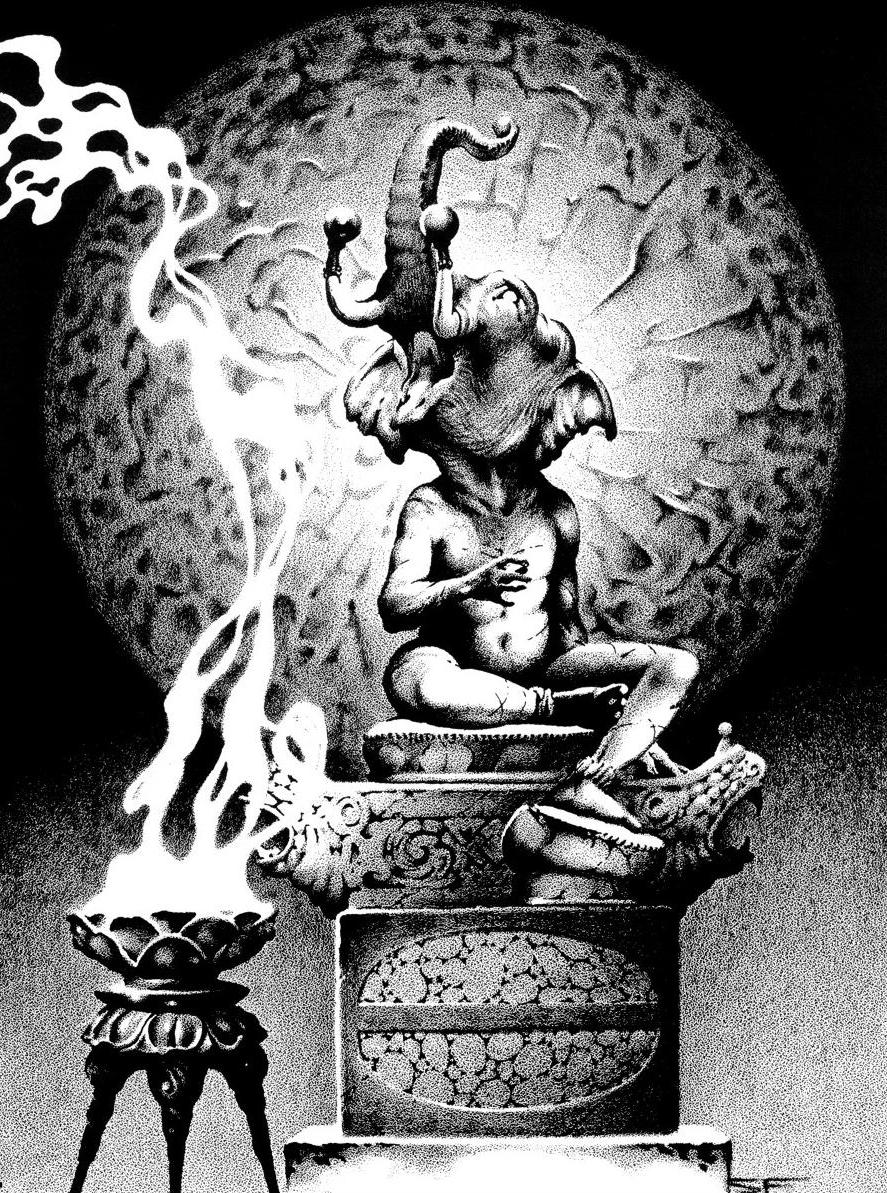
Because the Tower turns out to be the prison of Yag-kosha, a member of a space-faring species that has been on Earth for ages, a witness to the rise of the Hyborian world. Confronting blind, chained Yag-kosha, Conan is offered an overview not only of the history of his world, but also of the wonders of the cosmos, and is finally made into the instrument of the creature’s liberation and revenge.
Ruthless and amoral he can be, but Conan holds a barbarian’s simple sense of justice, and his horror at the condition of Yag-kosha counterpoints the awe the reader feels for the wonders the creature describes.
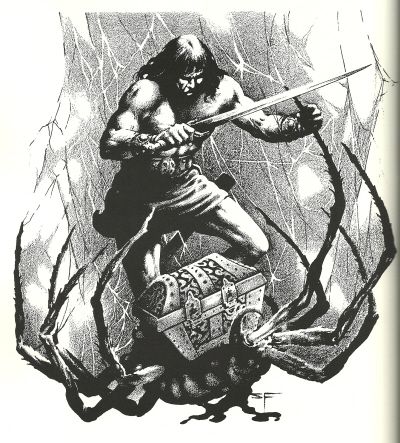
Art by Stephen Fabian
The story is fun, surprising, and carries the raw energy of Howard at his best. It is compact and essential, and still packs quite a punch.
We saw men grow from the ape and build the shining cities of Valusia, Kamelia, Commoria, and their sisters. We saw them reel before the thrusts of the heathen Atlanteans and Picts and Lemurians. We saw the oceans rise and engulf Atlantis and Lemuria, and the isles of the Picts, and the shining cities of civilization. We saw the survivors of Pictdom and Atlantis build their stone age empires, and go down to ruin, locked in bloody wars. We saw the Picts sink into abysmal savagery, the Atlanteans into apedom again. We saw new savages drift southward in conquering waves from the arctic circle to build a new civilization, with new kingdoms called Nemedia, and Koth, and Aquilonia and their sisters. We saw your people rise under a new name from the jungles of the apes that had been Atlanteans. We saw the descendants of the Lemurians who had survived the cataclysm, rise again through savagery and ride westward, as Hyrkanians. And we saw this race of devils, survivors of the ancient civilization that was before Atlantis sank, come once more into culture and power—this accursed kingdom of Zamora.
The Tower of the Elephant, chapter 3
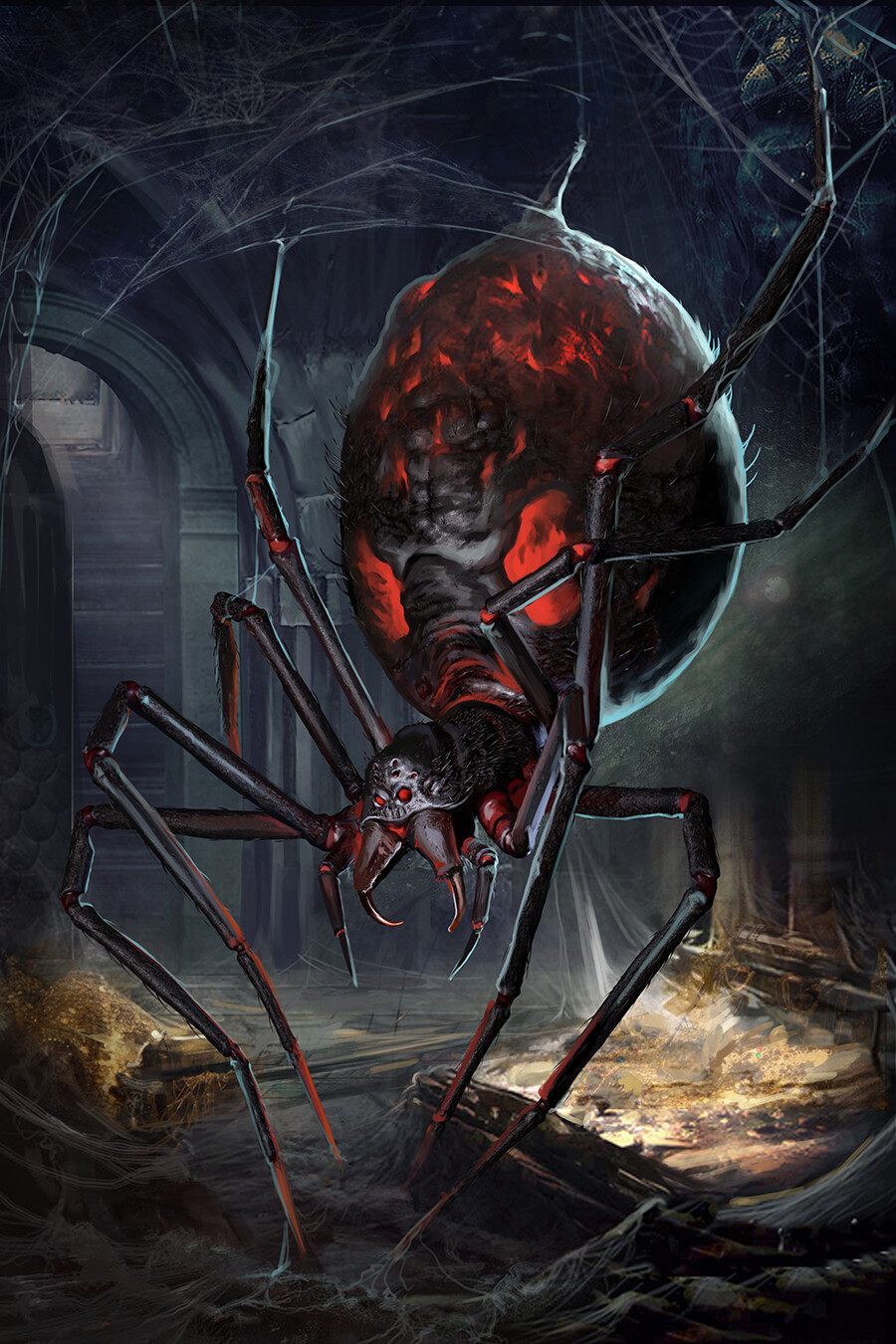
There are a number of reasons why I chose this story. I love the setting, the city of Arenjun in the nation of Zamora, and the disreputable neighborhood of the Maul, a kaleidoscope of peoples, deftly described in a single scene. I like young Conan as he tries to come to terms with civilization. There is a good deal of action, including a fight with a giant spider (together with giant snakes, quite a common specimen of Hyborian fauna). We also get a thumbnail summary of Hyborian history. And the whole third chapter, with Yag-kosha’s narration and death, and then Conan confronting Yara the Sorcerer to dish out some barbarian justice, is absolutely excellent.
This is also one of the rare stories in which Conan does not get the girl – for the simple reason that there is no girl. And it’s OK like this.
Art by Dai Nguyen
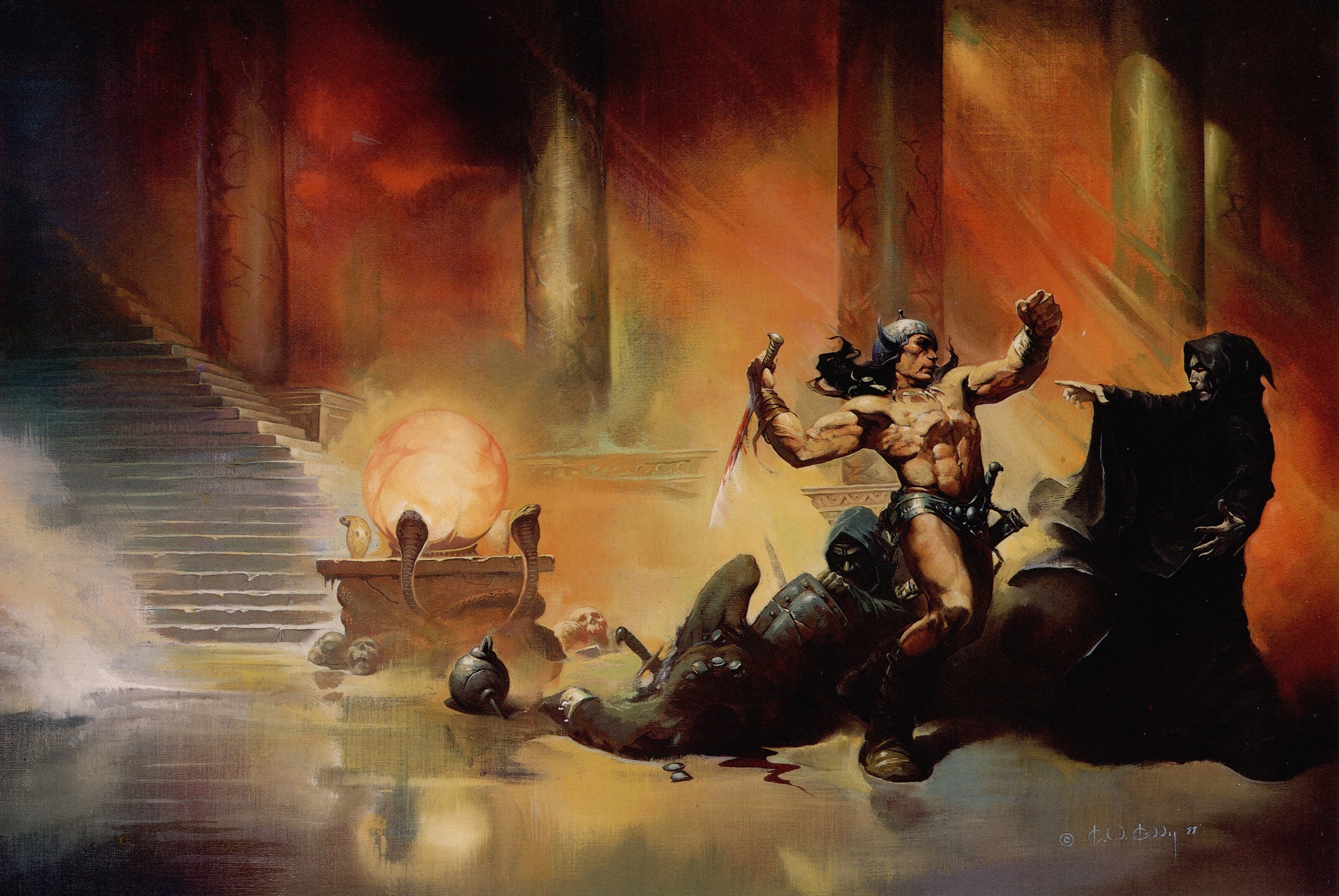
The Tower of the Elephant is a short story, and yet it offers a perfect balance of worldbuilding, action, adventure, horror and wonder. It is strikingly visual, and this explains probably why so many artists have created paintings and sketches based on it. I have placed a few examples in this post.
I have also linked the electronic text of the story, in Wikisource, and the complete scans of the March ’33 issue of Weird Tales in the Internet Archive.
And as an extra bonus, here is an audio-drama adaptation:








 Karavansara