

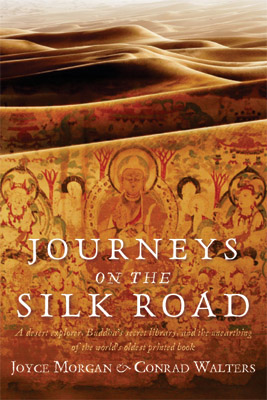
 The latest addition to my ever-growing library of books about the Silk Road is Journeys on the Silk Road *, by Joyce Morgan and Conrad Walters.
The book was published in 2012 and was a gift from my brother.
The book focuses on Aurel Stein‘s second Silk Road expedition, between 1906 and 1908.
Following his passion for the history of Central Asia and a series of often unlikely leads, Stein reached the Mogao Caves – also known as the Caves of Thousand Buddhas – in the Taklamakan region, and there he started playing a bargaining game with the local monk, the Daoist Wang.
At the end of a long battle of wits, the monk agreed to part with a few thousand ancient texts, which had been waiting in a cave for eight centuries.
The collection – which Stein acquired somewhat wholesale for 130 sterling pounds – included texts in a number of languages, and on a variety of subjects, from sacred texts to personal letters.
A veritable cross-cut of a multicultural community whose existence had never been suspected by western scholars.
The bundle included the oldest printed book known – a woodblock print copy of the Diamond Sutra, one of the central texts in the Buddhist canon.
Morgan & Walter’s text does therefore shift its attention from the old explorer to the text, outlining its importance for the development of Buddhist culture in Asia, but also its impact on Western culture.
All in all, a book that touches on so many interests of mine, it was impossible for me not to like it a lot – I started and finished it in one day, also thanks a very long train journey.
The volume is highly enjoyable and gives a sympathetic, humane portrait of Stein, a giant of archaeology who’s been somewhat forgotten by the public, and whose activities in Cantral Asia are often portrayed as piracy and plunder, not excavation and research.
The book keeps a balanced view of Stein’s work, while presenting the reader with a character that is, as they say, larger than life.
Filled with anecdotes, quotes from Stein’s diaries, books and letters and a good number of funny bits.
Stein’s companions on the road and his competitors in the race for the Mogao Caves are a gallery of unique characters.
Great reading.
And the book is also supported by a nice and informative website.
————————————————–
* The title “Journeys on the Silk Road”, and variations thereof, must be the most widely used when Central Asian travel and Silk Road exploration are concerned.
Which is not bad – dial it in the Amazon search window, and you’ll find a treasure trove of great reads, and excellent music.
Related articles
- The Secret Art of the Silk Road (bbc.co.uk)

 Karavansara