


My interest for Ancient Egypt is on record – I talked about a book on Egyptian archeology just a few days ago, I used to hang out at the Museo Egizio in Turin as a kid, and I’ve been writing a series of stories featuring an Egyptian sorceress.
I love this stuff1.
And I liked very much a recent article posted on the website of the University of Melbourne, about a complex, wonderful work of reconstruction carried out on the head of a mummy in the university collection: a young woman of 18/25 years called Meritamun.
It is a type of study called forensic archaeology, and it’s quite interesting: the researchers’ and the artists’ work is extraordinary, and Meritamun is absolutely beautiful2.


If you’d like to read more, here is a link to the original article, which features a wealth of information, and also some fascinating videos.
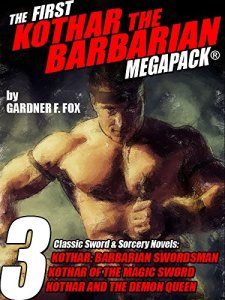 Last week I received a gift certificate for Amazon, and – after buying a gift for my brother’s birthday – I went on a rampage through my wish list.
Among the dozen or so ebooks that I bought – and some of which you’ll see reviewed here in the future – I invested about two bucks in the two Wildside Press Megapacks dedicated to Kothar the Barbarian.
A Conan clone that hit the stalls in 1969 to ride the wave of the Cimmerian’s success, Kothar appeared in five novels: Kothar: Barbarian Swordsman, Kothar of the Magic Sword, Kothar and the Demon Queen, Kothar and the Conjurer’s Curse and Kothar and the Wizard Slayer.
All of these were the work of Gardner R. Fox – an author I did not know, and that is certainly a fascinating discovery for me. Continue reading
Had lots of fun, a few nights back, watching Ronal the Barbarian, a Danish animation movie released in 2011.
It was the perfect end to a few weeks spent re-watching old sword & sorcery movies1, and a wonderful discovery.
The 90 minutes feature is basically what Pixar would do if Pixar movie characters were allowed to wear next to nothing and say f#ck a lot… and it is absolutely a hoot.
Today I will bore you guys with a post about writing.
Back in 2014 I did a piece on how I use a spreadsheet to plan my action scenes.
And of course there is the good practice of keeping track of word count and time spent writing to improve productivity1.
Today I found out another interesting application for spreadsheets: explore an ongoing series of stories, trace character arcs and keep the new material fresh.
And maybe I’m re-inventing the wheel, but…

Writing a series, especially if we are writing the different episodes out of chronological order, presents a number of pitfalls.
How many sword & sorcery stories – not to mention roleplaying scenarios! – start in a tavern? How many times did our old friend Conan fight a giant snake? How many times the bad guys motivation boiled down to “evil”? Continue reading
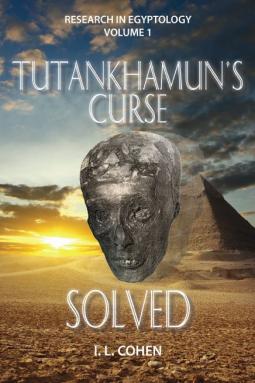 I must admit I was rather skeptical when I started reading I.L. Cohen’s Tuthankamun’s Curse Solved, the first volume in a series called Research in Egyptology.
The legend of the ancient pharaoh’s curse has been done to death ever since the 1970s, and as a kid of the ’70s I was exposed to a number of pseudo-scientific books that were great fun and excellent fodder for my Cal of Cthulhu games, but were sometimes a little jiggly when it came to science.
I.L. Cohen’s research, if nothing else, is presented in a well-documented, believable way, and if some of the researcher’s conclusions are still pretty wild1, some of the arguments that this book raises are worth be explored further.
Based on modern analysis of both the reports of the mysterious deaths of many of the Carter/Carnarvon expedition, and a lot of other sources about the deaths of many aegyptologists, and some of their finds, Cohen comes to the conclusion that radiation could be the cause.
The Egyptian archaeological record could be filled, according to the author, with evidence for massive, widespread radioactive pollution and consequent deaths.
He also proposes – and here is where I get a bit skeptical again – the existence of an elite in Egyptian society that knew about radiations and their effects, and that basically handled nuclear emergencies in ancient times.
From here on, things get wilder, but in a scientific, well-documented, somewhat believable way.
The book is very good, well written and filled with informations, quotes and extracts from classical studies, and it is both entertaining and thought-provoking2.
Today it’s the birthday of Edgar Rice Burroughs, a man that, out of his dreams of escape from a monotonous, soul-killing life, built a whole culture – a culture of which I am part, and if you are here reading this, you are too.
And just don’t take my word on this.

I loved Tarzan movies and books as a kid, but it was discovering John Carter in high school that was a revelation.
If you really need to know it, my favorite by Burroughs is The Land that Time Forgot, with Pellucidar a close second – yeah, I like dinosaurs.
But should I choose a single title, I’d go for The Master Mind of Mars.
And so here’s a little game, for you… Continue reading

