I am back online, having scrapped one PC and set up a new one – with the usual corollary of backups, lost passwords and money I would have rather not spent.
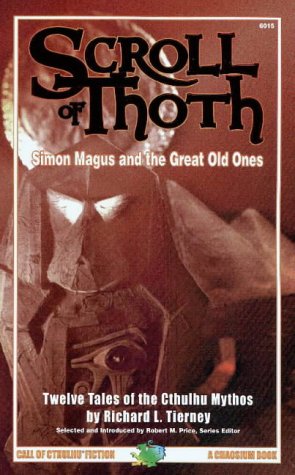
And while I was offline, working on my system, I received the news of the passing of author Richard L. Tierney, at the age of 86. I had discovered Tierney with a book by Fedogan & Bremmer called The House of the Toad – a solid entry in the Cthulhu Mythos catalogue. If that book was what put Tierney on my radar, it was the collection The Scroll of Thoth that turned me into a fan – because in Tierney’s stories about Simon of Gitta I found everything I liked in my sword & sorcery: a historical setting, a cast of intriguing characters, a modicum of Yog-Sothotheries, and a first class style of writing. What else could anyone ask?
Indeed, I usually mention the stories in that old Chaosium anthology as one of the main influences on my own sword & sorcery stories.
Through the years, Tierney became one of those writers whose work I was always on the lookout for, but that seemed to appear only in small press/limited editions, hard to find volumes.
In the last two years, the reprinting of the Simon of Gitta stories in the volume Sorcery against Caesar, and of the massive novel Drums of Chaos had been a welcome opportunity to spread the knowledge of this writer, by giving away ebooks as gifts to my friends.
Richard L. Tierney’s passing hit me like the loss of a loved uncle, the sort that you see only occasionally, but whose appearance is always a welcome occasion. He will be sorely missed.
I’ve just got my contributor copy of The Nefarious Villains of Sherlock Holmes, edited by David Marcum for Belanger Books. The volume includes my story “The Tiger and the Bear”, featuring Sebastian Moran.
As for the photo, I can quote the late Leonard Cohen and point out “I don’t usually look this good, or this bad (depending on your politics)”.
Queens walk in the dusk Thomas Burnett Swann, 1977
What an unusual book!
Thomas Burnett Swann was a critic, a poet and a writer of fantasy. He used classic mythology and history in his stories, and Queen walks in the dusk, while the first of the Latium Trilogy dealing with the origin of Rome, was in fact is last book, published posthumously – Swann died in 1976.
Swann’s name had been on my radar for ages – mentioned in articles and essays, sometimes compared to Jack Vance for his prose. That’s high praise indeed, and reason enough to check this guy out. It was a while now I wanted to read his books, and I decided to start from this one. And I was impressed, baffled, and utterly fascinated.
Queens walk in the dusk is a retelling of the story of Dido and Aeneas. I understand that to English-speaking readers, the story is familiar, if at all, through Henry Purcell’s opera, but to us in Italy, it is part of the school curriculum, and as such we know it well, and hate it (because we often hate what is imposed on us by school programs). So there is this sense of deja-vu, in the story Swann is telling us. But the strangeness and the charm of this book is not in the story itself – that is good, mind you – but in the style.
The world in which the story is set is the one of the ancient Greeks and Romans – a world peopled with monsters and gods that enter the everyday lives of the inhabitants, a world in which you can hold a conversation with a ship’s spirit. The sense of wonder of this state of affairs lays not in the extraordinary, but in its commonplace status. This is a wonderful world because everywhere is magic, and power. It is also quite cosmopolitan, the characters being aware not only of the various kingdoms and peoples of the Mediterranean, but also of far-away India (we visit an elephant town in Africa in which Ganesha is worshiped by the elephant population). And the story is told in such a world in a way that reminds one of the ancient epics – not for its bombast, but for its straightforward manner in which wonders and magic are presented, and for its economy. Dido loves Glaucus. He is killed by her brother Pygmalion. She flees Thyre, stealing half the fleet, and builds Carthage. Aeneas flees the burning Troy and seven years later lands on the coast of Carthage. All this, in thirty, forty pages. Not a word is wasted, and yet at the same time the language is rich, with a tempo that recalls a ballad or an oral tradition more than a book, a modern novel. The thoughts and the actions of the characters are thoughts and actions from the ancient world, guided and informed by different mores, and a different morality. This makes some situations particularly grating – Ascanius, Aeneas’ ten-years-old son is appalling in his role as a sex-obsessed smartass who tries in the bluntest of ways to get his dad a woman to replace his dead mother. But the character is historically realistic and true to the version in the Aeneid – and let’s admit it, we hated the little runt even in Virgil’s original, back in high school.
And yet, for all of these classically-derived elements, Queens walk in the dusk is a thoroughly modern tale, and one that gives us characters with complex and fully-developed psychologies.
The final result is strange, but highly entertaining and quite good. I will read more of Thomas Burnett Swann’s novels, and I fully understand why, while many seem to have forgotten him, those that remember his work cherish it and consider it a classic.
(WAIT! What happened to Book #2?! Apparently, WordPress decided to lose the programmed post – I will reload it in a few days. Sorry for the inconvenience)
So, it’s the end of the year. Today we celebrate St David, so I’ll have a bit of a celebration, here alone in the fog-shrouded countryside, and then I’ll take a while off.
I will take this time to r4echarge my batteries before I dive into my writing work again in January, and I will also put the finishing touches on my silly projects (aka “good propositions”) for 2022.
I should be writing, but I am reading instead. It’s very cold, the countryside is still and dreary, and I need to recharge my batteries. I have stories to write, stories to translate, work on two games over which the deadline looms closer and closer. But like I always do, like I have been doing ever since I was eight, I got a new book for Christmas, and I am reading it.
The book is Dangerous Visions and New Worlds: Radical Science Fiction 1950-1980, and it is a multi-faceted, in-depth survey of what I grew up calling “New Wave”.
Edited by Andrew Nette and Iain McIntyre, this is part of a series, and I should get the other two books – about counterculture and youth culture in pulp and popular fiction respectively.
It will be a while, I am afraid, because as I have explained elsewhere, one of my good propositions for 2022 is to stop buying books until I’ll have been through a substantial part of my ever-growing TBR. I will also cut all unnecessary expenditures, in an experiment whose purpose is trying to stop compulsive (and meaningless) buying.
This sounds a lot more radical and political than it really is, and goes well with the book I am reading – because here we have the highs and lows of the revolution, the Swinging London of Michael Moorcock and the savage fury of authors like Ellison, Disch, Farmer.
The volume is a collection of monographic articles, nicely illustrated with covers from the books of the time. For someone like me, that grew up reading SF in the late ’70s and through the ’80s, this is like browsing an old school yearbook, and catching photographs of old friends.
It is also a dire menace to my promise of not buying books in 2022 – because a lot of the titles discussed I read, but a lot I only know through word of mouth, and now, after seeing them so intelligently analyzed, I want to read them.
Today I took a day off from the web. I shovelled some snow off the courtyard and then went with my brother for a supply run. In the next weeks, we will hole up in our house and crawl under a stack of blankets.
And while I was away from my PC, the news dropped about the Summer of 2022 release schedule from Aconyte Books … and lo and behold, there is my name on the list!
I am therefore happy to announce that next year my novel The Raiders of Bloodwood will be released by Aconyte, as part of their line of novels supporting the Descent, Legends of the Dark tabletop game.
The novel is a sprawling high fantasy romp, featuring a mismatched band of common people that will find themselves in a tight spot, and will have to learn to be heroes. It is going to be fun.
I am very proud of being part of the Aconyte team, and I am very happy with the opportunity they gave me to write a big fat novel filled with monsters, escapes, battles, magic and strangeness.
And here is the cover, by the excellent Asur Misoa.





 Karavansara