Karavansara

East of Constantinople, West of Shanghai


Leave a comment

Cimmerian September #7 – Rogues in the House

The seventh Conan story, Rogues in the House, shares the pages of the January 1934 issue of Weir Tales with the usual suspects – Seabury Quinn, Clark Ashton Smith, Edmond Hamilton, Abraham Merritt, Howard Wandrey. H.P. Lovecraft appears in the mail section.
The Howard story does not make the cover, but has other points of interest.

The plot starts out almost hard-boiled – a nobleman is in danger of being exposed as a traitor by a high priest, and arranges for Conan to escape from jail on the condition the Cimmerian will kill the priest. Things get complicated and the three main characters end up trapped in the priest’s house, playing hide and seek with a simian creature.

The story is short and economically written, and shows Howard trying out new plot devices and structures, while at the same time exploring the Conan biography – we have met the king, the mercenary, the pirate, now we meet the thief.
Conan is his usual barbaric self, and the civilized characters are there to act as foil.
Howard continues to portray the aristocracy as corrupt and unreliable – both a critique of civilization and of the class system at large; but the criminals in the thieves’ quarter are no better, of course.

In the end Conan faces Thak, the simian servant of the High Priest, who has finally decided to free himself from his master. The scene was made famous in a Frank Frazetta cover, and was used in the second Conan movie, in a sequence partially inspired, of all things, by Enter the Dragon.

While the story threads much of the usual terrain, the different premise and the setting are a welcome change.


2 Comments

Cimmerian September #6 – The Pool of the Black One

The October 1933 issue of Weird Tales has possibly one of the most iconic covers of all time, and features the usual selection of stories, spearheaded as usual by Seabury Quinn. Both H.P. Lovecraft and Frank Bellknap Long have stories in the magazine, and Conan is back with the story The Pool of the Black One.

The story is not particularly memorable – coming after The Tower of the Elephant is hard – but it does have one of the most memorable openings in the whole series, as a soaking Conan climbs up on a vessel in the middle of the ocean.
This, we find out, is Conan in his pirate days – and he’s had a falling out with his former friends, the Barrachan Pirates. He is accepted on board and has an eye for Sancha, the captain’s woman (who shows a similar interest).


From here, the story proceeds to a visit to an uncharted island, peopled by sinister humanoids who capture and plan to sacrifice the crew. The titular pool is the place where the strange creature dwell, and in which they cast their prisoners to kill and shrink them
As predictable, Conan saves the day and goes back to the ship, having won the girl and found a crew with which he’ll launch a further career in piracy.

Apart from the opening, the only other noteworthy bit in the story is probably Sancha, a Zingaran noblewoman who, kidnapped by the pirates, found that she enjoyed the lifestyle of captain’s mistress.
She’s selfish and amoral, and injects a little excitement in a story that goes from one set-piece to the next with the usual energy but with a certain lack of momentum.

A fun romp, but hardly one of Howard’s best.


Leave a comment

Cimmerian September #5 – The Slithering Shadow

This is where I come in.
The comic book adaptation of The Slithering Shadow marks the first time I became aware of Conan.
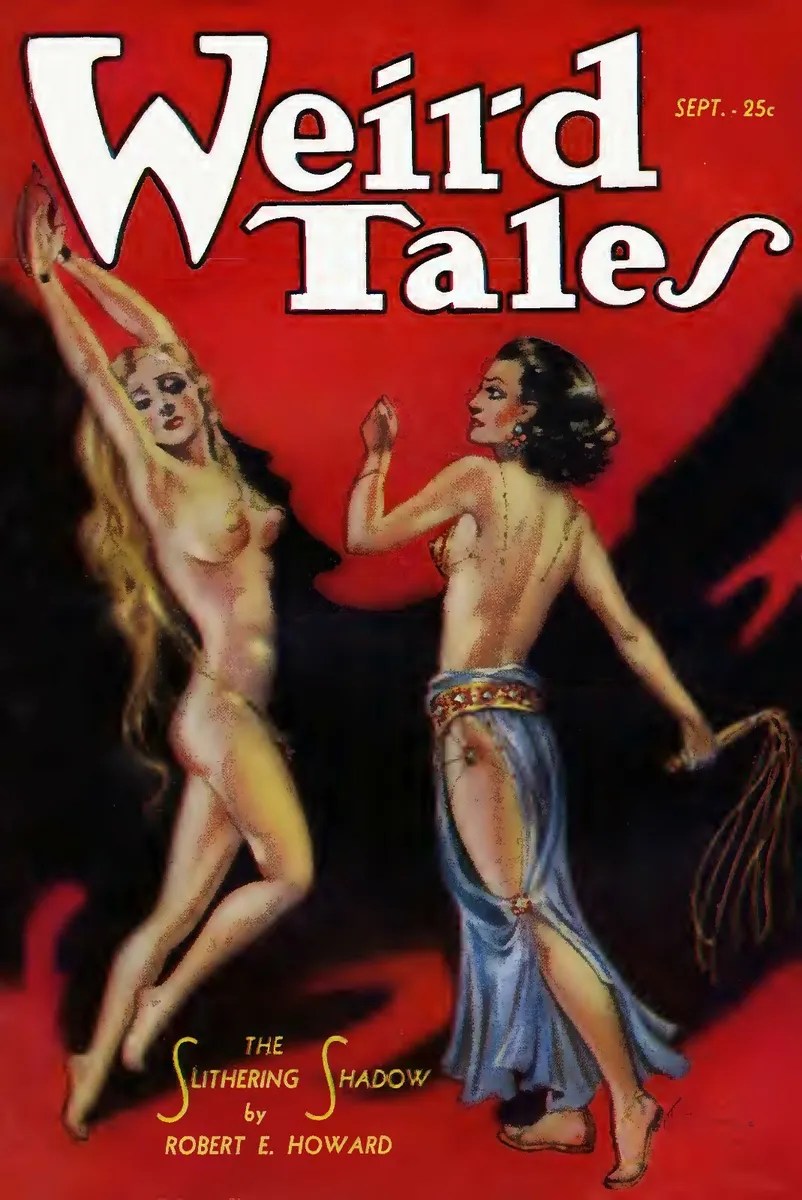
The story was originally published in September 1933 issue of Weird Tales – and again made the cover. The Howard piece was the opener of an issue jam-packed with great stories: Edmond Hamilton and Seabury Quinn, Hugh B. Cave, Jack Williamson and Frank Bellknap Long.


The story opens with Conan in his mercenary days, last survivor – together with a blond slave-girl, Natala – of an army that was destroyed in battle by the Stygians. Lost in the desert, they find refuge in a strange citadel, where the few inhabitants spend their time in drug-fueled dreams, and serve as snacks for Thog, a Shoggoth-like creature.
The situation is further complicated by Thalis, a evil woman that develops an interest for Conan (or maybe for Natala – it’s complicated).

I found the comic-book adaptation of this story, by Roy Thomas, John Buscema and Alfredo Alcala sometimes in the early 80s. Subsequently, I decided to check out the stories by Howard, and here we are.

The Slithering Shadow (sometimes known as Xuthal of the Dusk) has all the elements that to me, today, mark the perfect sword & sorcery story: a mysterious place, a lost civilization, clear, small scale stakes, a sexy evil woman, a creative monster. Howard provides also a lengthy flagellation scene – that apparently Margaret Brundage found inspiring.
This is not Howard’s best story, but it’s pretty solid, it is compact and economical, with great action scenes and a creeping sense of menace.
Maybe Natala is somewhat insipid as a character, but Thalis more than compensates what the blonde is lacking. And the setting reprises the sense of wonder and the deep past on the previous Tower of the Elephant. To me this is way better that the usual “undead sorcerer, conspirators and battlefield” formula that Howard has been milking so far,,
True, Fritz Leiber called it childish – but it’s never too late for having a happy childhood.


Leave a comment

Cimmerian September #4 – Black Colossus

And finally, in June 1933, Robert E. Howard and Conan finally make the cover of Weird Tales.
The story is Black Colossus, and after the cosmic wonders of Tower of the Elephant, Conan is back to his initial formula. A kingdom in peril, an evil wizard, and a mighty battle.


Awakened after 3000 years of undeath by a thief, the evil wizard Thugra Khotan, under the alias of “Nathok”, builds an army and start spreading north from the borders of Stygia. The kingdom of Khoraja is next in line, and in the absence of its young king, the rule of the land falls of young princess Yasmela, who is in the wizards sights as a potential consort. The girl consults the priests of Mithra and is told to entrust her future to the first man she’ll meet on the road. The man happens to be a Cimmerian mercenary, Conan.


All the standard elements of a Conan story are featured in Black Colossus – the evil undead wizard, the young princess that falls for Conan, a giant snake, a huge battle. Even the contempt for the aristocracy is there, and probably an in-joke about Prohibition.
Howard manages to make movement of troops and strategy as entertaining as ever, and we have the finale with the wizard killed by a sword used as a throwing weapon.
The end result is fun, and shows once again Howard’s skill in building his geography on the run.
Yasmela is a little lacking in personality, and does not shine as other female companions of the Cimmerian would.
But the story id more that OK.

Silly personal detail: the (beautiful) Margaret Brundage cover was the image we initially selected for the launch of our fantasy movie podcast, “Chiodi Rossi”; we changed it when we received some complaints by some acquaintances that were afraid Facebook would have penalized them should they share our “pornographic imagery” on the social network.


Silly, of course – but having the first episode of our podcast self-censored by nervous friends would have been a very bad start. We selected another image.
Poor Brundage – 90 years on, they still can’t tell her art from smut.


Leave a comment

Cimmerian September #3 – The Tower of the Elephant

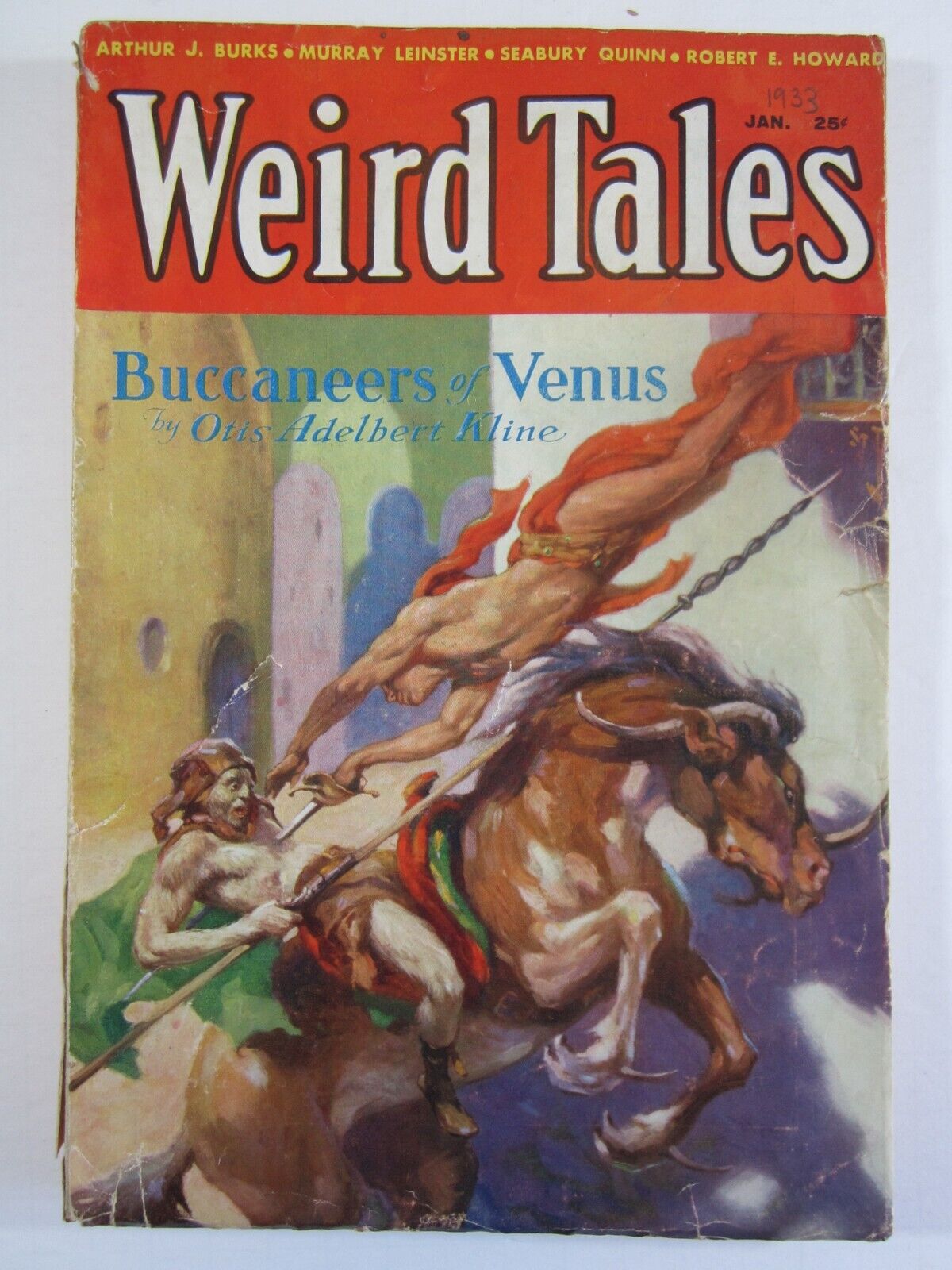
The Weird Tales issue for March 1933 hits the readers with yet another installment of Otis Adelbert Kline’s Buccaneers of Venus (that by now has got me curious enough that I’ll probably read it in October), yet another novelette by Seabury Quinn featuring Jules de Grandin, and then two stories by Robert E. Howard and Clark Ashton Smith.

As luck would have it, The Tower of the Elephant and The Isle of the Torturers are two of my favorite stories by the respective authors. And I have already posted about both this year, so for today I will just link here what I wrote.

The Tower of the Elephant

The Isle of the Torturers


2 Comments

Cimmerian September #2 – The Scarlet Citadel

January 1933 brings a new issue of Weird Tales, featuring the works of Murray Leinster, Edmond Hamilton, Seabury Quinn and a new installment of Otis Adelbert Kline’s Buccaneers of Venus (that again gets the cover). The letters section includes one from Jack Williamson.
And halfway through the issue we find a new Robert E. Howard story featuring Conan the Cimmerian, the novelette The Scarlet Citadel.

The story is an almost direct follow-up of the one in the previous issue. King Conan of Aquilonia again has to defend his throne, this time by two treacherous nearby kings, the rulers of Ophir and Koth, aided by the sinister Tsotha-lanti, a sorcerer born (or so they say) of a Zamoran dancing girl and a black demon.

And here we get what is for me the most interesting element of this story: while in Phoenix on the Sword Howard dropped a lot of names of conspirators and aristocrats, here the naming game has a clear worldbuilding purpose. Cited en-passant for color, we get nation and cities of the Hyborian world, and we get passing references at Conan’s career. The upstart mercenary of the first story now reveals a past as a pirate and an adventurer all over the map. That a map has not yet been drawn for the readers is incidental – Howard has clearly the whole of Hyboria sketched in his mind.

Meanwhile, Conan is trapped in a dark dungeon, meets a number of weird horrors, fights the first of many giant snakes, and frees Pelias, a suavely dangerous sorcerer that helps him get his revenge (and provides transportation in the shape of a giant bat-thing).

We get a massive, epic battle and we catch a glimpse of the politics Conan/Howard, that is clearly critical of monarchy. Conan is a king that actually cares for the well-being of his subjects – a fact that leaves himself surprised.

Random note: king Conan has a harem. Ah, the barbaric life!

The story is solid, while not being one of my favorites.
Much probably depends by the order in which I originally read the Conan series – I always found the tales of the older Conan, dealing with politics and court conspiracies rather boring when compared to the more swashbuckling adventures of his youth.

But that’s just me.
In his second outing, Conan is finding his legs, and the Hyborian world is taking shape around him.


Leave a comment

Cimmerian September #1 – The Phoenix on the Sword

And so it begins -it’s December 1932 and Weird Tales magazine offers quite a selection to those readers willing to spend 25 cents: there’s a Jules DeGrandin story by the ever-popular Seabury Quinn, and stories by Edmond Hamilton, Vincent Starret and the second installment of Buccaneers of Venus (who gets the Allen St John cover), by Otis Adelbert Kline, plus the conclusion of a serialized reprint of Mary Shelley’s Frankenstein.
The third story in the issue is a new novelette by Robert E. Howard, featuring a new character – Conan the Cimmerian, in his first outing, The Phoenix on the Sword.
And this is the first day of Cimmerian September.

In fact, Howard is pulling a fast one – his King Kull story, By this axe I rule has been rejected, and being a writer who pays his bills by selling stories, he has simply reworked it in a new story, featuring a new character.
Nice and smooth.

The plot is straightforward – the rogue Aquilonian aristocrat Ascalante is riding a group of upper class malcontents, who resent the fact that a barbarian, Conan, has taken the throne of the kingdom. The conspirators think they are in control, and Ascalante is their tool – but is in fact the contrary. Yet, Ascalante’s royal ambitions are undermined by his slave, the Stygian renegade wizard Thoth-Amon, who has plans of his own. In the middle of all this game of shadows sits (literally) Conan, a former mercenary turned usurper, and target of a murder plot.

This is the first Conan story, and it is a strange beast – sure, the Cimmerian is here, muscular, brooding and animated by a sort of barbaric nobility his courtiers lack. But some things are still here from Kull’s tenure; in his fight against those that would overthrow his rule Conan receive the help of a long death priest, who appears in a dream. Dreams and illusions are a common occurrence in Kull stories, while Conan will soon develop a healthy diffidence for all things magic.

It’s the priest Epemitreus that places the phoenix symbol on Conan’s sword, thus enabling him to deal with the thing that Thoth-Amon has summoned to do away with both the King and his Master.

The story is good, if somehow bogged down by two many silly names (for an Italian or anyone with a smattering of Latin, most Aquilonian names sound silly) and while the action, as Conan faces the traitors and turns them into dead meat, is strong and satisfying, the more solemn, melancholy tone of the Kull stories can still be felt. It is not necessarily a negative – but there will be better stories.

But it’s done – it’s December 1932, Conan is on the stage, and he’s here to stay.
This is the first day of the Hyborian Era.