My novel Dreams of Fire will finally be available outside the US, and as a result I received a box with my author copies.
So I thought, why not do what all popular writers do online, and post a photo?
So here it is.


My novel Dreams of Fire will finally be available outside the US, and as a result I received a box with my author copies.
So I thought, why not do what all popular writers do online, and post a photo?
So here it is.
It’s been a busy week – and while I kept reading Conan, I had a hard time posting about it.
So today I will bundle together a few items.

Let’s start with Devil in Iron, a story I normally mix up with Shadow in the Moonlight – we start on an island, there are ancient ruins, and a young woman named Olimpia.
Other Howard staples include: an unsavory Turanian nobleman has plans that involve Conan, but a resurrected wizard has other ideas; Conan fights the resurrected wizard and a giant serpent.
It’s fun? Yes.
Is it good? Reasonably so.
Is it great? No.
Reading Conan in chronological order is particularly hard on Devil in Iron, that appeared in Weird Tales in August 1934, and therefore in squeezed between Queen of the Black Coast and People of the Black Circle, that are both excellent.
Following Devil in Iron in the September, October and November 1934 issues of WT, People of the Black Circle is probably my favorite Conan story, and I discussed it at length here.

Next up in December 1934 is A witch shall be born.
Howard and Conan are pretty popular with the Weird Tales crowd at this point – and they make the cover of the magazine regularly.
A witch shall be born is again not a great story, buy it has a killer structure – I usually point it out as a masterclass in how to write a tight, compact story cramming in all you need.
We get a bit of a Prisoner of Zenda plot when Queen Taramis of Khauran is replaced by her evil twin Salome, and Conan is sucked in the plot, after a stint hanging on a cross.
Yes, this story is where that scene comes from.
And we end this bundle piece with Jewels of Gwaluhur, that Fritz Leiber described as “repetitious and childish, a self-vitiating brew of pseudo-science, stage illusions, and the ‘genuine’ supernatural.”
And you know, Leiber’s harsh but it is not wrong.
It is a routine Conan yarn, once again penalized for coming after the solid Witch and before the masterful Beyond the Black River.
Once again we get a lost city in the jungle, a girl in peril, a treasure and a bunch of giant apes.
Fun, because Conan is always fun, but we’ve read better.
And this is it for the time being – next up is one of the best Conan stories aver, and we’re going to have fun.
It’s May 1934 and Weird Tales hits the stands with an issue featuring stories by E. Hoffman Price and C.L. Moore and one of the most important stories in the Conan canon – Queen of the Black Coast is a game changer, covering a lot of the biography of the Cimmerian, and more.
The story makes the cover, as it should.
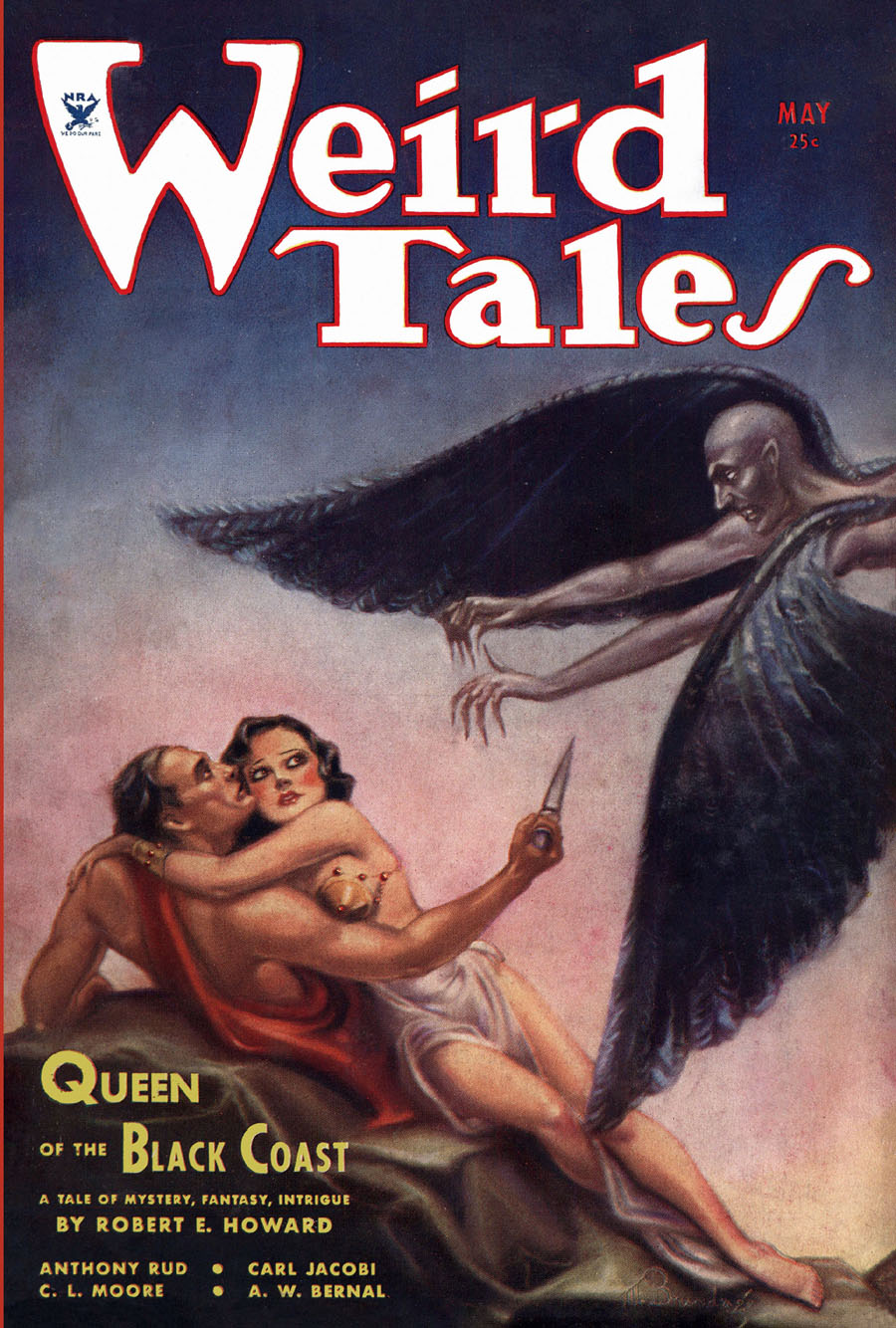
It’s a young Conan that boards an Argosean ship as he flees arrest after having brained a judge who did not understand his simple barbaric way. The Cimmerian is young but well-traveled – and Howard gives us a tour of the Hyborian nations by describing his clothes, weapons and armor.
When the ship whose crew he has joined is attacked by the pirates led by Belit, the sailors are killed without mercy, and Conan, the lone survivor, boards the attacking vessel, trying to take as many pirates with him in a last battle stand.
But he catches piratess Belit fancy (and he is smitten too), and gets invited to become her right hand man and ride in piratical bliss the Black Coast. And become lovers.
It’s all fun and piracy until the duo find some lost ruins in the jungle, guarded by a flying monster. Belit falls under the spell of a sinister necklace, the expedition goes to hell in a bucket, Belit is killed, everyone else is killed, and Conan survives only because Belit comes back in spirit to fight at his side one last time.

It’s apparently a nice serving of the usual stuff, but is not.
There is a passion and a darkness in Queen of the Black coast, that has so far never been seen in a Conan story.
It channels a lot of adolescent angst, and it has an underlying desperation that elevate the story above its basic adventurous plot to deliver a hard punch in the finale.
Maybe for this reason Belit, appearing in a single story, becomes such a memorable character.
Sure, Roy Thomas would later feature her in a number of apocryphal adventures in the comics, but that was much later.

This is where Conan starts to be something more, and something better, than plain old sword & sorcery adventure.
[Wordpress is giving me a hard time. I’m overworked and under the weather.
I’ve got 16 days and 11 short stories and one novel to read and post about.
It’s going to be fun]
This is another story I did a few months back for the Conan Re-Read, and you can find that post here.

The story was originally published in the April 1934 issue of Weird Tales, and once again shows Howard trying a different structure, this time focusing on the point of view of the female protagonist, Olivia.
The seventh Conan story, Rogues in the House, shares the pages of the January 1934 issue of Weir Tales with the usual suspects – Seabury Quinn, Clark Ashton Smith, Edmond Hamilton, Abraham Merritt, Howard Wandrey. H.P. Lovecraft appears in the mail section.
The Howard story does not make the cover, but has other points of interest.

The plot starts out almost hard-boiled – a nobleman is in danger of being exposed as a traitor by a high priest, and arranges for Conan to escape from jail on the condition the Cimmerian will kill the priest. Things get complicated and the three main characters end up trapped in the priest’s house, playing hide and seek with a simian creature.
The story is short and economically written, and shows Howard trying out new plot devices and structures, while at the same time exploring the Conan biography – we have met the king, the mercenary, the pirate, now we meet the thief.
Conan is his usual barbaric self, and the civilized characters are there to act as foil.
Howard continues to portray the aristocracy as corrupt and unreliable – both a critique of civilization and of the class system at large; but the criminals in the thieves’ quarter are no better, of course.

In the end Conan faces Thak, the simian servant of the High Priest, who has finally decided to free himself from his master. The scene was made famous in a Frank Frazetta cover, and was used in the second Conan movie, in a sequence partially inspired, of all things, by Enter the Dragon.
While the story threads much of the usual terrain, the different premise and the setting are a welcome change.
The October 1933 issue of Weird Tales has possibly one of the most iconic covers of all time, and features the usual selection of stories, spearheaded as usual by Seabury Quinn. Both H.P. Lovecraft and Frank Bellknap Long have stories in the magazine, and Conan is back with the story The Pool of the Black One.

The story is not particularly memorable – coming after The Tower of the Elephant is hard – but it does have one of the most memorable openings in the whole series, as a soaking Conan climbs up on a vessel in the middle of the ocean.
This, we find out, is Conan in his pirate days – and he’s had a falling out with his former friends, the Barrachan Pirates. He is accepted on board and has an eye for Sancha, the captain’s woman (who shows a similar interest).

From here, the story proceeds to a visit to an uncharted island, peopled by sinister humanoids who capture and plan to sacrifice the crew. The titular pool is the place where the strange creature dwell, and in which they cast their prisoners to kill and shrink them
As predictable, Conan saves the day and goes back to the ship, having won the girl and found a crew with which he’ll launch a further career in piracy.
Apart from the opening, the only other noteworthy bit in the story is probably Sancha, a Zingaran noblewoman who, kidnapped by the pirates, found that she enjoyed the lifestyle of captain’s mistress.
She’s selfish and amoral, and injects a little excitement in a story that goes from one set-piece to the next with the usual energy but with a certain lack of momentum.
A fun romp, but hardly one of Howard’s best.
This is where I come in.
The comic book adaptation of The Slithering Shadow marks the first time I became aware of Conan.
The story was originally published in September 1933 issue of Weird Tales – and again made the cover. The Howard piece was the opener of an issue jam-packed with great stories: Edmond Hamilton and Seabury Quinn, Hugh B. Cave, Jack Williamson and Frank Bellknap Long.
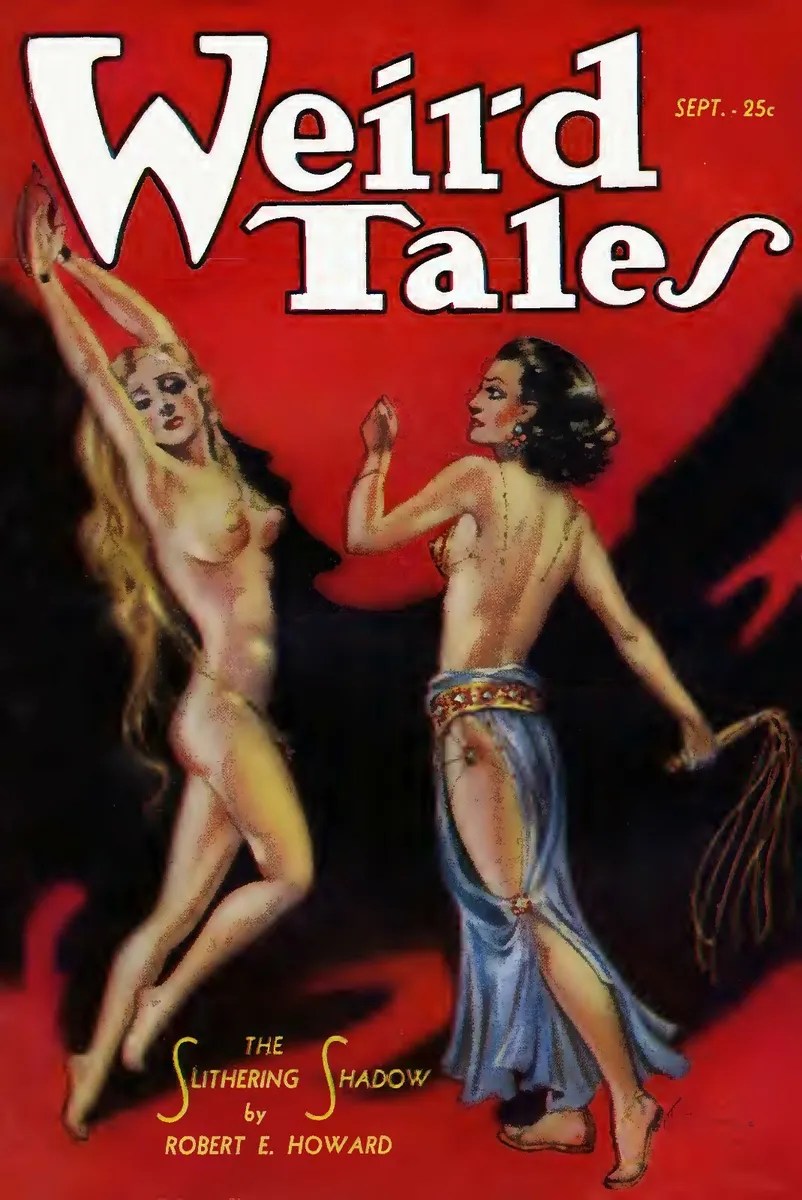
The story opens with Conan in his mercenary days, last survivor – together with a blond slave-girl, Natala – of an army that was destroyed in battle by the Stygians. Lost in the desert, they find refuge in a strange citadel, where the few inhabitants spend their time in drug-fueled dreams, and serve as snacks for Thog, a Shoggoth-like creature.
The situation is further complicated by Thalis, a evil woman that develops an interest for Conan (or maybe for Natala – it’s complicated).

I found the comic-book adaptation of this story, by Roy Thomas, John Buscema and Alfredo Alcala sometimes in the early 80s. Subsequently, I decided to check out the stories by Howard, and here we are.
The Slithering Shadow (sometimes known as Xuthal of the Dusk) has all the elements that to me, today, mark the perfect sword & sorcery story: a mysterious place, a lost civilization, clear, small scale stakes, a sexy evil woman, a creative monster. Howard provides also a lengthy flagellation scene – that apparently Margaret Brundage found inspiring.
This is not Howard’s best story, but it’s pretty solid, it is compact and economical, with great action scenes and a creeping sense of menace.
Maybe Natala is somewhat insipid as a character, but Thalis more than compensates what the blonde is lacking. And the setting reprises the sense of wonder and the deep past on the previous Tower of the Elephant. To me this is way better that the usual “undead sorcerer, conspirators and battlefield” formula that Howard has been milking so far,,
True, Fritz Leiber called it childish – but it’s never too late for having a happy childhood.
 Karavansara