

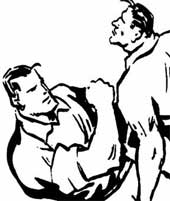
 As mentioned in a previous post, the Fascist Regime was bad juju for the pulps in Italy, but the genre did reflect on comics.
Graphic narratives were popular, and probably easier to manipulate.
A few American comics were “adapted” and later pirated by Italian artists – “Tim Tyler’s Luck” became “Cino & Franco”, Mandrake had its dialogues extensively rewritten, and a series of apocryphal Flash Gordon stories were published when the originals could no longer be imported.
The Regime feared the readers could still be seduced by the American way of life, even through adapted and manipulated comics.
With the American comics gone, the field was open for original heroes. And if “Lucio l’avanguardista” was probably the most all-out fascist-friendly comic book hero, the most popular was certainly Dick Fulmine.
NOTE: I’m indebted to my friend Alessandro Girola, who first wrote about Dick Fulmine on his blog, Plutonia Experiment.
Much of the research behind what follows started on Alex’s page.
It’s weird, if you think about it, that an Italian comic, developed according strict Regime guidelines, should have an American hero, a Chicago cop called Dick.
Granted, Dick Fulmine (literally “Dick Lightning”) was an Italian-American cop.
But it still feels strange.
Carlo Cossio, the designer, claimed to have taken inspiration from Gary Cooper, but Dick had quite a bit of Primo Carnera in him.
Also, much was made at the time of the character’s “fascist profile”.

The character debuted in March 1938, the stories being penned by Vincenzo Baggioli, who had a long experience as a sports writer.
Maybe for this reason, many stories of Dick Fulmine take place in the world of car and bike racing, and of course of boxing.
 The stories were approved and supported by the Italian Ministry of Popular Culture (aka MINCULPOP), that at the same time was waging a silent war against American comics.
Dick Fulmine was in the right place at the right time – his stories, full of racial stereotipes and Fascist rhetoric came at the right time to fill a vacuum.
If we must believe what we learn from the Dick Fulmine stories, Chicago was a hellhole filled with strange foreign characters, in which law-abiding and proud Italians were under constant menace from devious Orientals, sneaky Jews, brutish Africans and many other frankly embarrassing bad guys.
 Dick’s nemesis was evil mastermind Zambo, an African-American gangster.
And when Chicago was not enough, Dick was willing to travel to exotic parts, to give the natives a serving of his own brand of brutal, simplistic retribution.
Some science fictional elements were sneaked in the stories, and Dick duly battled killer robots, fire ants and albino vultures living inside a volcano.
And in a few episodes, Dick dons a black mask, turning into “Fulmine Mascherato” (The Masked Lightning – which sounds pretty cool, admittedly.)
And it’s a pity that the stories were so unashamedly put in the service of ideology, because the art by Carlo Cossio is fresh and original even eighty years on.
But it’ hard reading these pages without a certain sense of unease – and this is probably why Dick was pulled off the stands with the fall of the Regime, never to resurface.
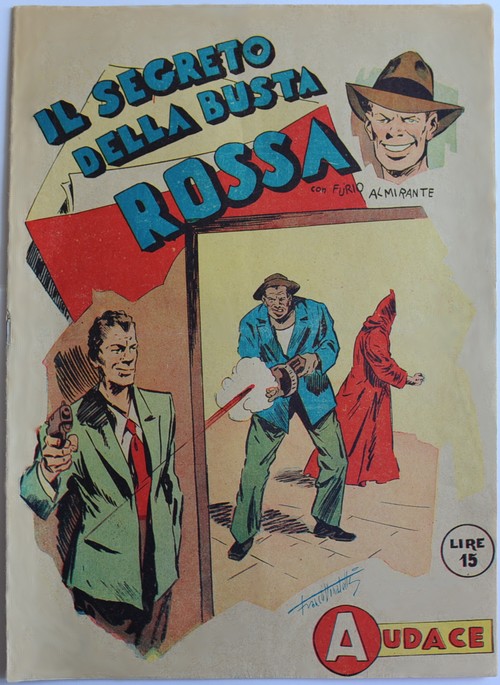 His clone Furio Almirante fared better – again designed by Cossio, but written by Italian comics legend Gian Luigi Bonelli, Furio started his carreer in 1941 as an Italian boxer living in the USA, a two-fisted do-gooder with a fascist twist.
He did his propaganda stint during the War Years, carried on to 1948 with his ideological bend opportunely down-toned, and afterwards put on a mask and became Furio Mascherato (Masked Furio – which is rather uncool).
He resurfaced in various versions, by different artists but by the same author, in the second half of the sixties.
Not bad, for a clone.
Furio’s strange transformations bring us back to what made comics survive the rigors of fascist censorship – comic book characters are strangely plastic, and can be adapted, modified, provided with an ideological agenda or not, depending on convenience and commercial considerations.

 Karavansara