Karavansara

East of Constantinople, West of Shanghai


1 Comment

A most disreputable book

51iu0ea3n7l-_sl500_sy344_bo1204203200_One of the fun bits – well, if you are the kind that finds such stuff fun – of doing research, is that you get a lot of weird stares for some of the books you are reading, or re-reading.
And because in these days either I am at home typing or I am sitting in a waiting room somewhere, I usually read my books in public.

And in the weird stares/odd looks department, my current perusal of a very very old and badly mangled used copy of Ralph Shaw‘s Sin City is certainly setting a record.
Yes, it’s because of the cover.
And the title, that even in an English-illiterate area such as the Astigianistan hills can be pretty obvious. Continue reading


Leave a comment

Cheap (and great!) travel books

Despite (or maybe, who knows, because) of my current reduced circumstances, I’m getting real good at catching excellent books for real cheap – because I can go without food (for a while, at least) but I need good books to read.
So, why not share my discoveries?

Consider the following: the fine folks of Humble Bundle have teamed up with Lonely Planet to offer up to 17 travel books and guides for a tiny tiny offer.
For one buck, you get five great titles – and then you can upgrade.

Selezione_005

Here is wonderful opportunity to both bring home a lot of excellent books, and to help the National Parks Service on its 100th Anniversary. The Parks guys will get a percentage of what you spend.
Cool, right?

Follow this link, and check out this offer.
There are still a few days before it closes.


Leave a comment

The Haunting of Pemberley House

pemberley-coversmallThere was only one man who could write a pulp homage to gothic romance, dragging in references from Jane Austen to Edgar Rice Burroughs, from Sir Arthur Conan Doyle to Lester Dent, and beyond, while making it deliciously naughty.
And that man was, of course, the late lamented Philip José Farmer.
The Evil in Pemberley House by Farmer and Win Scott Eckert – who completed the novel based on Farmer’s outline and notes – is exactly that: a P.J. Farmer tour de force featuring subtle (and not-so-subtle) references and tongue-in-cheek plot twists, feeding both the old master and his readers’ obsession for the pulps and the icons of popular literature.

The plot in brief: Pat Wildman, daughter of world famous adventurer/crimefighter Doc Wildman, moves to England after the loss of her parents. She has inherited old Pemberley House, with its ghosts and its curses, and carries a number of unresolved issues herself.
But what is happening really in Pemberley House, and what connections have the events that Pat is witnessing with the history of her family? Continue reading


4 Comments

Other People’s Pulps: The man who invented the Batarang

51Wtnb+Q4kLLast week I received a gift certificate for Amazon, and – after buying a gift for my brother’s birthday – I went on a rampage through my wish list.
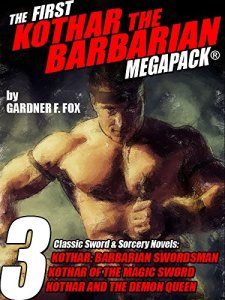
Among the dozen or so ebooks that I bought – and some of which you’ll see reviewed here in the future – I invested about two bucks in the two Wildside Press Megapacks dedicated to Kothar the Barbarian.

A Conan clone that hit the stalls in 1969 to ride the wave of the Cimmerian’s success, Kothar appeared in five novels: Kothar: Barbarian Swordsman, Kothar of the Magic Sword, Kothar and the Demon Queen, Kothar and the Conjurer’s Curse and  Kothar and the Wizard Slayer.
All of these were the work of Gardner R. Fox – an author I did not know, and that is certainly a fascinating discovery for me. Continue reading


Leave a comment

Curse of the Pharaoh

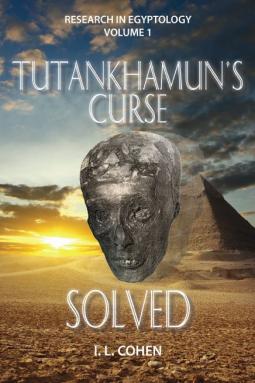
cover89385-mediumI must admit I was rather skeptical when I started reading I.L. Cohen’s Tuthankamun’s Curse Solved, the first volume in a series called Research in Egyptology.
The legend of the ancient pharaoh’s curse has been done to death ever since the 1970s, and as a kid of the ’70s I was exposed to a number of pseudo-scientific books that were great fun and excellent fodder for my Cal of Cthulhu games, but were sometimes a little jiggly when it came to science.

I.L. Cohen’s research, if nothing else, is presented in a well-documented, believable way, and if some of the researcher’s conclusions are still pretty wild1, some of the arguments that this book raises are worth be explored further.

Based on modern analysis of both the reports of the mysterious deaths of many of the Carter/Carnarvon expedition, and a lot of other sources about the deaths of many aegyptologists, and some of their finds, Cohen comes to the conclusion that radiation could be the cause.
The Egyptian archaeological record could be filled, according to the author, with evidence for massive, widespread radioactive pollution and consequent deaths.
He also proposes – and here is where I get a bit skeptical again – the existence of an elite in Egyptian society that knew about radiations and their effects, and that basically handled nuclear emergencies in ancient times.
From here on, things get wilder, but in a scientific, well-documented, somewhat believable way.

The book is very good, well written and filled with informations, quotes and extracts from classical studies, and it is both entertaining and thought-provoking2.


  1. in my opinion, of course, and I am just an armchair archaeologist. 
  2. the sort of I-must-write-a-story-about-this tought-provoking, which is just fine. 


Leave a comment

A yacht cruise in 1964

I like to read a good travel book once in a while, and in the summer is a good way to travel without moving.
My interest in travel literature started more or less when I was doing my the first year of university, and it goes well with my passion for fantasy and adventure stories: all these different narratives hinge on travel and exploration, one way or another, they all talk about other places, other times, other people.
Travel books – just like memoirs and biographies – are also a great way to do research, of course.
And what’s better than a travel memoir, then? Continue reading


6 Comments

Reading Skelos #1

And then of course all of your best laid plans go hawry.
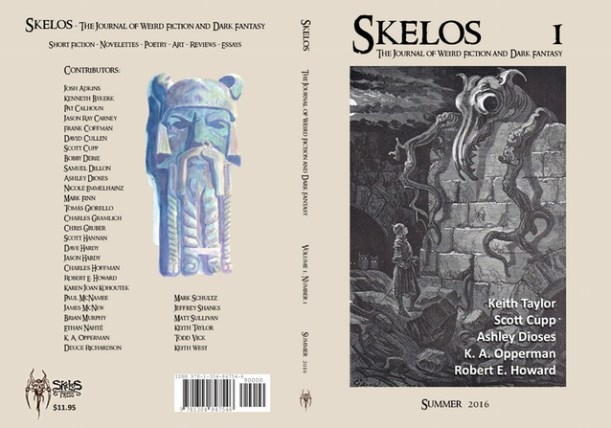
A few months back I backed the Kickstarter for the launch of a new magazine, called Skelos.
And you either catch the title reference, or you are on the wrong blog, and there’s no use for me to try and explain.
The complete title is Skelos – The Journal of Weird Fiction and Dark Fantasy, and my backer digital copy of #1 arrived last night – and all my plans went hiwire.

Skelos-Issue-1-Covers

Of course I had to start reading it straight away, despite the fact that it was night and it’s a PDF – the epub and mobi version will be delivered later on – and it’s not the most convenient format for digital reading. Continue reading