

I’ve been spending the last two hours trying to find my way around the various reprints and repackagings of Michael Moorcock’s Elric series. I read the books out of order, part in English and part in Italian translation, back when I was in high school.
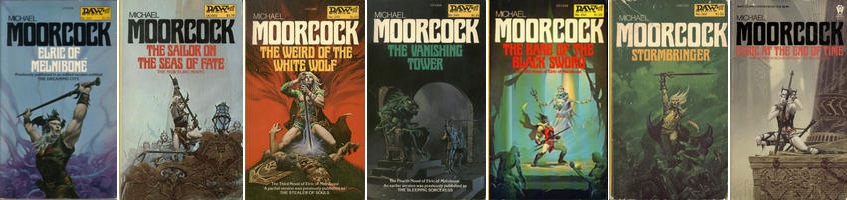
Now, much as I enjoyed the stories back in the ’80s, and for all of their role in shaping the sword & sorcery genre, Elric is not my favorite Moorcock character or series (I prefer Gloriana, or The Dancers at the End of Times).
But I wanted to read through some of the stories because… ok, you know why.
Because I’m writing a series about a time-displaced heroine that’s deployed through history, by unseen masters, as a mystical troubleshooter.
And that’s the Eternal Champion, of course*.
So I wanted to take a look at the original.
Anyway, while I was picking lost books out of dusty boxes, I read the letter to the reader which opens 1993 Gollancz/Millenium collection, Elric of Melnibone.
And apart from Moorcock’s list of influences – Pratt’s The Well of the Unicorn, yes, Fritz Leiber and Poul Anderson, but also Lord Jim – there’s a passage that I thought I’ll post here…
There is a level at which the hero becomes fairly ridiculous, often because he never fundamentally questions his society. John Wayne was always basically in favour of old-fashioned paternalism, no matter how much a rugged individualist he claimed to be.
And indeed – if heroes speak for a collective, for a civilization, what is that civilization like?
And what of alienated heroes, detached from a single here and now, missing a reference group, a society to back them up, a civilization to identify with?
Moorcock again…
The ‘alienated’ hero or heroine is often able to stand back a little and work out what’s really going on.
[…]
I have nothing wrong with heroes that reflect the best that we would wish to be and do. I still have unashamed affection for my heroes who remain skeptical of authority and its pronouncements.
And this really helps me set straight a few things in what I’m writing.
Advice from the best – accept no substitute.
——————————————————-
* Yes, it’s also JOhn Brunner’s The Traveller in Black, and Sapphier & Steel, among others, but let’s not get into that at the moment.
Related articles


 Karavansara
24 July 2014 at 19:58
The saga of Gloriana is a good story, but I prefer the more grim view of the Albino…
LikeLike