

I’m happy to post here the original interview with author and poet Fatima Bhutto, which was conducted by my friend Giulia, webmistress of the Italian literary blog Liberi di Scrivere.
Enjoy!
Liberi di Scrivere – An interview with Fatima Bhutto
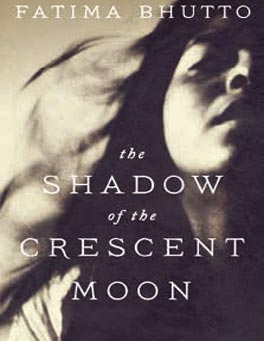 1. Welcome Fatima, and thank you for granting Liberi di Scrivere this interview. I will not ask you any question about your family (our readers are invited to check out your biographical essay, Songs of Blood and Sword). I’d rather ask you about your work as a fiction writer: The Shadow of the Crescent Moon (2013), is your first novel, a fictional work that reflects anyway everyday life in Pakistan, especially from the point of view of the younger generations. Does fiction help to better focus on reality?
I think fiction is very liberating. It allows us to discuss subjects that would otherwise be too frightening or too difficult to look at head on. It gives you a space free of judgment and that’s really important, especially when you are dealing with heavy political topics or sensitive issues.
2. Five characters, two women and three men, are at the core of the story: Mina and Samarra, Aman Erum, Sikandar and Hayat. My favorite male character is certainly Sikandar, who is very different from the idea a lot of western writers have about Muslim men: he’s sensitive, an idealist, tenderly loves his wife accepting her angry outbursts, her somewhat unfair recriminations (the pain for the loss of a son is common to them both). How did you build a character so starkly different from current stereotypes?
I really felt a lot of sympathy for Sikandar too and I felt it because he shows us that fear is universal. There is no escaping it, no matter how hard one tries. Until you deal with the cause of your fear it haunts you. Men are not braver than women, I don’t believe that at all, but they have more stigma when it comes to fear. They must hide their fear from others, even themselves.

Fatima Bhutto (Photo credit: Wikipedia)
3. East and West, two worlds far apart and yet not irreconcilable. Feelings, weaknesses, goals, are in the end the same. What unites us, what keeps us apart?
Love unites us, compassion too. We live in an incredibly connected world and if there is a truth about the universe I believe it is that – that we are all connected. A lot more unites us than divides us. Fear keeps us apart, it stops us from seeing that we are all one.
4. The plot unfolds through three hours, from 9 to 12 am on a December Friday, a rainy day, the first of Eid. A number of flashbacks dilate the time dimension, and then contract it in the most dramatic and emotional moments, almost trapping it like a fly in amber. East and West also differ in their concept of time. Was this something you wanted to underscore in your novel?
Absolutely! You’re the first journalist to notice this – it’s very true that the East and the West have totally different perspectives on time. In the West there is a sense of importance given to time – at eight you wake up, at ten you are in the office, at one you have lunch at six you go home and not just that but in life too. At eighteen you leave the house, at twenty five you own a flat, at thirty you marry and so on. But in the East inaction is as vital a movement as action. The East sees time more as a journey, completely separated from order. There is chaos in the journey – it is a big part of the journey actually.

(cover of the Italian edition)
5. Justice, together with freedom and compassion, is one of the main themes of your novel: in the forest, Mira accuses the Talibans of being unjust, and no harder accusation could be expressed. How did you render in words this almost vital necessity man has for justice, no matter where they are?
Mina personified it, this need for justice, not only through her standing up to the Taliban but also through her grief and her constant search for a community that would understand her and would share in her loss. For me justice is the heart of politics and society. It is a primal need and the wonderful thing about fiction was to show how subjective it is. Justice for Mina may mean injustice for someone else – the outcomes might be different, but the quest is the same.
6. The Shadow of the Crescent Moon is a hard novel to classify: it’s a family story, it’s political, generational, a cross-section of society portraying the contradictions and the current situation of contemporary Pakistan, while at the same time showing tenderness, and poetry. Being also a published poet helped you, as you were writing?
That’s an interesting question but one I can’t really answer as I suppose it was the mood of the story! I mean, I wasn’t conscious of it but felt a great tenderness for the characters and for their world and perhaps that came through…
7. The Shadow of the Crescent Moon is a bold novel, likely to cause frictions in your country due to its observations, especially on matters politic. How do you plan to counter criticism?
When you deal with any sensitive political topics – and it seems when a small group is defending itself against masses, everything becomes sensitive – there will always be attacks and friction. But I believe that to stay silent on these matters is what is dangerous, not speaking out. I’m prepared to take what comes with that.
8. You did not choose a linear development, you hide and reveal rapidly certain elements – I’m thinking for instance about the true reason why Mira infiltrates the funerals of perfect strangers – and this way you create a sense of tension and mystery. Is this some way connected to the concept of time we already mentioned?
Partly, yes but also because in life we deal with this tension between knowing and not knowing all the time. We have wide spaces for secrecy that we are always trying to counterbalance with our need for transparency. So just like in life you will never know the heart of the matter that disturbs someone the first day you meet them, in the novel you have to travel a little with the characters before they let you inside.
9. Aman Erum is the most fragile and in a certain way debatable, even if you never use but the most fair terms when describing him. He wants to flee abroad in search of economic stability and security, to the point he becomes an informer for Colonel Taric, the man with the red gold band; he considers himself a patriot, but unwittingly causes the arrest of Samarra and all that follows. His father does not approve of his choices, in the most moving passage in the book, but hides this with the tone of his voice. Will he find redemption?
I hope so, yes. I think all the characters in the novel are dealing with the situations they are placed in by their country. They are all struggling in their own ways to find some justice, to find some redemption. But the novel is very much about betrayal and how much we have to betray in order to survive in today’s modern world…
10. Thank for your kindness. I would like to close this interview asking you what your future projects are? Is there a new novel in the works?
Thank you for your thoughtful and sensitive questions, it was a pleasure to answer them. I hope very much to work on more fiction in the future and soon as I finish with the book tour then I will get back to work on writing rather than speaking!
Related articles


 Karavansara
Pingback: :: Un’ intervista con Fatima Bhutto | Liberi di scrivere