Karavansara

East of Constantinople, West of Shanghai


2 Comments

At last, The Far Pavilions

The_Far_PavilionsMy goodness, it’s been 18 months!
In January 2015, I announced my intention of reading M.M. Kaye’s The Far Pavilions1 as part of my reading list of adventure/historical novels set in India.
I got me a cheap, second-hand, printed-so-small-you’ll-burn-your-eyes hardback copy of the Italian translation2, and then all hell broke loose, my priorities changed, the book got buried at the bottom of my reading pile, and I picked it up again five days ago.
I’m going through it like a speeding train – basically because it’s a novel that reads like a breeze. It will be over by Wednesday.

Now, some personal background – I’m pretty sure my mother read The Far Pavilions when it came out in Italian in 1980. My aunt lent my mom her copy – I have this faint memory of the two of them talking about it. And both my mom and my aunt were into it because of the romantic element – about which, more later.

So, what’s the deal with The Far Pavilions? Continue reading


Leave a comment

The Tiger House Party

hahnA different kind of medium, today – plain old written word, the oldest and most widespread form of information transfer.
As I am putting the finishing touches to “The Snowball Caper”, the first novelette in my new Hope & Glory series, I’ve had the sheer luck of chancing upon the delightful The Tiger House Party: the Last Days of the Maharajas, by the delectable Emily Hahn.
Once again, a demonstration that there’s nothing more entertaining than doing research. Continue reading


10 Comments

Three on the Silk Road

51DHEESMHZL._SY344_BO1,204,203,200_OK, so I decided to complicate my life some more.
And this time I’m complicating my life for you, dear Karavansara readers.
I hope you are moved by  this.

As I mentioned, one of the “minor” (but not minor at all) gifts I got for Christmas is Stuart StevensNight Train to Turkestan.
That is an attempt at retracing the road followed by Peter Fleming and Ella Maillart in their famous China-to-India (by way of Afghanistan) journey, in 1935.

Now, the interesting bit is – both Fleming and Maillart wrote about their experiences on the road.

Continue reading


2 Comments

Where the unreal’s real

Rudyard Kipling 1865-1936[11]My friend Clare, over at the Scribblings blog, just published a post about Kipling’s poetry and the voice of objects.
And she says…

Whenever I read one of these poems, I can’t help thinking of those Japanese legends where an object takes on some sort of life by long association with and use by human beings… A concept I’ve always found highly poetic.

I was trying to put together some form of intelligent comment, and then I thought, what the heck, I’ll write a post for Karavansara.
And here we are – fast and loose.
Continue reading


5 Comments

Discovering Mughal India

611bobcm9hL._SY344_BO1,204,203,200_So much to do and so little time to do it.
I remember an old article by Isaac Asimov, old Ike saying that if you want to be a writer you have to love writing above everything else – given the choice between reading and writing, for instance, writing should take first place, without any hesitation.

Well, but what when you are doing research?
Is time spent reading time that should be better spent writing?
I don’t think so.
And therefore I’m taking the afternoon off to go on with The Mughals of India, by Harbans Mukhia. Continue reading


Leave a comment

Unknown binding – now known

mK8iWxOLZpc2o3gdQJsx6lwAs I mentioned in a comment to a previous post, my copy of The Far Pavillions arrived this morning, and this solved the mystery of the unknown binding.
The book is a sturdy hardback, originally published in 1981 by an Italian mail order book club. Not very exciting, for an unknown whatever, but it’s ok.
Including the postage expenses it cost me less than half the English paperback (that was, in turn, two bucks cheaper than the ebook), and if the cover is pretty blah, well, it’s the story that counts, right? Continue reading


1 Comment

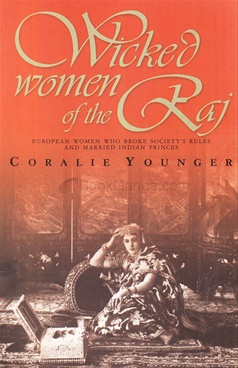
Wicked Women of the Raj

bf59a97080c1496fa4dd239205f58419I’ve just finished Coralie Younger’s Wicked Women of the Raj, and it was a fun, informative and inspiring read.

Younger’s essay is basically a catalog of the western women that, in the 19th and early 20th century, married Indian princes, the fabled Rahjas of India.
Each “wicked woman” gets her own chapter, maybe one photograph, and a collection of facts detailing her biography, and her “scandalous” choice. Continue reading